
7 Leading Futures Trading Platforms for Australia in 2026
The Ultimate Guide to Low-Margin, Top-Tier Brokers Empowering Aussie Day Traders This Year
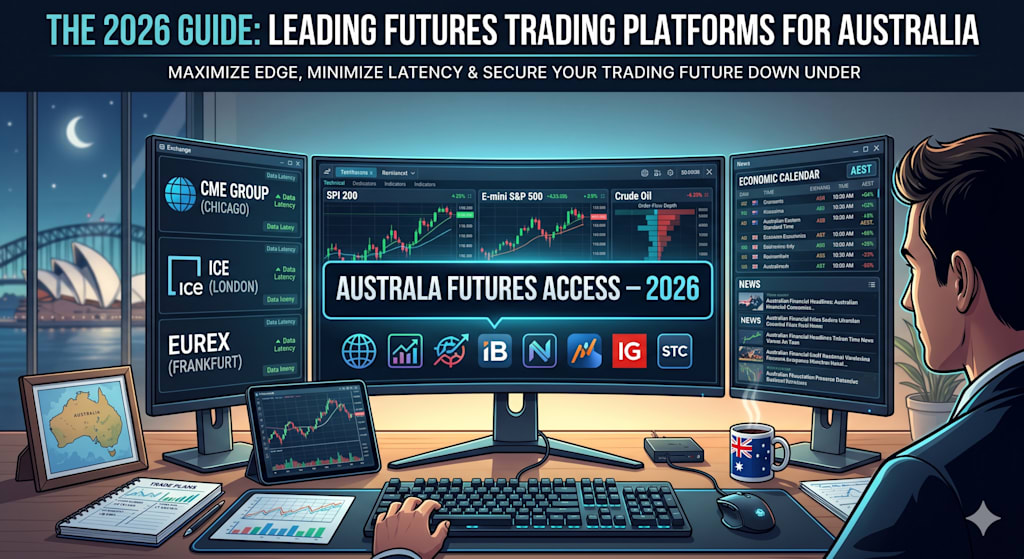
Australia’s futures traders are in a good spot in 2026: local derivatives activity remains anchored by ASX 24, while global access to CME, ICE, Eurex, and other major venues is easier than ever through modern platforms. What matters now is not just whether a broker “offers futures,” but whether it gives you the execution speed, market access, data quality, and order-entry tools needed to trade them properly. Reuters reported that ASX 24 is the exchange’s derivatives venue for equity, commodity, and interest-rate contracts, while Optimus Futures highlights access to 100+ global futures markets across CME, CBOT, NYMEX, ICE, and Eurex.
Here are seven leading platforms worth knowing about.
1. NinjaTrader
NinjaTrader is one of the most futures-focused platforms on the market, and it shows. Its site emphasizes integrated multi-device trading, access to major futures markets, low intraday margins, low commissions, simulation, and a large add-on ecosystem. It also supports desktop, web, and mobile workflows, which matters if you are moving between charting, order entry, and risk management throughout the session.
For Australian traders who want a futures-first setup, NinjaTrader is especially appealing because it balances professional tools with a learning environment that is easy to test in simulation before going live. That is also why traders who come from funded-evaluation environments like Apex Trader Funding often feel comfortable with it: the workflow is built around repetition, discipline, and execution quality.
2. Interactive Brokers
Interactive Brokers remains a heavyweight choice for traders who want one account that can handle futures alongside other markets. Its widely documented strengths are global reach and direct market access across asset classes, including futures, with a worldwide client footprint. That makes it a strong fit for Australians who want to trade beyond a single domestic market and keep everything under one umbrella.
IBKR is not the simplest platform on this list, but it is one of the most flexible. For active futures traders, that flexibility can matter more than a polished interface, especially when the goal is to trade multiple contracts, multiple exchanges, and multiple asset classes without constantly switching brokers.
3. TradeStation
TradeStation is another strong futures contender, especially if you care about execution quality and a more traditional desktop-style trading stack. Its own site shows a dedicated futures product line, a FuturesPlus platform, futures margin rates, and access to major venues including CME, ICE Futures U.S., Eurex, and ICE Futures Europe through clearing arrangements.
That breadth makes TradeStation useful for traders who want both an execution platform and a broader trading ecosystem. If your approach depends on chart studies, strategy testing, and structured order management, TradeStation’s futures tools can be a serious advantage.
4. Optimus Futures
Optimus Futures is built for the serious futures trader. The firm says it offers $50 day-trading margins on micros, commissions starting at $0.25 per side on micros, and access to more than 20 platforms, including Optimus Flow, Optimus Web, Optimus Mobile, TradingView, Sierra Chart, Rithmic, Bookmap, and ATAS. It also says clients can access 100+ global futures markets.
That combination is hard to ignore if you are focused on costs, data choice, and execution infrastructure. Optimus is especially attractive to traders who want a more modular setup, where the broker and the front-end platform can be chosen to match the strategy rather than forced into one closed system.
5. SaxoTraderPRO
Saxo is a strong choice for traders who want a more premium, multi-asset environment rather than a purely futures-only shop. Saxo Bank’s profile shows that it provides access to futures and futures spreads through its proprietary platforms, SaxoInvestor and SaxoTrader, and it has offices in major financial centres including Singapore. In 2025–2026, Saxo also underwent major ownership changes, including the completion of a majority stake sale, while Saxo Australia remained part of the group’s wider footprint.
For Australian traders, Saxo’s appeal is the polished interface, the broad product menu, and the fact that it sits comfortably in the “professional but not overcomplicated” category. It is a good option if you want futures inside a broader trading account rather than a highly specialized futures-only setup.
6. TradingView
TradingView is not a futures broker in the traditional sense, but it is one of the most useful futures trading platforms because of its charting, scanning, and brokerage integration. Its site highlights CME Group futures, Eurex futures, brokerage integration, and a trading section that includes top brokers and brokerage connectivity. For many traders, TradingView is the front end where the entire session starts.
That matters because futures trading is often won or lost before the order is even placed. If your edge comes from clean chart structure, session levels, or fast review of multiple contracts, TradingView can be the most efficient place to do that work.
7. Plus500
Plus500 deserves a spot because it combines futures trading with a simpler, more retail-friendly experience. Its company profile states that it offers futures trading and options on futures, and it also has an Australian presence through regulated operations in the country. For traders who want a less intimidating entry point, that makes it worth a look.
Plus500 is usually the kind of platform traders move to when they want straightforward execution rather than deep customization. It may not be the first choice for high-end order-flow scalpers, but it can be appealing for traders who value clarity, speed of onboarding, and a cleaner user experience.
Final thoughts
The right futures platform for Australia in 2026 depends on how you trade. NinjaTrader and Optimus Futures stand out for futures-specific execution. TradeStation and Interactive Brokers are stronger all-rounders. TradingView is the charting layer many traders lean on every day. Saxo works well for those who want futures inside a broader premium account, while Plus500 offers a simpler retail entry point.
The best choice is the one that matches your style, contract size, and execution needs, not just the one with the loudest marketing.
About the Creator
Enjoyed the story? Support the Creator.
Subscribe for free to receive all their stories in your feed.
Comments
There are no comments for this story
Be the first to respond and start the conversation.