
3D Printing in Healthcare Market Set to Reach US$ 9.69 Billion by 2033 as Personalized Medicine Revolution Accelerates
From Custom Implants to Bioprinted Tissues, Additive Manufacturing Is Reshaping the Future of Healthcare

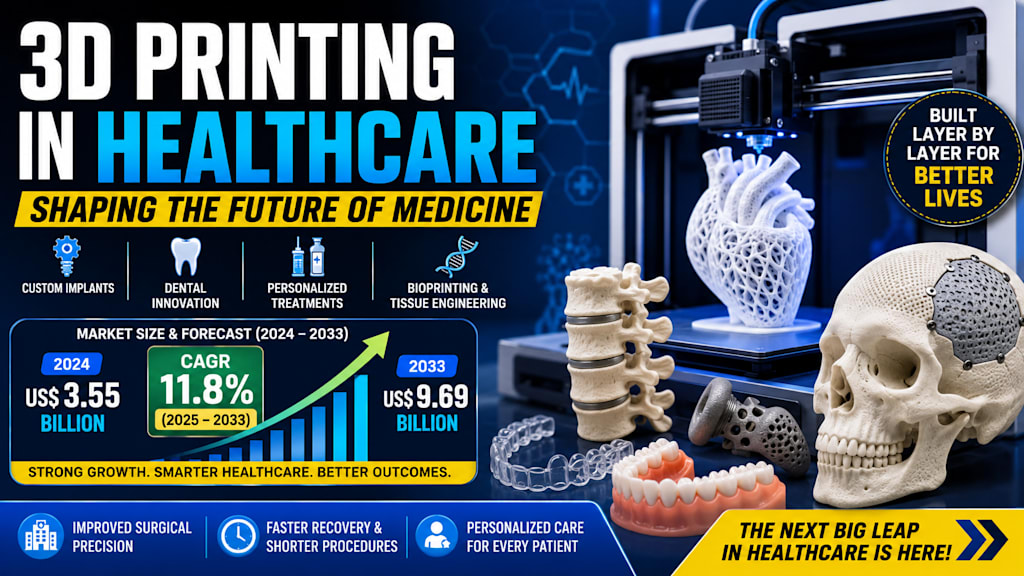
The healthcare industry is undergoing a remarkable transformation, and one of the most influential technologies driving this change is 3D printing. Once considered a niche manufacturing technique, 3D printing—also known as additive manufacturing—has evolved into a powerful tool capable of producing customized medical devices, patient-specific implants, prosthetics, anatomical models, and even living tissues.
As healthcare providers continue to pursue precision medicine and personalized treatment strategies, 3D printing is emerging as a critical enabler of innovation. The technology offers unparalleled flexibility, reduced production timelines, lower material waste, and improved patient outcomes. These advantages are fueling widespread adoption across hospitals, research institutions, pharmaceutical companies, and medical device manufacturers worldwide.
According to Renub Research, the global 3D Printing in Healthcare Market is projected to grow from US$ 3.55 Billion in 2024 to US$ 9.69 Billion by 2033, expanding at a CAGR of 11.8% during the forecast period from 2025 to 2033. The market's impressive trajectory reflects the growing importance of customized healthcare solutions and advancements in additive manufacturing technologies.
Why 3D Printing Is Becoming Essential in Modern Healthcare
Healthcare systems around the world are increasingly focused on delivering patient-centered care. Traditional manufacturing methods often struggle to produce highly customized medical products quickly and cost-effectively. This is where 3D printing provides a significant advantage.
Using digital imaging data from CT scans, MRIs, and other diagnostic tools, healthcare professionals can create exact replicas of a patient's anatomy. These models help surgeons plan complex procedures with greater precision and confidence. In many cases, customized implants and surgical guides can also be produced specifically for individual patients.
The result is improved surgical accuracy, reduced operation times, shorter hospital stays, and enhanced patient satisfaction. These benefits are contributing significantly to the growing adoption of 3D printing technologies across healthcare settings.
Personalized Medicine Is Driving Market Growth
One of the most exciting developments in healthcare today is the rise of personalized medicine. Rather than relying on standardized treatments, physicians are increasingly tailoring therapies to individual patients.
3D printing aligns perfectly with this approach by enabling the production of customized prosthetics, implants, dental devices, and medical instruments. Unlike conventional manufacturing processes that often require expensive tooling and large production volumes, additive manufacturing allows for efficient production of single, highly personalized products.
Patients benefit from better-fitting devices, improved comfort, and enhanced treatment outcomes. For healthcare providers, personalization can lead to greater clinical success and patient satisfaction.
As demand for individualized healthcare continues to grow, the role of 3D printing will become even more critical.
Rising Investments in Research and Development
Research and development activities are playing a central role in advancing the capabilities of healthcare 3D printing. Governments, private companies, academic institutions, and healthcare organizations are investing heavily in innovative applications of additive manufacturing.
These investments are driving breakthroughs in materials science, software development, bioprinting technologies, and medical device engineering. Researchers are exploring new ways to print biological structures, improve implant performance, and accelerate product development cycles.
Innovation supported by robust R&D funding is helping manufacturers develop safer, more effective, and more affordable healthcare solutions. This trend is expected to remain a key growth driver throughout the forecast period.
The Growing Role of 3D Printing in Pharmaceuticals
The pharmaceutical sector is increasingly recognizing the value of additive manufacturing. Traditional drug production methods often lack the flexibility needed for personalized treatments. 3D printing is changing that dynamic.
Healthcare providers can now explore customized drug formulations tailored to specific patient requirements. This capability is particularly valuable for patients who require precise dosages, multiple medications, or specialized treatment regimens.
Additionally, 3D printing enables the development of advanced drug delivery systems that improve medication effectiveness and patient compliance. Pharmaceutical researchers can rapidly prototype and test new formulations, reducing development timelines and costs.
As regulatory frameworks evolve to accommodate these innovations, pharmaceutical applications are expected to become an increasingly important segment of the market.
Bioprinting Opens New Frontiers in Regenerative Medicine
Perhaps the most groundbreaking application of healthcare 3D printing is bioprinting. This emerging field involves the creation of biological tissues using living cells and biocompatible materials.
Scientists are making significant progress in producing tissue structures that may eventually be used for transplantation, drug testing, and regenerative therapies. While fully functional printed organs remain under development, advances in bioprinting are already creating new opportunities in medical research and treatment.
Regenerative medicine, stem cell therapies, and cancer treatment research are benefiting from these innovations. Researchers can create realistic tissue models that help improve drug testing and disease understanding while reducing reliance on animal testing.
The long-term potential of bioprinting represents one of the most exciting opportunities in modern healthcare.
Applications Transforming Healthcare Delivery
The versatility of 3D printing has enabled its adoption across numerous healthcare applications.
Dental Applications
The dental industry has emerged as one of the largest adopters of additive manufacturing technologies. Dentists and laboratories use 3D printing to create crowns, bridges, aligners, dentures, and surgical guides with exceptional precision.
Digital workflows reduce turnaround times while improving accuracy and patient comfort.
Prosthetics and Orthotics
Custom-designed prosthetic limbs and orthopedic devices can be produced quickly and affordably using 3D printing. Patients benefit from personalized solutions that provide improved mobility and comfort.
Medical Implants
Orthopedic implants, spinal devices, and cranial implants are increasingly being manufactured using additive manufacturing techniques. These customized implants often fit patients more accurately than traditional alternatives.
Surgical Planning Models
Patient-specific anatomical models allow surgeons to visualize complex structures before entering the operating room. This improves planning accuracy and reduces procedural risks.
Tissue Engineering
Researchers are leveraging additive manufacturing to create scaffolds that support cell growth and tissue regeneration. These developments are accelerating progress in regenerative medicine.
Challenges Facing the Industry
Despite its tremendous potential, the healthcare 3D printing industry faces several challenges.
Integration with Existing Healthcare Systems
Introducing additive manufacturing into traditional healthcare environments requires significant organizational changes. Hospitals must invest in equipment, software, infrastructure, and employee training.
Successful implementation often demands close collaboration among clinicians, engineers, information technology teams, and regulatory specialists.
Resistance to change and uncertainty regarding return on investment can sometimes slow adoption.
Regulatory and Ethical Considerations
As healthcare applications become more sophisticated, regulatory oversight becomes increasingly important.
Bioprinting technologies raise complex ethical questions related to ownership, consent, intellectual property, and patient safety. Regulatory agencies around the world are working to establish frameworks that balance innovation with appropriate safeguards.
Clear and consistent regulations will be essential for supporting sustainable industry growth.
North America Continues to Lead the Market
North America remains the largest regional market for healthcare 3D printing. The region benefits from advanced healthcare infrastructure, strong research capabilities, and significant investments in medical technology.
The United States is at the forefront of innovation, with hospitals, universities, and technology companies collaborating to develop cutting-edge applications. Customized implants, surgical guides, and patient-specific anatomical models are becoming increasingly common across American healthcare facilities.
A favorable innovation ecosystem and strong demand for personalized healthcare continue to support market expansion throughout the region.
Europe Demonstrates Strong Adoption
Europe represents another significant market for healthcare 3D printing, with Germany serving as a leading innovation hub.
The country combines advanced manufacturing expertise with a highly developed healthcare system. Strong government support for medical technology innovation has encouraged widespread adoption of additive manufacturing solutions.
European healthcare providers increasingly utilize 3D printing for surgical planning, implant production, and medical research, contributing to continued market growth.
Asia-Pacific Emerging as a Major Growth Engine
The Asia-Pacific region is experiencing rapid expansion in healthcare 3D printing adoption.
China, in particular, has made substantial investments in additive manufacturing technologies. Government initiatives aimed at strengthening domestic medical technology capabilities are accelerating innovation and commercialization.
Hospitals across China are adopting 3D printing for personalized implants, surgical planning, and prosthetic production. As healthcare spending rises throughout Asia-Pacific, demand for advanced medical technologies is expected to increase significantly.
UAE Strengthens Its Position Through Innovation
The United Arab Emirates is establishing itself as a regional leader in healthcare 3D printing through strategic government initiatives.
The Dubai 3D Printing Strategy aims to position Dubai as a global center for additive manufacturing innovation. Healthcare remains one of the key focus areas of this initiative.
Collaborations between healthcare providers and technology companies are helping integrate 3D printing into clinical workflows, improving patient outcomes and supporting medical innovation.
10 Recent Developments Among Leading Healthcare 3D Printing Companies
1. 3D Systems Corporation
Expanded its healthcare solutions portfolio through continued investment in personalized surgical planning and patient-specific implant technologies.
2. Materialise NV
Enhanced its medical software ecosystem to improve surgical planning, anatomical modeling, and hospital-based 3D printing workflows.
3. Formlabs Inc.
Introduced advanced medical-grade printing materials designed to support dental, orthopedic, and surgical applications.
4. General Electric
Continued expanding additive manufacturing capabilities through its industrial healthcare technology initiatives.
5. Organovo Holdings, Inc.
Advanced research programs focused on bioprinting human tissues for pharmaceutical testing and regenerative medicine applications.
6. Proto Labs
Expanded rapid prototyping services supporting medical device manufacturers and healthcare innovators.
7. ExOne Company
Strengthened additive manufacturing solutions for specialized healthcare and medical device production environments.
8. Oxford Performance Materials
Continued developing high-performance polymer implants designed for patient-specific orthopedic and cranial reconstruction procedures.
9. Materialise Hospital Partnerships
Expanded collaborations with healthcare institutions to integrate point-of-care 3D printing capabilities directly into hospitals.
10. Formlabs Dental Expansion
Increased focus on digital dentistry solutions, helping clinics streamline production of customized dental devices and aligners.
Competitive Landscape Remains Highly Dynamic
The healthcare 3D printing market features a diverse mix of global technology providers, medical device manufacturers, software developers, and specialized bioprinting companies.
Competition increasingly centers on innovation, material development, regulatory expertise, and the ability to deliver highly customized healthcare solutions. Strategic partnerships between technology providers and healthcare institutions are becoming increasingly common as organizations seek to accelerate adoption and commercialization.
Companies capable of combining advanced printing technologies with clinical expertise are expected to gain a significant competitive advantage in the years ahead.
Final Thoughts
The future of healthcare is becoming increasingly personalized, and 3D printing is helping make that future a reality. From customized implants and prosthetics to advanced drug delivery systems and bioprinted tissues, additive manufacturing is transforming nearly every aspect of patient care.
As technological capabilities continue to improve and healthcare organizations become more comfortable with adoption, the industry's growth potential remains substantial. With the market expected to reach US$ 9.69 Billion by 2033, healthcare 3D printing is no longer an experimental technology—it is rapidly becoming a cornerstone of modern medicine.
Organizations that invest in innovation, collaboration, and regulatory readiness today will be best positioned to capitalize on one of the most exciting healthcare technology opportunities of the coming decade.
About the Creator
Enjoyed the story? Support the Creator.
Subscribe for free to receive all their stories in your feed.
Comments
There are no comments for this story
Be the first to respond and start the conversation.