
Zelensky Said Yes to 75%. The Word That Matters Is Freeze.
He accepted a ceasefire line, not a border. That difference explains why Moscow still says nothing has changed.
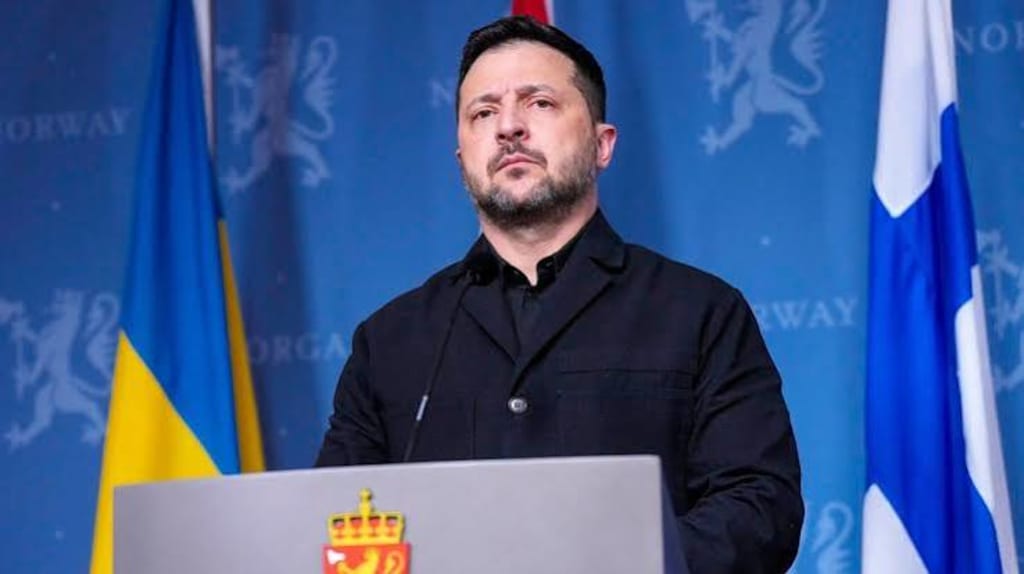
On October 21, 2026, Brian Kilmeade put a condition to Volodymyr Zelensky on Fox & Friends. Would Ukraine accept a peace deal that freezes the front “as it is now” if Kyiv kept 75 percent or more of its territory? Zelensky said yes. “We need to stop now,” he said, “and I think that’s the real way to end this war. We declare a ceasefire, or a stop the killing, as President Trump called it. Freeze and stop.”
The word that circulated was yes. The word that carried the concession was freeze.
A number the host supplied
The 75 percent figure did not come from Zelensky. Kilmeade offered it as a rough description of Ukraine keeping most of its land. Zelensky did not repeat the number. The Harvard Belfer Center’s Russia Matters project put Russian control at roughly 19 percent of Ukraine’s territory and Ukrainian control at about 81 percent in its October 14 assessment. The gap between 75 and 81 separates a television host’s shorthand from a battlefield statistic. It does not reveal a hidden bargaining reserve.
What Zelensky endorsed was a ceasefire along the current line of contact. When Kilmeade pressed on whether Ukraine would hand over the Donbas for peace, Zelensky rejected the idea. “It’s unfair,” he said. He added that Russia “did not succeed” in 2026 and “is not winning on the battlefield.” He accepted a military freeze. He rejected a legal transfer. A ceasefire line is a fact on a map. A border is a claim of right. Zelensky kept those two verbs apart.
What freeze concedes and what it does not
Ukrainian officials have described the front line as the only realistic starting point before. Zelensky’s October 21 answer was different because he said it on American television without restating the 1991 borders as a precondition. For most of the war, Kyiv’s public formula began with full territorial restoration, Crimea included, then moved to reparations, tribunals, and security guarantees. The October 21 answer began with a ceasefire and ended with a request. After the freeze, Zelensky said Ukraine would turn to Trump and European leaders “for security guarantees.”
The order of those requests carries the concession. Freeze first, guarantees second, territory later reverses the earlier sequence, in which territory came first. Zelensky is not giving up the claim to the land. He is accepting that the current army cannot enforce that claim on the current line. The Donbas rejection marks the limit of that acceptance. He will freeze on the fortress belt in Donetsk oblast, where Ukrainian forces still hold more than 20 percent of the region according to ISW, but he will not walk away from it for a signature.
Putin says nothing has changed. He means it.
On the same day Zelensky spoke to Fox News, Trump’s envoy Steve Witkoff was in St. Petersburg presenting a new American peace proposal to Vladimir Putin. The Kremlin’s public line has not moved. In September 2026, spokesman Dmitry Peskov said Russia’s conditions “have not changed” since Putin’s June 2024 foreign ministry speech. Those conditions require Ukrainian troops to withdraw from the entirety of Donetsk, Luhansk, Zaporizhzhia, and Kherson, including areas Russia does not control. They also require Kyiv to abandon NATO membership. Peskov added that the only thing that has changed in two years is that “the situation on the ground has become much worse for Ukraine.”
That claim runs against the available data, and that is why it matters. ISW’s October 16 assessment estimates that Russia gained about 144.5 square kilometers net between January and September 2026. It lost about 122 square kilometers net after September 1. Putin claimed 6,500 square kilometers over the same period. Independent analysis puts the figure at roughly one forty-fifth of that claim. In March 2026, AFP’s analysis of ISW data found no Russian territorial gains on the front line. That was the first such month in two and a half years. A military that is gaining almost nothing cannot demand the surrender of four provinces from a position of strength. Putin is not negotiating from the front line. He is negotiating from a narrative in which the front line is about to collapse. Peskov’s “worse for Ukraine” works as the premise the Kremlin needs to keep its maximalist terms on the table without appearing to lose. It does not read like an intelligence assessment.
The American clock is running faster than the battlefield clock.
Zelensky’s timing does not follow from a Russian breakthrough. It follows from American pressure. In the weeks before the interview, the Trump administration warned Kyiv and European allies that it could suspend intelligence sharing and block American weapons purchases for Ukraine if Ukrainian strikes on Russian energy infrastructure continued. Trump said publicly that Ukraine “should change presidents” and that Zelensky “must have the will” to negotiate. On the day of the interview, Witkoff was in St. Petersburg, not Kyiv, carrying a document Washington had developed with Moscow in mind. The message was plain: the United States could talk to Russia without Ukraine in the room.
Zelensky’s yes to Kilmeade reads as an attempt to put Ukraine back in the room before the door closed. He needed to show Washington that he could say the word it wanted to hear, freeze, while using the rest of the interview to set a price: security guarantees, no Donbas handover, and a ceasefire that stops the killing without conceding the claim. Calling it a strategic surrender misses the tactical repositioning under a clock accelerated from outside the battlefield.
The domestic floor is lower than “no concessions” and higher than “any concession.”
Zelensky could not have made even this move without domestic room. A Rating Group poll conducted October 3 to 5, 2026, found that 56 percent of Ukrainians would accept territorial concessions in exchange for durable peace if the United States and Europe offer security guarantees. Thirty-five percent rejected concessions outright. Sixty-eight percent said any final decision on territory must go to a national referendum. The Ukrainian public has moved beyond the official 1991 borders formula. The same public has not authorized a president to sign away the Donbas. The freeze fits the space the polls describe. A formal cession would not.
The distance is not between 75 and 100.
The headline arithmetic, Ukraine “giving up” 25 percent, misreads the number and the verb. The number came from the interviewer. The verb was freeze, not cede. Zelensky accepted a ceasefire on a line that leaves Ukraine with roughly 81 percent of its territory. He refused a transfer of the contested oblasts Russia has not fully captured. Putin insists that nothing has changed since 2024 while his army’s net gain over nine months amounts to a patch of land smaller than most Kyiv districts.
The gap runs between two presidents. Zelensky has accepted the military reality of a frozen line. Putin refuses to accept the military reality of a stalemate. One side has adjusted its language to the front line. The other is still waiting for the front line to catch up with its language. Until that gap closes, freeze will remain a Ukrainian verb and withdraw will remain a Russian one. The shooting will continue in the space between them.
About the Creator
Jin
Writer of reamstories
https://reamstories.com/jin
Enjoyed the story? Support the Creator.
Subscribe for free to receive all their stories in your feed. You could also become a paid subscriber, letting them know you appreciate their work.
Comments
There are no comments for this story
Be the first to respond and start the conversation.