
Xi, Trump and Putin Will Meet in Shenzhen. Abu Dhabi Shows Why Ukraine Is Still So Far From Peace
The November 19 summit will bring three major powers into the same room. Yet a reported Russian proposal in Abu Dhabi, involving Ukrainian territory, NATO and Moldova, reveals how far apart the parties remain over Europe's future security.
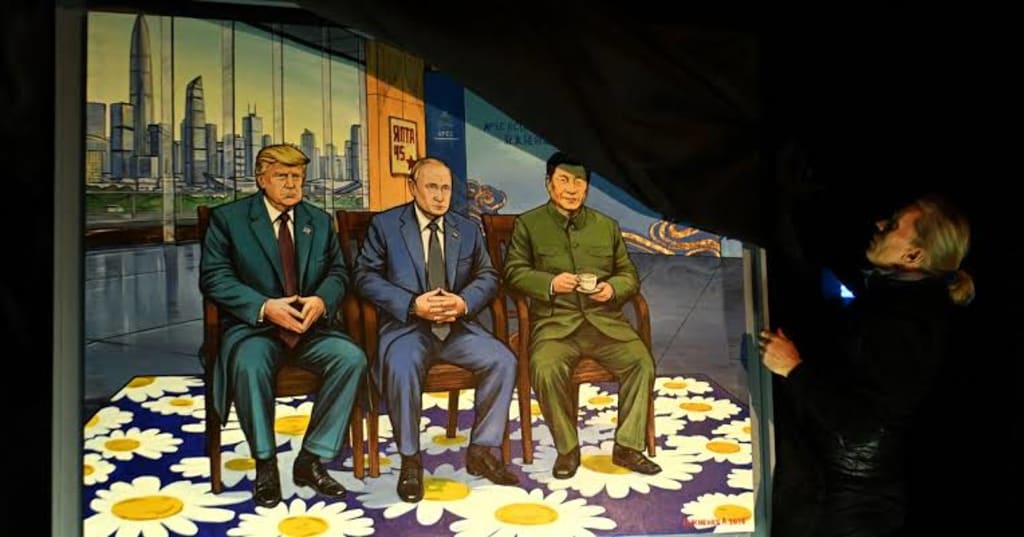
On November 19, Xi Jinping, Donald Trump and Vladimir Putin are expected to sit across the same table in Shenzhen.
The diplomatic preparations are taking place against a very different backdrop in Abu Dhabi. At talks held on November 10 and 11, Russian representatives reportedly circulated a set of conditions that would affect far more than the future of Ukraine. The demands, as reported by Germany's Bild, reach into NATO membership, military deployments in the Baltic states and Moldova's political structure.
The contrast is striking. Three presidents are preparing for a meeting that could improve communication between Washington, Beijing and Moscow. Meanwhile, negotiators are discussing terms that would require several European countries to accept changes to their security arrangements.
These are two separate diplomatic efforts. Together, they expose a central problem in the current international negotiations: the major powers may be willing to talk, but they have very different ideas about what a settlement should look like.
Shenzhen: A historic meeting with a limited agenda
China's Foreign Ministry officially confirmed on November 16 that Xi would host Trump and Putin in Shenzhen on November 19. Beijing described the gathering as the first face-to-face meeting of the three countries' leaders in this format and called it a meeting of groundbreaking significance.
The summit will take place alongside the Asia-Pacific Economic Cooperation (APEC) leaders' meeting. China's public agenda focuses on world peace and strategic stability between major powers. Beijing has not published a detailed list of negotiating subjects.
The White House has offered a clearer indication of Trump's priorities. He intends to raise nuclear arms reduction and the war involving Iran. U.S. officials have indicated that the Ukraine war is not expected to be a subject of the trilateral discussion.
Nuclear arms control presents an immediate challenge.
The New START treaty between Washington and Moscow expired in February 2026. It had placed limits on the two countries' deployed strategic nuclear arsenals. Its expiration leaves the world's two largest nuclear powers without that treaty's restrictions.
Trump has expressed interest in bringing China into a new arms-control discussion. Beijing has resisted joining negotiations on equal terms with Washington and Moscow, arguing that the two countries possess much larger nuclear arsenals and should address their own stockpiles first.
That disagreement will not disappear because the three presidents meet.
Xi has an interest in maintaining China's position as a major diplomatic actor without accepting restrictions that Beijing considers disproportionate. Trump wants a nuclear agreement that could become a major achievement of his presidency. Putin has an opportunity to discuss strategic stability directly with both leaders while reinforcing Russia's international standing.
Their priorities overlap in some areas. Their expectations do not necessarily match.
For Beijing, Shenzhen also carries a domestic and diplomatic dimension. Hosting the other two leaders during APEC gives China an opportunity to demonstrate that it can maintain direct communication with Washington and Moscow, even as its relationship with the United States remains difficult.
But there is a limit to what the meeting can settle.
Ukraine is not represented in the trilateral format. European governments are also absent, despite the fact that any agreement affecting European security would have consequences for them.
A private conversation among Xi, Trump and Putin might help establish diplomatic ground rules. It cannot substitute for negotiations involving the countries whose territory and security are at stake.
Abu Dhabi: Russia's reported demands extend across Europe
The reported proposal from Abu Dhabi makes that problem easier to see.
According to Bild, Russian representatives circulated an unofficial package of conditions to European counterparts around the November 10–11 negotiations. Ukrainian territory was only one part of the reported demands. The package also dealt with NATO, the Baltic states and Moldova.
Its territorial provisions would allow Russia to retain the Ukrainian territory it currently occupies and gain control of the remaining parts of Donbas still held by Kyiv.
The proposal would also require the ports of Odesa and Mykolaiv to be demilitarised, preventing their use as naval bases. It included arrangements to guarantee freedom of navigation in the Black Sea and the Baltic Sea.
The military and political demands would extend further.
Ukraine would have to accept permanent neutrality, ruling out NATO membership while retaining the possibility of joining the European Union.
Finland would be required to leave NATO. The alliance would also be prevented from maintaining military bases in Estonia, Latvia and Lithuania.
Moldova would face a separate set of conditions. Russia reportedly proposed turning the country into a federal republic incorporating Transnistria and Gagauzia. If Moldova joined the EU, those regions would be granted the right to hold independence referendums.
In return, Moscow would offer to withdraw its nuclear weapons from Belarus, refrain from deploying intermediate-range missiles there and remove its troops from Moldova's Transnistria region.
The terms amount to a proposed reorganisation of European security that reaches well beyond the battlefield in Ukraine.
There is an important qualification. The package has not been published as an official Russian government document. Bild described it as one of several unofficial proposals circulating through separate negotiating channels. Interfax-Ukraine reported that it remains unclear whether Putin personally approved this particular package.
The Kremlin also denied that Russia had demanded Finland's withdrawal from NATO. Presidential spokesman Dmitry Peskov said he was unaware of such a demand and that the issue had not been discussed.
That distinction matters. The reported conditions should be treated as claims about an unofficial negotiating position, not as a formally adopted Russian peace plan.
Why these terms are so difficult to accept
The proposal creates problems because its demands affect several sovereign countries that have their own security interests and political decisions to protect.
For Ukraine, the territorial requirement would mean surrendering parts of Donbas that remain under its control. Permanent neutrality would also restrict its future choices on defence and alliances.
Kyiv has repeatedly resisted arrangements that would leave the country exposed to another Russian attack after a ceasefire. Giving up territory while accepting long-term military restrictions would make the question of future security guarantees even harder.
Finland faces a different issue.
It joined NATO in April 2023, following Russia's full-scale invasion of Ukraine. The decision ended decades of military non-alignment and followed a national assessment of Finland's security needs.
Finnish Defence Minister Antti Häkkänen rejected the reported demand, saying Finland's NATO membership was not open to negotiation. He also accused Moscow of seeking to persuade NATO countries to impose restrictions on themselves that would benefit Russia.
There is a practical obstacle here. Finland's membership belongs to Finland. Russia cannot negotiate it away with Washington.
The same applies to the Baltic states. Decisions about NATO's military presence in Estonia, Latvia and Lithuania involve those governments and the alliance itself. They are not simply concessions that can be offered by another country during discussions over Ukraine.
Moldova presents another complication. Its constitutional structure, the status of Transnistria and the rights of Gagauzia are internal political matters with direct consequences for the country's sovereignty. A settlement negotiated by Russia, the United States and European intermediaries would not automatically give it legitimacy inside Moldova.
The proposed Russian concessions also raise questions about balance.
Removing nuclear weapons from Belarus, refraining from additional missile deployments and withdrawing troops from Transnistria could all contribute to regional security. But these measures are not equivalent to Ukraine surrendering territory or NATO members accepting restrictions on their defence arrangements.
The costs would fall on different countries, while Russia would be negotiating over military positions and deployments under its own control.
That imbalance would make implementation and verification difficult even if the parties agreed to discuss individual elements.
A negotiating position, not a workable peace agreement
Why would Moscow put forward conditions that face so much resistance?
One explanation is that the proposal establishes an opening position far beyond what other governments are likely to accept. By starting with maximal demands, Russia could attempt to make a narrower set of concessions appear reasonable in later negotiations.
Another possibility is that Moscow wants to broaden the discussion from Ukraine's territorial future to the wider European security structure.
That approach is consistent with Russia's longstanding objections to NATO's expansion and military presence near its borders. The reported proposal would turn those objections into concrete negotiating demands involving countries that are not directly participating in the war.
But the difference between raising security concerns and demanding changes to another country's sovereign decisions remains substantial.
There is also a question of whether the reported package reflects a single, agreed Russian position. The existence of several unofficial negotiating groups means that not every proposal circulating around the talks necessarily represents Putin's instructions.
The Kremlin's denial regarding Finland reinforces the need for caution.
For now, the reported terms tell us more about the range of positions being discussed than about the actual conditions under which Russia would accept a ceasefire.
Two meetings, two different tests
The Shenzhen summit and the Abu Dhabi negotiations should not be treated as parts of one formal diplomatic process.
Shenzhen is a meeting among three major powers. Its immediate purpose is to establish direct communication on nuclear arms control, Iran and strategic relations.
Abu Dhabi deals with the conditions surrounding the war in Ukraine and the future of European security.
The connection between them lies in the influence Washington, Beijing and Moscow have over the wider international environment.
A conversation among Xi, Trump and Putin could reduce the risk of miscalculation. It could also open the way for further discussions on nuclear arms control after the expiration of New START.
But the three presidents cannot decide Ukraine's territorial future without Ukraine. Nor can they determine Finland's NATO membership or Moldova's constitutional arrangements without those countries' participation.
The concern surrounding the Shenzhen summit is precisely that major powers might discuss the future of smaller countries without giving them a seat at the table. The historical comparison to Yalta has already surfaced in international reporting, although the political circumstances today differ considerably from those of 1945.
For the November 19 meeting, success may mean keeping diplomatic channels open and establishing a basis for further talks rather than producing a major agreement.
For the Ukraine negotiations, the test is much harder. Russia would have to move towards terms that Ukraine and European governments can accept. Any ceasefire would also need credible arrangements to prevent the conflict from simply restarting.
Three presidents will meet in Shenzhen.
The unresolved question in Abu Dhabi is whether Russia is prepared to negotiate an end to the war without demanding that the rest of Europe reorganise its security around Moscow's preferences.
About the Creator
Jin
Writer of reamstories
https://reamstories.com/jin
Enjoyed the story? Support the Creator.
Subscribe for free to receive all their stories in your feed. You could also become a paid subscriber, letting them know you appreciate their work.
Comments
There are no comments for this story
Be the first to respond and start the conversation.