
Why Automotive Air Suspension Systems Are Becoming Essential for Modern Vehicles
Luxury demand, electric vehicles, commercial transportation, and smart automotive technologies are accelerating the global air suspension market.

The future of driving is becoming smoother, smarter, and more adaptive
Modern vehicles are no longer judged only by speed, horsepower, or fuel efficiency. Today’s consumers increasingly expect comfort, stability, advanced safety systems, and intelligent driving experiences. As a result, automotive manufacturers are investing heavily in technologies that improve ride quality and vehicle performance — and air suspension systems are emerging as one of the most important upgrades in modern transportation.
Once found mainly in luxury vehicles, automotive air suspension systems are now expanding into trucks, buses, electric vehicles, and commercial fleets. Their ability to automatically adjust vehicle height, improve load management, and enhance ride comfort is making them increasingly valuable in both passenger and commercial transportation markets.
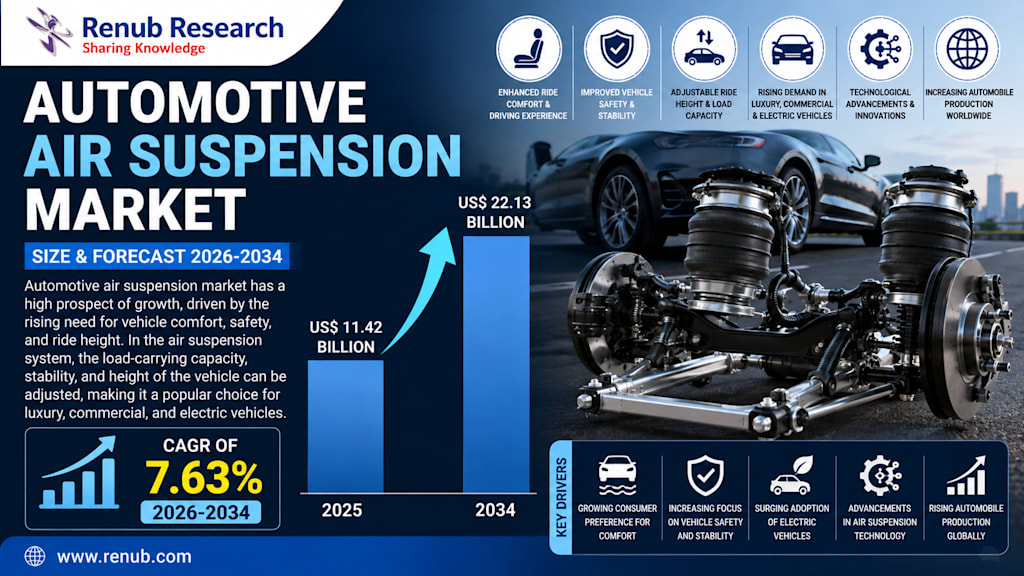
According to Renub Research, the Automotive Air Suspension Market is expected to grow from US$ 11.42 billion in 2025 to US$ 22.13 billion by 2034, expanding at a compound annual growth rate (CAGR) of 7.63% during 2026-2034. The report attributes this growth to rising demand for vehicle comfort, safety, adjustable ride height, technological advancements, and increasing global automobile production.
This steady expansion reflects how suspension technology is becoming a central part of the next generation of smart mobility.
Air suspension is transforming vehicle performance
Traditional suspension systems rely on steel springs to absorb shocks and stabilize vehicles. Air suspension systems replace those springs with air-filled rubber bags or air springs, creating a smoother and more adjustable driving experience.
The technology allows vehicles to automatically maintain proper ride height regardless of road conditions or vehicle load. This improves handling, stability, comfort, and safety, especially during long-distance travel or uneven terrain.
Air suspension systems are becoming increasingly popular in luxury vehicles, commercial trucks, buses, and electric vehicles because they offer superior ride quality compared to conventional suspension technologies.
Consumers today expect premium driving experiences even in non-luxury segments, and air suspension is gradually becoming part of that expectation.
Luxury vehicle demand is driving market growth
One of the biggest growth drivers for the automotive air suspension market is the increasing global demand for luxury and premium vehicles.
Modern luxury car buyers expect high levels of comfort, smooth driving performance, and advanced technological features. Air suspension systems help manufacturers meet those expectations by delivering better shock absorption, improved ride quality, and adjustable vehicle height.
As disposable income rises in many regions, more consumers are entering premium automotive categories, increasing adoption of advanced suspension systems.
The report highlights that BMW sold more than 2.16 million vehicles globally during 2025, reflecting continued strength in premium automotive demand.
Luxury SUVs, high-end sedans, and performance vehicles increasingly rely on electronically controlled air suspension systems to differentiate themselves through comfort and driving precision.
Automotive brands are also using suspension innovation as a competitive advantage in increasingly crowded premium vehicle markets.
Commercial transportation is becoming a major growth area
Beyond luxury vehicles, commercial transportation is becoming one of the strongest contributors to air suspension demand.
Trucks, buses, and trailers frequently carry heavy loads that affect vehicle balance, stability, and tire wear. Air suspension systems help distribute weight more evenly while maintaining proper ride height.
This improves vehicle safety, reduces maintenance costs, enhances fuel efficiency, and increases driver comfort during long-distance operations.
Fleet operators increasingly prefer air suspension systems because they help extend vehicle lifespan and reduce mechanical stress caused by rough road conditions and uneven loading.
The rapid growth of global logistics, e-commerce, and transportation industries is accelerating this trend. As freight movement expands worldwide, demand for durable and efficient suspension systems is expected to rise steadily.
Electric vehicles are creating new opportunities
The rapid expansion of electric vehicles is creating another major opportunity for air suspension manufacturers.
Electric vehicles benefit significantly from air suspension systems because they improve aerodynamics, energy efficiency, and vehicle stability.
Air suspension can automatically lower vehicle height at higher speeds to reduce air resistance and improve battery performance. It can also adjust ride characteristics based on road conditions and driving modes.
Manufacturers developing premium electric SUVs and trucks increasingly incorporate advanced suspension systems to improve overall driving experience.
The report highlights Stellantis’ launch of the STLA Frame platform designed for full-size electric pickup trucks and SUVs, including flexible suspension designs integrated into advanced vehicle architecture.
As electric mobility expands globally, air suspension systems are expected to become more common in next-generation EV platforms.
Smart suspension systems are becoming more intelligent
Technology is rapidly transforming automotive suspension systems into intelligent electronic systems.
Modern electronically controlled air suspension systems use sensors, electronic control units, and automatic leveling systems to continuously monitor vehicle conditions and adjust suspension settings in real time.
These systems respond dynamically to road surfaces, vehicle speed, passenger weight, and driving conditions, improving stability, handling, and passenger comfort.
The integration of air suspension with advanced driver-assistance systems and connected vehicle technologies is creating smarter and safer vehicles.
Automotive manufacturers are investing heavily in research and development to improve suspension durability, automation, and responsiveness.
As connected and autonomous vehicle technologies continue evolving, intelligent suspension systems are likely to become even more sophisticated.
High costs still limit wider adoption
Despite strong growth potential, air suspension systems remain significantly more expensive than conventional suspension technologies.
The systems require specialized components such as compressors, air springs, sensors, electronic modules, valves, and control systems.
This increases manufacturing costs and often limits adoption primarily to premium vehicles and commercial transportation fleets.
Maintenance costs are also higher because components such as compressors and air springs may require replacement over time.
For many consumers, especially in price-sensitive markets, conventional suspension systems remain more affordable and practical.
Manufacturers are therefore focusing on reducing production costs and improving system reliability to support broader adoption across mid-range vehicle categories.
Reliability concerns remain a challenge
Reliability and component durability continue to be important concerns for the industry.
Air suspension systems contain multiple interconnected components including hoses, valves, sensors, compressors, and electronic controls. Failure of any single component can affect overall system performance.
Common issues include air leaks, compressor failures, and sensor malfunctions.
Harsh weather conditions, dust, road damage, and heavy commercial use can also affect durability, particularly in challenging operating environments.
Fleet operators are especially sensitive to reliability because suspension failure can lead to delays, increased maintenance costs, and operational disruptions.
Improving long-term reliability remains a key priority for manufacturers competing in this market.
Electronically controlled systems are leading innovation
Electronically controlled air suspension systems represent one of the fastest-growing segments within the industry.
These advanced systems use automation and sensor technology to optimize ride height, handling, stability, and comfort continuously.
Luxury vehicles, electric SUVs, and premium commercial vehicles increasingly adopt electronically controlled systems because they provide a more refined driving experience.
Manufacturers are also integrating intelligent suspension systems to improve aerodynamics and energy efficiency.
As the automotive industry moves toward automation and smart mobility, electronically controlled air suspension is expected to play an increasingly important role.
Air spring suspension systems remain critical
Air spring suspension systems remain at the core of modern air suspension technology.
These systems use flexible air-filled rubber bags instead of steel springs, delivering smoother rides, better shock absorption, and improved vibration reduction.
Demand is especially strong in trucks, buses, trailers, and luxury passenger vehicles where comfort and load management are critical.
As transportation volumes continue increasing globally, air spring systems are becoming increasingly important in logistics and commercial mobility sectors.
Buses are adopting air suspension for passenger comfort
Bus manufacturers and public transportation operators are increasingly using air suspension systems to improve passenger experience.
Air suspension minimizes vibrations and road shocks, making long-distance and urban bus travel more comfortable.
The technology also enables kneeling functions that lower buses closer to the ground, improving accessibility for elderly and disabled passengers.
Governments and transport authorities are modernizing public transportation fleets with advanced suspension technologies to improve comfort, safety, and accessibility.
This trend is expected to strengthen further as urban transportation systems continue evolving.
Truck demand is accelerating rapidly
Truck air suspension systems are witnessing especially strong growth because of expanding logistics and freight industries.
Heavy-duty trucks require advanced suspension systems to maintain load stability, reduce cargo damage, and improve driving comfort.
Fleet operators also benefit from lower maintenance costs and improved vehicle lifespan when using air suspension systems.
As global trade, e-commerce, and transportation demand continue rising, the truck segment is likely to remain one of the market’s most important growth engines.
The United States remains a leading market
The United States continues to dominate the automotive air suspension market because of strong demand for luxury vehicles, pickup trucks, SUVs, and commercial transportation systems.
The country’s growing electric vehicle sector is also driving demand for advanced suspension technologies designed to improve aerodynamics and efficiency.
The report highlights a strategic partnership announced by Wabco Holdings in October 2025 to develop next-generation air suspension systems specifically for electric vehicles.
This reflects how electrification is opening new opportunities for suspension innovation.
India is becoming a high-growth opportunity
India’s automotive air suspension market is expanding rapidly due to growth in logistics, e-commerce, transportation infrastructure, and premium passenger vehicle demand.
Commercial trucks and buses remain major growth drivers, but adoption in passenger vehicles is also increasing steadily.
The report highlights Hendrickson’s launch of innovative air and mechanical suspension systems for trailer applications in India during 2023.
As India modernizes its transportation ecosystem, demand for advanced suspension technologies is expected to rise significantly.
Final thoughts
The automotive air suspension market is becoming increasingly important as vehicles evolve into smarter, more connected, and more comfort-focused machines.
Consumers want smoother rides, commercial operators want better efficiency, and electric vehicle manufacturers want improved aerodynamics and performance. Air suspension technology addresses all of these demands simultaneously.
Although high costs and reliability concerns remain challenges, ongoing technological advancements are steadily improving system durability, intelligence, and affordability.
With the market projected to surpass US$ 22 billion by 2034, automotive air suspension systems are no longer limited to luxury experimentation. They are becoming a foundational technology shaping the future of modern transportation.
About the Creator
Enjoyed the story? Support the Creator.
Subscribe for free to receive all their stories in your feed.
Comments
There are no comments for this story
Be the first to respond and start the conversation.