
What 537 Characters Leave Out: Taiwan and the Limits of the Xi-Trump Summit Deal
Taiwan was absent from the eight-point public outcomes, but it was not absent from the leaders' talks. The omission says more about what Washington and Beijing could document together than about whether the issue had been set aside.
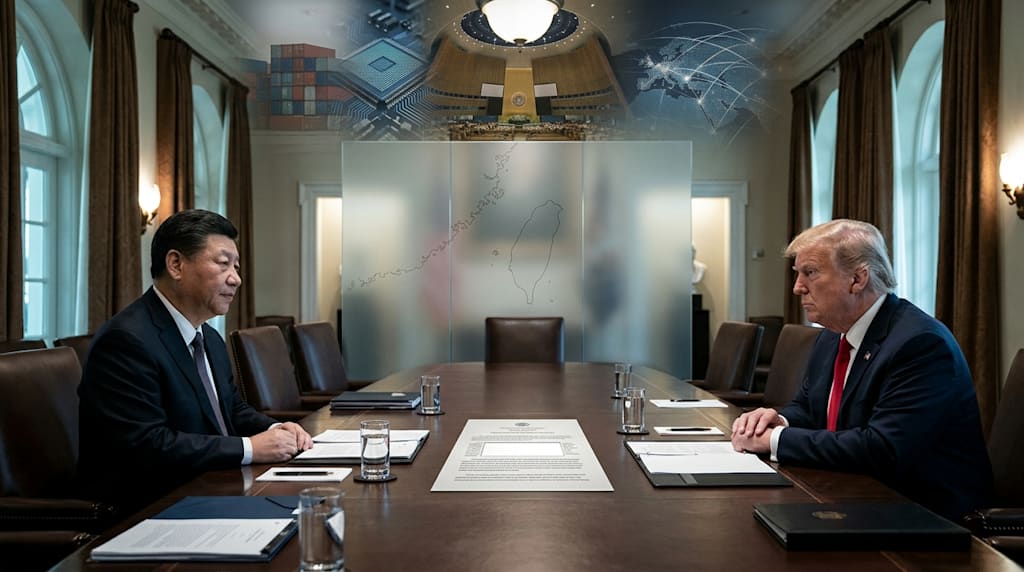
Eight points. Roughly 537 Chinese characters.
The list covers a new framework for the relationship, mutual support for the APEC and G20 summits, Iran's nuclear issue, international waterways, trade, counternarcotics cooperation, artificial intelligence and even the arrival of two giant pandas at an Atlanta zoo.
One subject is missing: Taiwan.
That omission immediately raises a question. Taiwan is one of the most sensitive issues in U.S.-China relations. Why does it disappear from the formal list of summit outcomes?
The answer depends on what the list is understood to be.
It is not a record of every issue discussed by Xi Jinping and Donald Trump. It is a list of outcomes the two sides chose to publicize as areas of agreement or follow-up. The Chinese foreign ministry's readout separately confirms that Taiwan was discussed. Xi told Trump that Beijing's position on national reunification and territorial integrity was clear and asked Washington to oppose "Taiwan independence" and handle the Taiwan question cautiously.
So the more revealing question is not why Taiwan was "avoided."
It is what the two governments were prepared to put into a shared public record.
An outcome list is not a list of disagreements
Diplomatic documents rarely reproduce every disagreement between governments. They normally emphasize what can be jointly stated, implemented or carried into the next round of talks.
The eight-point Chinese list follows that logic.
It records an agreement to build what Beijing describes as a constructive relationship of strategic stability based on respect, fairness and reciprocity. It records plans for the two leaders to attend each other's APEC and G20 meetings. It records trade arrangements, counternarcotics cooperation and a new AI dialogue. It also includes issues where the two sides could state a common position, such as Iran's nuclear status and opposition to tolls on international waterways.
Taiwan is different.
Beijing regards the Taiwan issue as a question of sovereignty and national unity. Washington maintains a different policy framework under which it recognizes the People's Republic of China diplomatically while retaining unofficial relations with Taiwan and providing support for its self-defense.
That makes a jointly worded Taiwan outcome unusually difficult.
The absence of a Taiwan clause therefore does not by itself establish either a concession or a breakthrough. It may simply show that the two governments had no new formulation they were prepared to endorse together.
Discussed, but not jointly recorded
This is the most important distinction.
Taiwan was not absent from the leaders' conversation.
China's official account says Xi directly raised the issue and asked the United States to oppose "Taiwan independence" and handle the Taiwan question cautiously. The same readout says the two leaders also discussed Iran, Ukraine and the Korean Peninsula.
But that discussion did not become one of the eight publicized outcomes.
That is different from saying that the issue was resolved, shelved or traded away.
Diplomatic language often operates at several levels. Leaders can state their positions directly, negotiators can discuss areas of disagreement privately, and only a subset of those exchanges may appear in a joint or parallel public document.
Taiwan appears to have remained in the first two categories rather than the third.
The United States has also not announced a change in its underlying Taiwan policy as part of the summit. An assessment by the Institute for the Study of War said the talks produced no reported change in U.S. Taiwan policy.
That matters because a missing sentence is not itself a policy commitment.
Why the economic and AI items were easier to publish
The contrast with the other outcomes is revealing.
The trade component produced a concrete mechanism. The two countries agreed on more favorable tariff treatment for US$30 billion of non-sensitive goods in each direction under their bilateral trade framework. The White House also said the two sides had operationalized their trade and investment boards.
The AI discussion produced another concrete mechanism: a bilateral dialogue on the technology's risks and benefits, with another round scheduled for November, alongside a communication channel for AI-related incidents.
Counternarcotics cooperation was also presented through specific enforcement results, while the two governments agreed to support each other's APEC and G20 meetings.
These are issues where Washington and Beijing could identify something operational.
Taiwan does not fit as neatly into that category.
There was no new jointly announced settlement on the political status of Taiwan, no new bilateral formula for arms sales, and no announced change in either side's underlying position. Putting Taiwan into the same list would therefore have created a very different kind of headline: not "what did the two governments agree to do?" but "what did they agree about Taiwan?"
The distinction is important.
The summit produced several items that could be implemented. Taiwan remained principally a subject of strategic communication and risk management.
The $14 billion arms question adds another layer
The timing of U.S. arms sales to Taiwan gives the omission additional context, although it should not be treated as proof of a summit bargain.
The United States has delayed approval of a Taiwan arms package worth about $14 billion. Reuters reported before the summit that Beijing was expected to press Trump on Taiwan arms sales, while Trump had previously described such sales as a negotiating tool.
Separate reporting said the possible postponement could extend until after the APEC summit in Shenzhen.
But the reasons for the delay have been described differently by different sources. Earlier reporting from the Washington Post attributed the pause partly to U.S. weapons shortages related to the war in Iran, while also reporting that Chinese officials had pressed Washington to delay or scale back arms packages.
That makes a simple causal statement difficult to sustain.
The evidence shows that Taiwan arms sales were part of the broader strategic context surrounding the summit. It does not establish that Washington delayed the $14 billion package specifically to protect the summit or the subsequent APEC and G20 meetings.
That distinction is exactly where a serious analysis should stop short of inference.
The real value of the omission may be strategic ambiguity
From Beijing's perspective, the essential requirement is that Washington understand its position.
From Washington's perspective, preserving room for maneuver on Taiwan remains important.
Those objectives are not identical.
The result is a familiar diplomatic structure: each side states its own position, but neither side necessarily converts the most sensitive disagreement into a joint sentence.
That does not eliminate the dispute. It can, however, prevent the dispute from consuming the entire summit agenda.
The eight-point list consequently tells us something about the hierarchy of what could be advanced at this meeting.
Trade could be operationalized.
AI could receive a dialogue channel.
Counternarcotics cooperation could be measured through law-enforcement cases.
High-level visits could be scheduled.
Crisis communication could be strengthened.
Taiwan could be discussed, but a new common position was not announced.
The next meetings may matter more than this sentence
The summit was not presented as a one-off encounter.
The two governments agreed to support each other's APEC and G20 meetings, with Xi and Trump intending to attend the meetings hosted by the other side. China's official account also says the two leaders have maintained communication through different channels and that their latest meeting was aimed at giving greater direction to the bilateral relationship.
That creates another reading of the Taiwan omission.
Rather than treating the absence of Taiwan from the eight-point list as a final political signal, it may be more useful to see it as an indication of where the two governments currently have usable negotiating space.
They can build channels around areas where cooperation is possible while continuing to manage the issues where their positions remain fundamentally different.
That does not mean Taiwan has been moved out of the relationship's center of gravity.
It means the public outcomes were built around what could be recorded without requiring the two sides to manufacture a new consensus.
What 537 characters actually tell us
The interesting fact is therefore not simply that Taiwan is absent.
It is that Taiwan is absent while the issue was explicitly raised in the leaders' talks.
The eight-point list is consequently better read as a map of the areas where the summit generated concrete follow-up, rather than as a complete account of the U.S.-China relationship.
That leaves three facts standing side by side.
Taiwan remains one of the most sensitive disputes between Washington and Beijing.
The leaders discussed it directly.
But neither government's public outcome list turned that discussion into a new bilateral agreement.
For now, that is the boundary of what the summit's 537 characters can tell us.
The next test will not be whether Taiwan appears in a press release. It will be whether future meetings, military contacts, arms decisions and crisis-management mechanisms show the two sides becoming more capable of handling the issue without allowing it to derail the rest of the relationship.
About the Creator
Jin
Writer of reamstories
https://reamstories.com/jin
Enjoyed the story? Support the Creator.
Subscribe for free to receive all their stories in your feed. You could also become a paid subscriber, letting them know you appreciate their work.
Comments
There are no comments for this story
Be the first to respond and start the conversation.