
Vučić Quit the Presidency to Run for Prime Minister. The Office He Wants Has More Power.
Serbia’s president is trading a term-limited office for the one that controls the budget, the police, and the party machine.
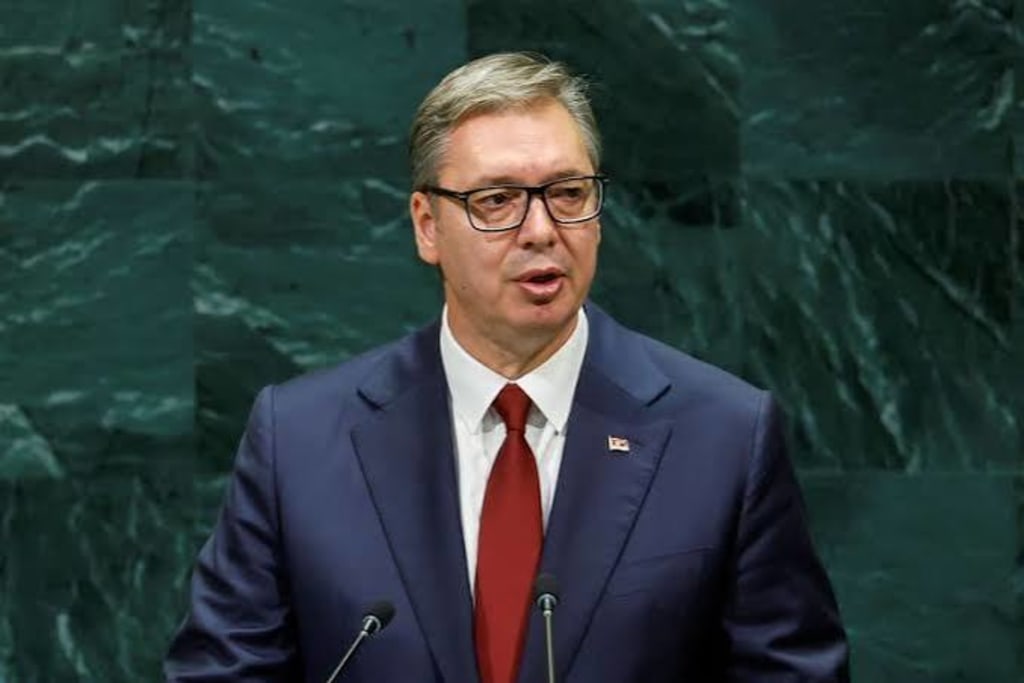
September 27, 2026, Belgrade. Aleksandar Vučić stands in front of the presidency, addressing supporters, announcing that he is resigning as President of Serbia. After the speech, he signs his resignation and transfers presidential duties to National Assembly Speaker Ana Brnabić. The next day, Brnabić becomes acting president.
Eight months remain before his original term would have ended. He is changing chairs.
I. The prime minister’s office holds the real power
Vučić was first elected president in 2017 and re-elected in 2022. Serbia’s constitution says the president serves five years and can be re-elected once. In 2027, he would hit that limit.
He chooses to resign the presidency and run for prime minister.
To understand this move, look at Serbia’s power structure. The president is the head of state. Under Serbia’s parliamentary system, the prime minister holds executive power. The president handles ceremony and diplomacy. The prime minister controls the budget, appointments, and economic policy.
Vučić knows this structure well. From 2014 to 2017, he served as prime minister. That experience taught him the weight of the office.
International media compared the move to Vladimir Putin’s 2008 transfer to the prime ministership. There is a key difference. Russia is a super-presidential system, where the prime minister’s power is limited. Serbia is a parliamentary system, where the prime minister holds substantive authority. For Vučić, becoming prime minister circumvents the term limit. In real power, the office may exceed the presidency.
The move is a precise job swap.
II. Protests and a legitimacy crisis
The other side of Vučić’s urgency is social discontent inside Serbia.
In 2024, the canopy at Novi Sad railway station collapsed, killing 16 people. The disaster became a detonator for public anger. The protesters’ rage was not aimed only at the accident. In their view, the disaster symbolized systemic problems that had accumulated over more than a decade under the ruling party.
Vučić had been deeply tied to the railway station renovation project. He promoted it as a symbol of Serbia’s progress. The disaster created a political liability he could not easily cut away from that symbol.
The protest movement escalated. Students, teachers, workers, and farmers joined. Demonstrations lasted through the summer and at one point turned into street clashes amid allegations of police violence.
Faced with this situation, Vučić chose a retreat that is also an advance. Through early elections, he would ask voters to authorize him again. Resigning the presidency and entering the campaign as an ordinary citizen reinforced that narrative. On September 14, when he announced his resignation plan in an interview, he said: “I will participate in the campaign as an ordinary citizen, traveling to cities and villages across Serbia, communicating with the people.”
III. The electoral chessboard
In polling numbers, Vučić’s odds look strong.
A survey by Faktor Plus in early September showed that the Serbian Progressive Party had the support of 47.2 percent of voters who had decided how to vote. That is close to the threshold for an outright parliamentary majority. Its main rival, the “Student List,” stood at 31.5 percent, a gap of nearly 16 percentage points.
The Progressive Party’s organizational capacity is also striking. Serbia has a population of about 6.63 million. The Progressive Party has about 700,000 members. Its mobilization network in towns and villages is deep and dense.
But numerical advantage is not unshakable.
Polling counts decided voters. A significant share of swing voters is not included. If they are factored in, the opposition camp’s total support could approach 40 percent. That narrows the gap.
Geography matters too. In Belgrade, the Progressive Party’s support is lower than its national average. In the September 2026 local elections, the ruling coalition’s vote in Niš trailed four opposition lists by a combined 3,350 votes. In the city assembly, the opposition camp overpowered the ruling party with a 45 percent advantage.
Young people in big cities are tilting toward the opposition. Even if the Progressive Party wins a national majority, the quality of its seats may be discounted.
The compressed election cycle is another card in Vučić’s hand. From his resignation on September 27 to the vote on October 25, the campaign window is less than a month. This calendar gives the opposition little time to integrate alliances and coordinate candidates. It favors the side with stronger organization and a denser grassroots network.
Even if he wins, Vučić will not face a smooth road.
If he fails to lead the Progressive Party to an outright majority of the 250 seats, he will need to form a coalition with small parties. His promised 13-person cabinet will be hard to deliver. Cutting government means cutting agencies and reducing staffing. A considerable portion of the Progressive Party’s 700,000 members depend on positions inside the system. Once the reform promise is implemented, backlash from entrenched interests within the party will be unavoidable.
IV. Kosovo, the EU, and China
Vučić’s job swap moves domestic pieces. It also triggers chain reactions abroad.
The most sensitive issue is Kosovo. Serbia refuses to recognize Kosovo’s independence. This is an untouchable red line for Belgrade. The European Union links the resolution of the Kosovo issue to Serbia’s EU accession negotiations.
Vučić has admitted that because Serbia refuses to sanction Russia and refuses to recognize Kosovo’s independence, it has been unable to open new chapters in EU accession talks for five years. EU pressure has never stopped. Vučić’s position on Kosovo is both the support of his nationalist base and his biggest bargaining chip with the West.
Relations with China are another key piece on Vučić’s diplomatic chessboard.
On the night of his resignation, Vučić attended a Chinese National Day reception in Belgrade. In his speech, he said: “The strategic partnership between Serbia and China and the brotherhood between our peoples transcend any office, term, or time. This is an eternal, unbreakable bond, and we will continue to cultivate it in the future.”
The timing was no accident. The remarks were both a political assurance to Beijing and a signal to the West: no matter what office Vučić holds, Serbia’s relationship with China will not waver because of a change in position.
China is Serbia’s second-largest trading partner and one of its largest foreign investors. From the Hungarian-Serbian railway to the Smederevo steel plant, Chinese investment has left tangible marks in infrastructure and employment. This relationship, supported by both economic cooperation and sovereignty support, forms an important foundation for Serbia’s strategic autonomy in the great-power game.
The direction of China-Serbia cooperation is unlikely to change with Vučić’s title. The relationship’s stability over the next decade may face new tests.
V. The presidential vacuum
After Vučić’s resignation, an easily overlooked institutional risk is emerging: who will hold the presidency.
Under Serbian law, after the president resigns, the National Assembly speaker acts as president and must hold a presidential election within three months. Serbian voters will go to the polls twice in 2026. First the parliamentary election in October. Then the presidential election.
Vučić has not yet clearly designated a presidential candidate.
If the Progressive Party puts forward a candidate close to Vučić, coordination between the president and prime minister will not be a problem. If the new president comes from a different political camp, or has independent ambitions, the tension between the prime minister and the president could become an obstacle to policy.
More subtly, if Vučić as prime minister holds real power while the presidency is occupied by a figure lacking political weight, power would shift from the presidential palace to the government building. That will trigger debate about checks and balances.
VI. The endgame
Vučić’s resignation is not an exit. It is a calculated displacement.
He gives up the nominal presidency, bound by constitutional limits. He aims for the real power of the prime ministership, which has no term ceiling. In Serbia’s political structure, he is moving from a door that is about to close to a window that no one is guarding.
This job swap is far from the finish line.
He needs to win the election. He needs a stable majority in parliament. He needs to manage the conflict of interest triggered by his party’s reform promises. He needs to maintain balance in the great-power game. He also needs to ensure that the presidency does not fall into the hands of someone beyond his control. Every step is full of variables.
For Serbia, Vučić’s political fate is tied to the country’s strategic direction. The deadlock over Kosovo, the stagnation of EU accession, and the balancing act between Russia and China on one side and the West on the other are structural problems. They will not disappear because of a change in office.
Vučić has used resignation to buy time. Whether time can be converted into space depends on everything after October 25.
Autumn is arriving in Belgrade. The flag in front of the presidency has changed color. The flagpole is still the same flagpole.
About the Creator
Jin
Writer of reamstories
https://reamstories.com/jin
Enjoyed the story? Support the Creator.
Subscribe for free to receive all their stories in your feed. You could also become a paid subscriber, letting them know you appreciate their work.
Comments
There are no comments for this story
Be the first to respond and start the conversation.