
United States Sodium-ion Battery Market Set for Strong Growth as Energy Storage Innovation Accelerates Through 2033
Rising renewable energy deployment, abundant raw material availability, and growing investments in domestic battery manufacturing are positioning sodium-ion batteries as a strategic component of America’s future energy ecosystem.

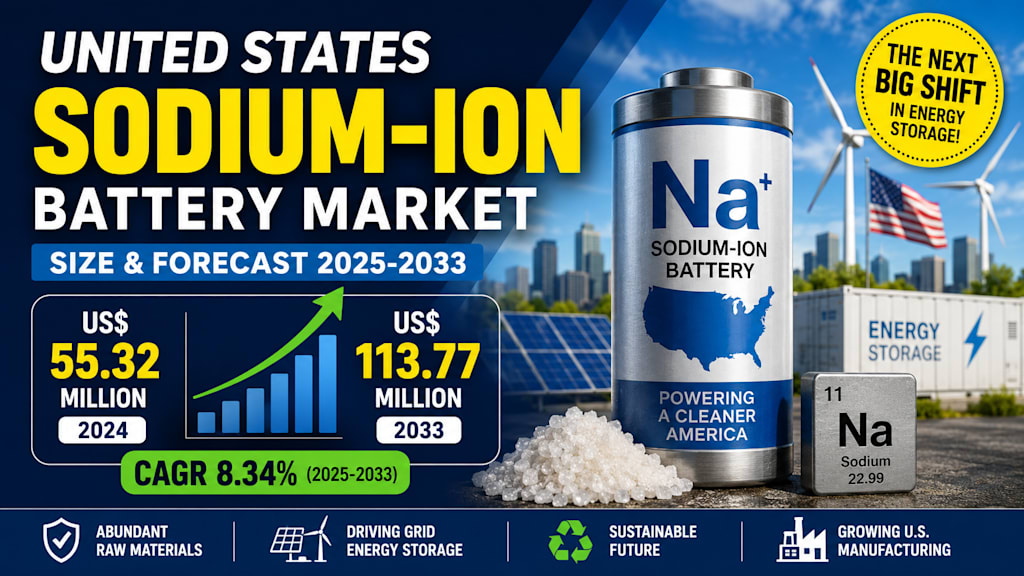
United States Sodium-ion Battery Market Size & Forecast 2025–2033
The United States sodium-ion battery market is entering an exciting phase of development as the country seeks cost-effective, sustainable, and secure alternatives to conventional lithium-ion battery technologies. According to Renub Research, the United States Sodium-ion Battery Market is projected to increase from US$ 55.32 million in 2024 to US$ 113.77 million by 2033, expanding at a CAGR of 8.34% during 2025–2033.
The rapid expansion of renewable energy projects, increasing concerns about critical mineral supply chains, and the need for affordable energy storage solutions are encouraging both public and private sector investments in sodium-ion battery technologies. While lithium-ion batteries currently dominate the market, sodium-ion batteries are emerging as a compelling alternative for grid-scale storage, industrial applications, and selected transportation segments.
Understanding Sodium-ion Battery Technology
Sodium-ion batteries operate using sodium ions as charge carriers instead of lithium ions. Similar to lithium-ion batteries, sodium ions move between the cathode and anode during charging and discharging cycles. The major distinction lies in the raw material used.
Sodium is one of the most abundant elements on Earth and can be sourced from seawater and mineral deposits. This abundance makes sodium-ion batteries attractive from both economic and strategic perspectives. As global demand for batteries continues to rise, concerns regarding lithium availability, mining challenges, and geopolitical supply chain risks have intensified.
Sodium-ion technology addresses many of these concerns by offering a more accessible and potentially lower-cost battery chemistry. Furthermore, these batteries demonstrate strong safety characteristics, making them suitable for stationary energy storage systems and industrial applications.
As the United States continues its transition toward cleaner energy systems, sodium-ion batteries are increasingly being evaluated for renewable integration, backup power solutions, microgrids, and future mobility applications.
Market Growth Driven by Abundant Raw Material Availability
One of the strongest growth catalysts for sodium-ion batteries is the widespread availability of sodium resources. Unlike lithium, which is concentrated in specific regions around the world, sodium is readily accessible and abundant.
This availability significantly reduces supply chain vulnerabilities and lessens dependence on imported critical minerals. For policymakers and manufacturers focused on strengthening domestic energy security, sodium-ion batteries represent an attractive long-term solution.
The growing emphasis on local battery production is further supporting market expansion. In August 2024, Natron Energy announced plans to build the first large-scale sodium-ion battery manufacturing facility in the United States. The company’s proposed US$1.4 billion North Carolina plant is expected to produce approximately 24 GWh of batteries annually, marking a major milestone for domestic sodium-ion battery manufacturing.
Such investments demonstrate increasing confidence in the commercial viability of sodium-ion technologies and reinforce the country's broader efforts to establish resilient battery supply chains.
Expanding Demand for Grid-Scale Energy Storage
The United States is witnessing unprecedented growth in renewable energy deployment, particularly solar and wind power generation. However, renewable energy sources are inherently intermittent, creating a growing need for efficient and reliable energy storage systems.
Sodium-ion batteries offer several advantages for stationary energy storage applications. They provide strong cycle life, enhanced thermal stability, and improved safety compared to many conventional battery chemistries.
Utilities and grid operators are actively exploring sodium-ion battery solutions to improve grid resilience, stabilize energy supply, reduce peak demand pressures, and facilitate renewable energy integration.
A significant development occurred in August 2025 when Peak Energy introduced its first sodium-ion battery energy storage system for pilot deployment with utilities and independent power producers. The project represents one of the largest sodium-ion phosphate pyrophosphate battery storage systems currently deployed in the United States.
As renewable generation capacity continues expanding nationwide, demand for affordable and scalable energy storage technologies is expected to remain a major growth driver for the sodium-ion battery market.
Sustainability Benefits Strengthen Market Potential
Environmental sustainability has become a central consideration in battery technology development. Sodium-ion batteries align closely with emerging sustainability goals due to their reduced reliance on scarce critical minerals and their potentially lower environmental footprint.
The extraction and processing of sodium generally require fewer environmentally intensive operations compared with lithium mining. Additionally, sodium-ion batteries contain non-toxic materials that simplify handling and recycling processes.
The push toward circular economy practices is encouraging interest in battery technologies that can be recycled more efficiently and sustainably. Sodium-ion batteries support these objectives while helping reduce the environmental impact associated with large-scale energy storage deployment.
In July 2025, Inlyte Energy announced the installation of an innovative iron-sodium battery system at California’s Alliance Redwoods Conference Grounds. Supported by a US$4.1 million grant from the U.S. Department of Energy, the project aims to improve wildfire resilience, reduce electricity costs, and provide a diesel-free backup power solution.
Such initiatives highlight the growing role of sodium-based technologies in supporting cleaner and more resilient energy infrastructure.
Challenges Limiting Wider Adoption
Despite promising growth prospects, sodium-ion battery technology still faces several challenges that could slow widespread adoption.
Lower Energy Density Compared to Lithium-ion
One of the most significant limitations is lower energy density. Sodium ions are larger and heavier than lithium ions, resulting in batteries that typically store less energy per unit weight.
This limitation reduces competitiveness in applications requiring compact and lightweight battery systems, particularly long-range electric vehicles. While sodium-ion batteries perform well in stationary energy storage and short-range transportation applications, they currently lag behind lithium-ion solutions in high-performance automotive markets.
Ongoing research and development efforts are focused on improving electrode materials, battery chemistry, and cell design to enhance energy density and overall performance.
Limited Commercial Ecosystem
Another challenge is the relatively immature commercial ecosystem surrounding sodium-ion technology in the United States.
Compared with lithium-ion batteries, which benefit from established supply chains, manufacturing infrastructure, and extensive industry partnerships, sodium-ion technology remains in the early stages of commercialization.
Limited large-scale production capacity can increase costs and slow market penetration. Continued investments in manufacturing facilities, pilot projects, and public-private partnerships will be necessary to accelerate adoption and achieve economies of scale.
Sodium-Sulphur Battery Segment Shows Continued Promise
Sodium-sulphur batteries represent one of the most mature sodium-based energy storage technologies currently available.
These batteries operate at elevated temperatures and are known for delivering high energy density, long cycle life, and reliable performance. In the United States, sodium-sulphur batteries have found applications in utility-scale energy storage projects where long-duration performance is particularly valuable.
As utilities seek solutions capable of balancing renewable generation over extended periods, sodium-sulphur technology is expected to maintain relevance despite ongoing competition from newer battery chemistries.
Research efforts focused on thermal management improvements and enhanced safety systems are likely to further strengthen the segment's future growth potential.
Sodium-Air Batteries Offer Long-Term Innovation Potential
Sodium-air batteries remain largely in the research and development phase but represent one of the most promising future battery technologies.
Theoretically, sodium-air systems can achieve energy densities comparable to or even exceeding those of lithium-air batteries. Researchers across the United States are investigating sodium-air chemistry as a low-cost and sustainable alternative for both transportation and stationary storage applications.
Although technical challenges such as cycle stability, oxygen management, and efficiency optimization remain unresolved, breakthroughs in these areas could unlock transformative opportunities for the energy storage industry.
For now, sodium-air batteries represent a long-term innovation opportunity rather than an immediate commercial market segment.
Transportation Sector Emerging as a Key Opportunity
The transportation sector is becoming an increasingly important area for sodium-ion battery adoption.
Because of their safety profile, affordability, and tolerance to varying environmental conditions, sodium-ion batteries are particularly attractive for buses, delivery fleets, urban mobility solutions, and short-range electric vehicles.
Commercial fleet operators often prioritize operational reliability and cost-effectiveness over maximum driving range. This makes sodium-ion technology well-suited for many transportation applications where predictable routes and regular charging infrastructure are available.
As cities continue investing in electrified transportation systems, sodium-ion batteries could become an important alternative to traditional lithium-ion technologies.
Automotive Industry Exploring Cost-Effective Alternatives
The U.S. automotive industry is actively evaluating sodium-ion batteries for entry-level and budget-friendly electric vehicles.
Although premium EV manufacturers will likely continue relying on advanced lithium-based batteries to maximize driving range, sodium-ion batteries could play an important role in expanding electric vehicle affordability.
Lower material costs, enhanced safety characteristics, and reduced supply chain risks make sodium-ion technology attractive for automakers seeking to reach broader consumer segments.
Success in this area will depend heavily on future improvements in battery performance and the development of robust domestic manufacturing capabilities.
Industrial Applications Supporting Market Expansion
Industrial users are increasingly adopting sodium-ion batteries for backup power, energy management, and operational resilience.
Factories, warehouses, logistics centers, and data centers require dependable power solutions that can operate safely under diverse conditions. Sodium-ion batteries offer advantages including non-toxicity, stable performance, and broad operating temperature ranges.
As sustainability initiatives gain momentum across industrial sectors, organizations are seeking cleaner and more environmentally responsible energy storage solutions. Sodium-ion batteries are well positioned to meet these evolving requirements.
Regional Market Spotlight
California
California remains the leading state for sodium-ion battery deployment due to its ambitious renewable energy targets and strong clean energy ecosystem.
The state's extensive solar and wind installations create substantial demand for grid balancing and energy storage technologies. Utilities, research institutions, and technology companies are actively evaluating sodium-ion solutions for microgrids and community energy storage projects.
New York
New York's aggressive investments in grid modernization and renewable energy infrastructure are creating favorable conditions for sodium-ion battery adoption.
The state's focus on safety and resilience makes sodium-ion batteries particularly attractive for dense urban environments where fire safety considerations are critical.
Washington
Washington State's commitment to carbon reduction and clean energy innovation supports ongoing research and deployment of emerging battery technologies.
Its strong research ecosystem and renewable energy leadership position the state as an important regional market for sodium-ion battery development.
Future Outlook
The future of the United States sodium-ion battery market appears increasingly promising. Rising renewable energy investments, growing concerns regarding lithium supply chains, and expanding domestic manufacturing initiatives are creating favorable market conditions.
While technical challenges remain, continued innovation and investment are steadily improving battery performance and commercial viability. Sodium-ion batteries are unlikely to replace lithium-ion technologies entirely, but they are expected to become a critical complementary solution in applications where affordability, safety, sustainability, and supply chain security are key priorities.
As the nation advances toward a cleaner and more resilient energy future, sodium-ion batteries are poised to play a growing role in supporting grid stability, industrial operations, and next-generation transportation systems.
10 Recent Developments Among Leading Sodium-ion Battery Companies
Natron Energy announced plans for a US$1.4 billion sodium-ion battery manufacturing facility in North Carolina with annual production capacity of 24 GWh.
Natron Energy expanded commercial deployment of sodium-ion batteries for data centers and industrial backup power applications.
Faradion Limited continued global expansion of its sodium-ion technology platform through strategic licensing agreements and partnerships.
Altris AB advanced development of high-performance Prussian White cathode materials aimed at improving sodium-ion battery efficiency.
HiNa Battery Technology accelerated commercialization of sodium-ion battery packs for electric mobility and stationary storage projects.
Tiamat Energy expanded pilot projects focused on fast-charging sodium-ion batteries for transportation and industrial applications.
NGK Insulators Ltd. strengthened research initiatives related to large-scale sodium-based energy storage systems for utility applications.
AMTE Power plc. continued development of next-generation battery technologies designed to improve safety and sustainability across energy storage markets.
NEI Corporation expanded advanced materials research supporting higher-performance sodium-ion battery components.
Aquion Energy's legacy saltwater battery innovations continue influencing modern sodium-based energy storage development and research programs.
Final Thoughts
The United States sodium-ion battery market is transitioning from research-driven innovation to commercial reality. With projected market growth from US$55.32 million in 2024 to US$113.77 million by 2033, the sector is attracting significant attention from investors, manufacturers, utilities, and policymakers alike.
Driven by abundant raw materials, expanding renewable energy deployment, sustainability advantages, and increasing domestic production capacity, sodium-ion batteries are emerging as an important pillar of America's energy transition. While technological and infrastructure challenges remain, continued advancements are expected to unlock substantial opportunities throughout the coming decade, making sodium-ion batteries a key contributor to the future of clean and secure energy storage.
About the Creator
Enjoyed the story? Support the Creator.
Subscribe for free to receive all their stories in your feed.
Comments
There are no comments for this story
Be the first to respond and start the conversation.