
United States Defense Market Set to Reach US$ 447.31 Billion by 2033 as AI, Cybersecurity, and Geopolitical Risks Reshape Military Priorities
Rising Global Tensions, Space Defense Investments, and Advanced Weapons Programs Are Accelerating Growth Across the U.S. Defense Industry

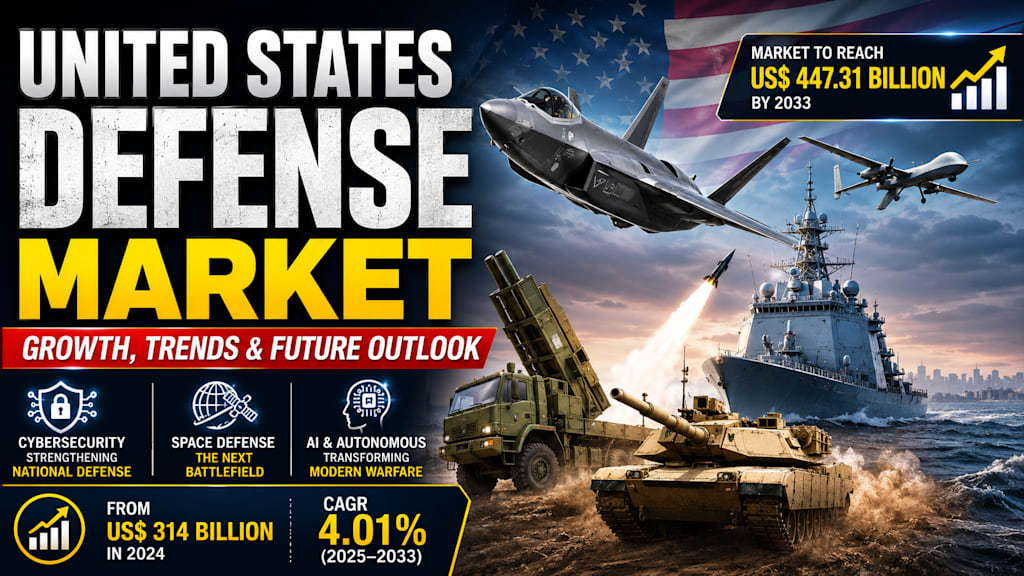
The United States defense industry is entering a transformative decade driven by geopolitical instability, rapid technological innovation, and increased government spending on national security. From artificial intelligence-enabled warfare to next-generation aircraft, missile systems, cybersecurity infrastructure, and autonomous military platforms, the U.S. defense ecosystem is evolving faster than ever before.
According to Renub Research, the United States Defense Market is projected to grow from US$ 314 billion in 2024 to US$ 447.31 billion by 2033, expanding at a CAGR of 4.01% from 2025 to 2033.
The market’s growth is being fueled by the modernization efforts of the U.S. Army, Navy, and Air Force, alongside increasing procurement contracts for advanced military systems and defense technologies.
The United States Continues to Dominate Global Defense Spending
The United States has long maintained one of the most sophisticated defense ecosystems in the world. Its military infrastructure extends far beyond traditional warfare and now includes cyber operations, satellite defense, space-based intelligence systems, and AI-driven combat technologies.
The U.S. Department of Defense continues to invest heavily in modern warfare capabilities to maintain military superiority against emerging threats from countries including China, Russia, and North Korea. Rising tensions in the South China Sea and concerns surrounding Taiwan and Indo-Pacific security have significantly increased the urgency for defense readiness.
This strategic shift is accelerating investments in:
Fifth-generation fighter aircraft
Unmanned aerial systems (UAS)
Hypersonic missile technology
Naval modernization
Space defense systems
Cybersecurity infrastructure
Artificial intelligence and autonomous combat systems
The defense sector also plays a major role in driving innovation across aerospace, robotics, advanced manufacturing, and secure communications technologies.
Cybersecurity Has Become a National Defense Priority
Modern warfare is no longer confined to land, sea, and air. Cyber warfare has emerged as one of the biggest national security threats facing the United States.
The growing integration of digital technologies within military systems has exposed critical vulnerabilities across defense networks and government infrastructure. According to the report, U.S. federal institutions experienced over 30,659 cybersecurity attacks in 2022 alone.
As a result, the U.S. government is dramatically increasing investments in:
Military-grade cybersecurity solutions
Cloud-based defense systems
Zero-trust architecture
Secure military communications
Cyber threat intelligence
Satellite protection systems
Cybersecurity contractors and defense technology companies are now central to future military planning, making this segment one of the fastest-growing areas within the defense market.
Space Defense Is Emerging as the Next Strategic Battlefield
The increasing reliance on satellites for navigation, communication, intelligence gathering, and missile tracking has transformed space into a strategic defense frontier.
The United States is investing aggressively in:
Space surveillance systems
Anti-satellite defense technologies
Missile warning satellites
Space-based communications
Orbital defense programs
The establishment and expansion of the U.S. Space Force reflects the country’s commitment to securing its dominance in space defense capabilities.
Private aerospace and defense firms are playing a critical role in building the next generation of military satellites and orbital defense infrastructure, further strengthening the market outlook.
AI and Autonomous Systems Are Revolutionizing Modern Warfare
Artificial intelligence is rapidly reshaping military operations worldwide. The U.S. defense industry is integrating AI into intelligence gathering, battlefield decision-making, predictive maintenance, drone operations, and autonomous weapons systems.
Autonomous military systems are increasingly being deployed for:
Reconnaissance missions
Border surveillance
Threat detection
Electronic warfare
Precision targeting
Logistics support
AI-powered systems can process massive amounts of battlefield data in real time, enabling faster and more accurate strategic decisions.
As defense agencies prioritize operational efficiency and reduced human risk exposure, the demand for intelligent autonomous systems is expected to surge significantly throughout the forecast period.
Aerospace and Naval Modernization Programs Fuel Procurement Growth
The U.S. Air Force and Navy continue to modernize their fleets with next-generation aircraft and naval platforms. Advanced fighter jets, stealth bombers, submarines, aircraft carriers, and missile destroyers remain critical to maintaining military superiority.
The defense market includes several major segments:
Fixed-wing aircraft
Rotorcraft
Ground vehicles
Naval vessels
Weapons and ammunition
C4ISR systems
Unmanned systems
Protection and training equipment
Military procurement programs are expected to remain strong as the U.S. replaces aging defense infrastructure with technologically advanced systems capable of addressing future combat scenarios.
Supply Chain Challenges Continue to Pressure Defense Manufacturers
Despite strong growth prospects, the defense industry faces several operational challenges.
The COVID-19 pandemic exposed major vulnerabilities across global defense supply chains, affecting manufacturing timelines, logistics networks, semiconductor availability, and component sourcing.
Defense contractors are now focusing on:
Domestic manufacturing expansion
Supply chain diversification
Resilient procurement strategies
Advanced inventory management
Secure semiconductor sourcing
Maintaining uninterrupted production for military systems has become a strategic priority for both government agencies and private defense firms.
Rising Costs Are Creating Budgetary Pressures
Although the United States maintains the world’s largest defense budget, rising operational costs remain a major concern.
Advanced technologies such as:
Artificial intelligence
Autonomous platforms
Hypersonic weapons
Space defense systems
Quantum computing
Cybersecurity frameworks
require massive research and development investments.
Additionally, maintaining legacy military infrastructure while simultaneously investing in next-generation technologies is creating significant financial pressure on defense programs.
Balancing modernization with budget efficiency will remain a critical challenge for policymakers over the coming years.
Regional Defense Hubs Are Strengthening Across the United States
Different regions of the United States continue to contribute uniquely to the country’s defense ecosystem.
Northeast United States
The Northeast region remains a critical center for:
Aerospace innovation
Cybersecurity research
Defense contracting
Government defense operations
States such as Virginia, Maryland, and New Jersey host major defense facilities and contractors closely connected to Pentagon operations.
Midwest United States
The Midwest serves as a major manufacturing and defense production hub, supported by strong industrial infrastructure and advanced manufacturing expertise.
States including Ohio, Michigan, Illinois, and Indiana contribute significantly to:
Military vehicle manufacturing
Aerospace systems
Robotics development
Autonomous systems
Defense R&D
The region’s skilled workforce and established industrial base continue to attract long-term defense investments.
Major Defense Companies Leading the Market
Several leading defense contractors continue to dominate the U.S. defense market through innovation, government contracts, and global military partnerships.
Key companies include:
Lockheed Martin
The Boeing Company
RTX Corporation
General Dynamics
Northrop Grumman
L3Harris Technologies
CACI International
Textron
These companies are heavily investing in AI, advanced weapons systems, cybersecurity platforms, and autonomous military technologies to strengthen their competitive positions.
10 Recent Developments in the United States Defense Industry
1. Lockheed Martin Expands Hypersonic Missile Programs
Lockheed Martin has accelerated development of hypersonic missile systems for the U.S. military, focusing on long-range strike capabilities and advanced missile defense technologies.
2. Boeing Advances Next-Generation Military Aircraft
The Boeing Company continues to invest in advanced fighter aircraft, autonomous combat drones, and military aviation modernization programs.
3. RTX Strengthens Missile Defense Systems
RTX Corporation has expanded its missile interception and air defense capabilities to support evolving global security requirements.
4. Northrop Grumman Enhances Space Defense Capabilities
Northrop Grumman is increasing investments in satellite systems, missile warning technologies, and space security programs.
5. General Dynamics Expands Naval Defense Projects
General Dynamics continues strengthening submarine and naval shipbuilding contracts for the U.S. Navy.
6. L3Harris Develops Advanced Communication Systems
L3Harris Technologies is expanding secure military communications and tactical intelligence systems for modern battlefield operations.
7. Textron Accelerates Autonomous Defense Systems
Textron is investing in unmanned defense technologies and autonomous military vehicles.
8. CACI International Strengthens Cybersecurity Services
CACI International continues expanding cybersecurity and digital defense solutions for federal agencies.
9. Increased Pentagon Investment in AI Warfare Technologies
The U.S. Department of Defense is significantly increasing funding for artificial intelligence applications across intelligence, surveillance, and autonomous combat systems.
10. U.S. Space Force Expands Satellite Defense Programs
The United States continues expanding military space capabilities through advanced satellite defense and orbital monitoring initiatives.
Final Thoughts
The United States defense market is entering a new era defined by technological transformation, geopolitical competition, and strategic military modernization. As global security threats evolve, the demand for advanced defense systems, cybersecurity infrastructure, autonomous technologies, and space defense capabilities will continue to rise.
While challenges related to supply chains, rising costs, and rapid technological change remain significant, the long-term outlook for the industry remains highly positive.
With sustained government investment, strong innovation pipelines, and the presence of leading global defense contractors, the United States is expected to maintain its leadership position in the global defense landscape throughout the next decade.
About the Creator
Enjoyed the story? Support the Creator.
Subscribe for free to receive all their stories in your feed.
Comments
There are no comments for this story
Be the first to respond and start the conversation.