
Ukraine’s Drones Are Pushing Russia’s Refineries Onto Chinese Equipment
The Volgograd strike hit four distillation units and a hydrotreater. The repair path that follows is faster, dirtier, and increasingly built around Chinese parts.
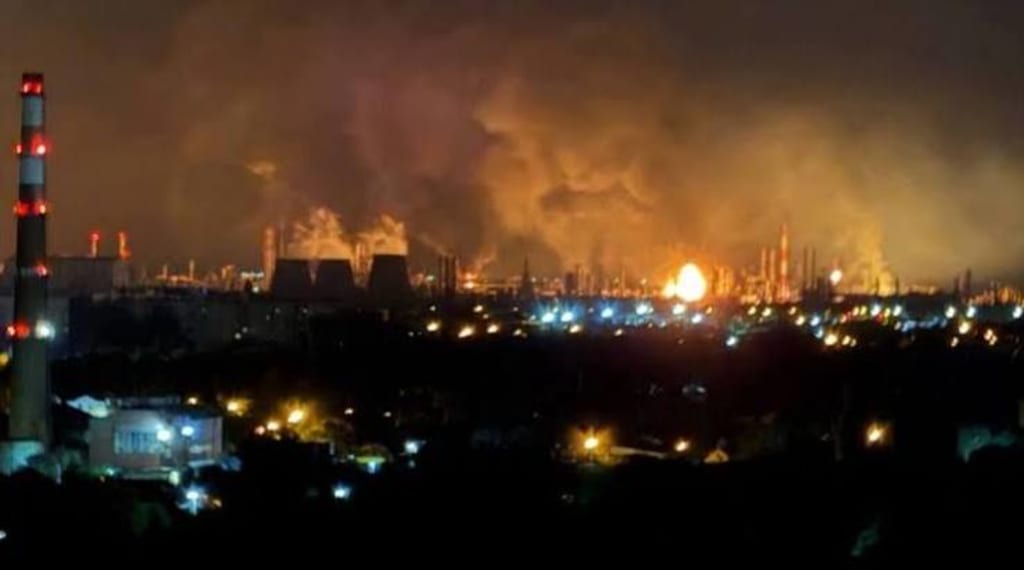
In the early hours of November 13, 2026, Ukrainian drones hit Lukoil’s Volgograd refinery. Ukraine’s target list was specific: AVT-1, AVT-3, AVT-5, and AVT-6 atmospheric-vacuum distillation units; one hydrotreating unit; one loading rack; six storage tanks of 2,000 cubic meters each.
The plant processes 14 million to 15 million tons a year, about 5 percent of Russia’s refining capacity, and supplies fuel to Russian forces on the southern front. The scale is not the main point. The target list is.
Earlier drone strikes hit storage tanks. The fires looked dramatic. Refining capacity barely moved. Tanks can be rebuilt. Crude can be rerouted. Volgograd was different. Four AVT units set the plant’s processing ceiling. The hydrotreater removes sulfur. Taking out both removes the plant’s processing limit and its desulfurization step.
The escalation matters because it met Western sanctions. Russia’s most complex secondary units, catalytic cracking, hydrofining, continuous reforming, depended on licenses and proprietary equipment from Honeywell UOP, Shell, and ExxonMobil. Sanctions cut spare parts, catalysts, and service. Bloomberg reported in October 2026 that Rosneft relied on “Russian copies and Chinese imports” to repair secondary units. Deliveries took months, and parts were “not always compatible with existing equipment.”
Ukraine’s calculation was simple. Sanctions close the Western repair path. Drones destroy the unit. With both blocked, repair becomes a dead end.
Alekperov gave a different timetable: two to three weeks.
By Western engineering logic, that is hard to believe. Structural damage to an AVT unit usually means months for assessment, procurement, transport, installation, and commissioning. Alekperov did not promise a proper repair. He promised to get the plant running.
Russia chose a downgrade. It stopped trying to restore secondary processing that depends on Western technology. It sent engineering resources to the simplest part: atmospheric-vacuum distillation. If crude can enter the towers and make basic fuel for the domestic market, the plant is back in service, even if quality falls.
The rules were relaxed to match. Russia extended fuel-standard waivers and allowed Euro-3 gasoline with sulfur up to 150 mg/kg. That is 15 times the Euro-5 limit of 10 mg/kg. Euro-2 was allowed again. The waiver did more than lower quality. It removed a technical roadblock. Repairs no longer had to center on hydrodesulfurization. They could skip the Western precision units that sanctions and drones had made unrepairable.
The supply chain behind that choice is built around general-purpose Chinese petrochemical equipment and speed, not performance.
Russian manufacturers meet about 30 to 45 percent of component demand, mostly pumps and compressors. The parts hit most often and needed fastest, distillation towers, heat exchangers, storage tanks, and pipeline valves, are exactly where Chinese suppliers have the most capacity and shortest lead times. Lanzhou LS Group shows the channel was already open. Its Russian company was set up in 2016. In February 2026 it signed a strategic cooperation agreement with Russia’s Prompak Group, citing localized service for pressure vessels and heat exchangers. When Volgograd’s AVT units stopped, a channel for replacement general-purpose equipment was already working.
The retrofit has a low compatibility threshold. Chinese towers, heat-exchange networks, valves, and fittings do not need deep integration with Honeywell or UOP control systems. They do not need to match Western process packages. They need to connect at the mechanical level. Crude needs a path. Distillation needs to restart under lower standards.
“Get it running” and relaxed fuel standards reinforce each other. Standards are lower, so repairs can skip Western precision units. If those units are skipped, general-purpose Chinese equipment can fill the sanction gap.
Once that cycle starts, it locks in. Refineries under repeated attack learn to restore basic distillation first. Spare-parts inventories follow Chinese specifications and delivery cycles. Maintenance procedures follow Chinese installation parameters. Switching back to the old technical route gets more expensive over time. Lanzhou LS and its Russian partners are turning an emergency supply relationship into a localized service arrangement.
Volgograd’s fires will go out. The damaged AVT units will probably restart in some lower-capability form within weeks. Each cycle pushes Russia’s refining system deeper into Chinese equipment manufacturing. Ukrainian drones tear apart Russian refining capacity at the physical level. Sanctions and emergency repairs change the structure: who supplies the parts, how repairs are scheduled, and what standards the plant can meet. A system built around Western technical standards is being connected, line by line, to China’s equipment track.
About the Creator
Jin
Writer of reamstories
https://reamstories.com/jin
Enjoyed the story? Support the Creator.
Subscribe for free to receive all their stories in your feed. You could also become a paid subscriber, letting them know you appreciate their work.
Comments
There are no comments for this story
Be the first to respond and start the conversation.