
U.K. Discovers Component in Naval Drones Sent Signals to China
A cybersecurity discovery involving British naval drones has exposed the growing risks hidden inside modern military supply chains.
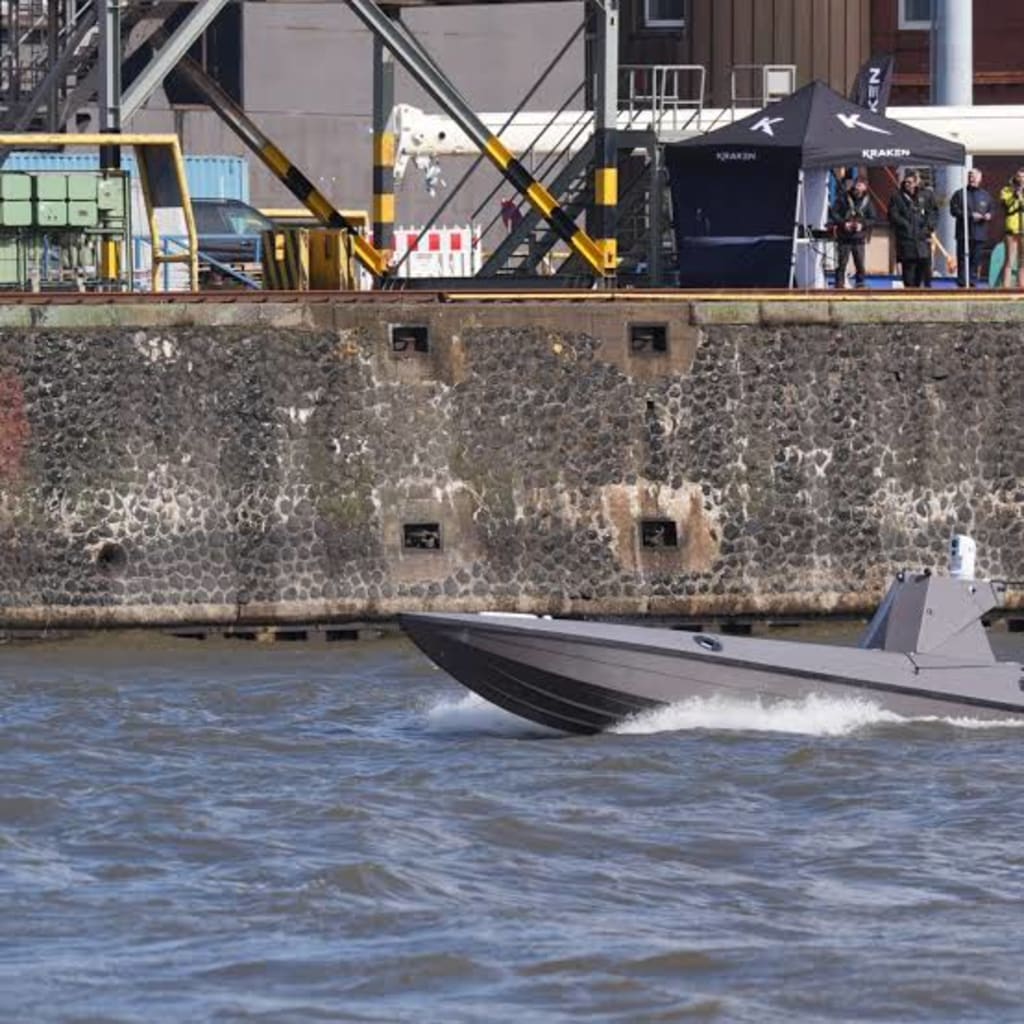
The United Kingdom has uncovered a potentially serious cybersecurity vulnerability involving one of its naval drone systems after officials discovered that a component inside a drone camera had been communicating with an internet address in China. The discovery has renewed concerns about the security of military supply chains and the difficulty of identifying every component used in increasingly sophisticated unmanned systems.
According to British officials, the issue was discovered during a routine cyber vulnerability assessment. Importantly, the U.K. Ministry of Defence said investigators found no evidence that sensitive government information or defence systems had been accessed, compromised, or transmitted externally. Nevertheless, the incident demonstrates how even a relatively small electronic component can create security questions inside a military platform.
What Happened Inside the Naval Drone?
The component was associated with cameras installed on a K3 Scout unmanned surface vessel produced by Kraken Technology, a British company based in Fareham, England. The K3 Scout is part of a growing class of autonomous and remotely operated maritime systems designed to perform missions without placing human crews directly aboard the vessel.
The discovery did not mean that the entire drone was secretly controlled by China or that classified British information had been stolen. The British government specifically stated that its investigation found no evidence of sensitive MOD data being compromised.
However, the fact that a component communicated with an address in China was enough to trigger concerns about how military equipment is sourced, assembled, tested, and monitored.
Kraken Technology said potential vulnerabilities had been identified and closed. The company has also attracted international attention, including a reported $49 million U.S. military contract for its drone technology.
Why a Small Component Can Become a Big Security Issue
Modern military drones are not made entirely from components manufactured by one company or one country. They can contain thousands of individual parts, including cameras, processors, motors, batteries, antennas, communication equipment, navigation systems, and software.
The challenge is that tracing the origin of every component can be extremely difficult.
A military manufacturer may purchase a sophisticated camera from one supplier, while that supplier obtains chips, sensors, circuit boards, or other parts from several additional companies. This creates a complicated chain of dependencies.
Security specialists have warned that understanding where a final product was assembled is not enough. Governments increasingly need to know where its critical components originated and what software or communication capabilities they contain.
That problem becomes particularly important when the equipment is designed for military surveillance or autonomous operations.
China's Dominance of Drone Components
The discovery also highlights the wider dependence of the global drone industry on Chinese manufacturing.
China has become a major producer of drone components, including cameras, motors, batteries, antennas, and other electronic equipment. These components are often significantly cheaper and easier to obtain than comparable products manufactured in Western countries.
For civilian drone companies, this can be an economic advantage.
For defence organizations, however, the calculation is different.
A component that is inexpensive and readily available may introduce supply-chain or cybersecurity concerns that are difficult to identify before equipment enters military service.
The challenge has become particularly visible as drones have moved from experimental technology to an important part of modern warfare.
Naval Drones Are Becoming More Important
Unmanned surface vessels are attracting increasing attention because they can perform dangerous missions without risking sailors.
Recent conflicts have demonstrated how relatively inexpensive drones can threaten much larger and more expensive military assets. Ukraine, in particular, has used maritime drones extensively against Russian naval targets and other vessels.
The technology is now evolving rapidly. Naval drones can potentially be used for surveillance, reconnaissance, mine detection, electronic warfare, logistics, and combat missions.
As their importance grows, cybersecurity becomes just as important as physical performance.
A drone does not necessarily need to be physically captured to become a security problem. A vulnerable communications system, compromised software package, or poorly secured component could potentially create opportunities for unauthorized access.
That does not mean every foreign-made component represents a security threat. Instead, it demonstrates why defence organizations need rigorous testing and continuous monitoring.
The Supply-Chain Problem
The British discovery is part of a much larger Western concern about dependence on foreign technology.
Governments in the United States and Europe have spent years attempting to reduce reliance on Chinese components in sensitive technologies. Yet completely removing those components can be difficult because Chinese manufacturers dominate several areas of the global electronics and drone supply chain.
Replacing them can also be expensive.
Industry experts have noted that European alternatives can cost several times more than comparable Chinese products. For military organizations trying to expand drone fleets quickly, cost and availability can therefore compete directly with security considerations.
This creates a difficult policy question: Should governments prioritize the cheapest available technology, or should they pay substantially more for components whose origins and security characteristics can be more easily verified?
A Warning for Future Military Technology
The incident involving the British naval drone does not prove that China deliberately inserted a surveillance mechanism into the system. That distinction is important.
The available information indicates that officials discovered unexpected communications from a component and investigated the issue. The British Ministry of Defence has said there was no evidence that its sensitive data or systems were compromised.
Nevertheless, the episode provides a valuable warning.
As military forces increasingly depend on autonomous vehicles, artificial intelligence, cloud-connected systems, and networked sensors, cybersecurity must begin at the component level.
Future defence procurement will likely focus not only on whether a drone can fly, sail, navigate, or identify targets, but also on whether every electronic component inside it can be trusted.
The battlefield of the future may depend on machines, but those machines will depend on thousands of tiny electronic parts.
The British discovery shows that sometimes the greatest security risk may not be the drone itself.
It may be something hidden inside it.
About the Creator
Enjoyed the story? Support the Creator.
Subscribe for free to receive all their stories in your feed.
Comments
There are no comments for this story
Be the first to respond and start the conversation.