
Trump’s Taiwan Card Has a Silicon Logo
The midterms, TSMC’s Arizona fabs, and the closing window for a chip-for-Taiwan deal
I. A signal that is easy to miss
With the US midterms approaching, Trump made a remark that many people treated as ordinary political noise. It deserves a closer look.
He said that if the United States had had smart presidents over the years, the problem between the mainland and Taiwan would not exist. Nobody cares about the Taiwan issue.
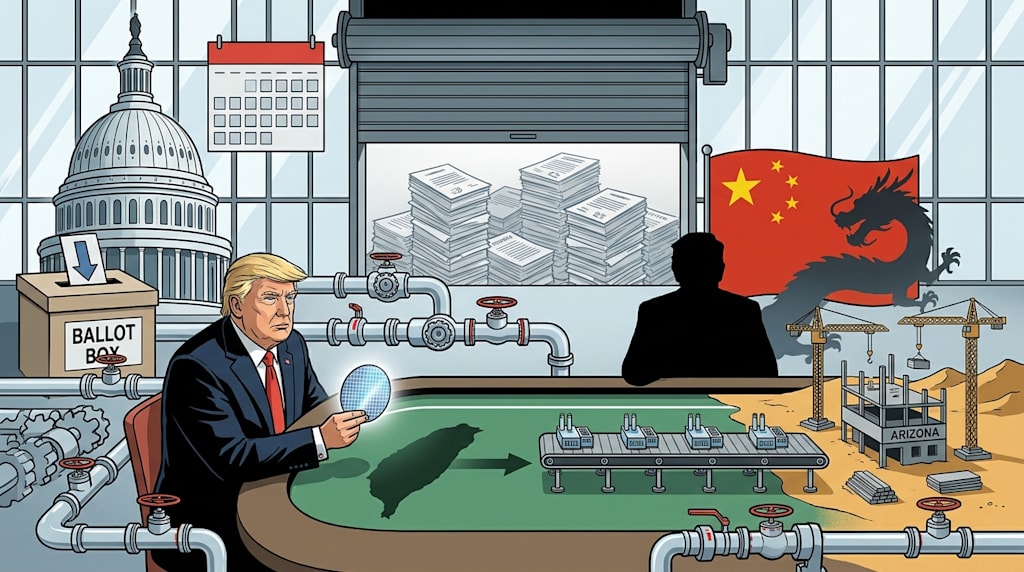
On the surface, this is blame-shifting onto Clinton, George W. Bush, Obama, and Biden. You were too stupid, and you turned Taiwan into a geopolitical powder keg. The deeper move is to pre-lay a transaction: Trump is redefining Taiwan from a democratic-values alliance into a supply-chain security issue. He is telling Beijing that he does not care about Taiwan’s democratic system or the first island chain. He cares about TSMC’s fabs. If advanced-process capacity can be moved to the United States, Taiwan stops mattering to him.
The signal matters, but its occasion and audience matter more. Before the midterms, the first audience is domestic voters: I am making deals with China, not preparing for war. The second is the Democrats and the deep state: I will not play the geopolitical card you want to play; I want industrial reshoring. China is the third audience. A signal released for an election can change face after the election. Sichuan opera has a famous act for that.
II. Chips act as a chokepoint
A popular claim says US financial hegemony has moved through three anchors: the gold dollar, the oil dollar, and the chip dollar. The frame has insight, but it needs correction.
The oil dollar rests on the coerciveness of settlement. OPEC accepts dollars for oil, global oil trade is priced in dollars, and countries hold dollar reserves because they have little choice. The chip dollar does not work that way. Chips are not a commodity that must be priced in dollars; global chip trade settles in dollars, euros, and yen. The chip effect sits at another level. The technology stack behind global high-end manufacturing depends on the United States: EDA tools, semiconductor equipment, IP cores, and access to advanced processes. Those chokepoints sit with the United States and its allies. Financial returns from that stack flow back into the US Treasury market and support it indirectly.
So Trump does not want an abstract chip-dollar hegemony. He wants TSMC’s advanced-process capacity physically moved to Arizona. That is industrial policy. Monetary hegemony is a different layer. The two are related, but they are not the same thing. Calling chips the third anchor turns an industrial fight into a financial one and blurs what Trump is trading for: factories, engineers, and process documents, not an exchange-rate mechanism.
III. The midterms: the legislative window matters more than the lame-duck label
Since the 1990s, the president’s party has almost always lost the House in midterms. Clinton lost it in 1994, George W. Bush in 2006, Obama in 2010 and 2014, and Trump in 2018. Losing the Senate is not automatic. The baseline is a lost House, not a lost Congress.
The key question is whether a lost House lets Congress weld shut Trump’s room to trade. Tariffs and export controls mostly run through the executive branch: IEEPA, the Export Control Reform Act, and executive provisions in the National Defense Authorization Act. The president keeps discretion there. Even with a lost House, Trump can keep raising tariffs and tightening export controls. Industrial subsidies, foreign aid, and arms-sale approvals must pass Congress. Trump can keep fighting. He cannot keep buying. A deal with China needs buying power: subsidies for TSMC relocation, market access for Chinese concessions elsewhere.
The bigger risk is a Democratic Senate and a Democratic House. China-hawk legislation would speed up. The Taiwan Policy Act, CHIPS Act 2.0, and stronger outbound investment screening would compress executive discretion. Trump would lose even the room to show a card. The midterm question is whether Congress’s China agenda closes the trading window before Trump does.
IV. The “destroy it” option and the mainland’s two tracks
Trump wants Taiwan’s wafer system. If it cannot be moved, Washington may prefer to destroy it rather than leave a complete chip supply chain to the mainland.
The direction is right, but the method is not bombing fabs. It is pulling out talent and IP. TSMC’s Arizona fab is already moving engineers and families, N5 and N3 process documents, and supplier capacity from Applied Materials and ASML. If that accelerates under Trump, Taiwan keeps mature-process and packaging-and-testing capacity. The marginal value to the mainland falls sharply, but it does not hit zero. Mature-process scale still matters for automotive chips, industrial chips, and power-management chips.
The mainland is already running two tracks. The first is SMIC’s mature-process expansion plus Huawei’s domestic equipment-chain substitution. That is the floor plan for surviving without Taiwan. The second is willingness to put TSMC’s advanced processes on the table inside a unification timetable. The speed comparison between those two tracks is the variable that decides the Taiwan issue. If US relocation reaches the critical point first, Washington keeps more leverage. If mainland self-sufficiency gets there first, Beijing does.
V. What cannot be negotiated is what decides
Analysts like to find answers in leaders’ statements, summits, and elections. The international situation is the backdrop. It is the image, the effect, and the final evolution after decisions are made. It is not the cause.
Trump’s remarks, the midterms, Shenzhen APEC, and Taiwan Strait patrols are surface waves. The deeper curves are mainland semiconductor self-sufficiency and US industrial reshoring. The other contest is between Congress’s legislative window and the president’s executive discretion. Whichever locks the other first sets the terms.
Trump is the last businessman-president who could drop the geopolitical card and still make a deal. Presidents after him will not be incapable of deals. The space for deals will be welded shut by legislation. The window is not “after Trump.” It is “before the 2026–2028 congressional window closes.” The midterms are the first signpost.
The answer will not arrive in a Trump tweet, a vote-counting board, or a summit photo. It will show up in TSMC’s Arizona construction schedule and SMIC’s capacity-ramp tables. What cannot be negotiated, the part buried in industrial data, legislative text, and yield curves, is what decides.
About the Creator
Jin
Writer of reamstories
https://reamstories.com/jin
Enjoyed the story? Support the Creator.
Subscribe for free to receive all their stories in your feed. You could also become a paid subscriber, letting them know you appreciate their work.
Comments
There are no comments for this story
Be the first to respond and start the conversation.