
Trump’s $400 Million Midterm Bet Is Running Into $6.50 Diesel
The checks are clearing. The voters are not.
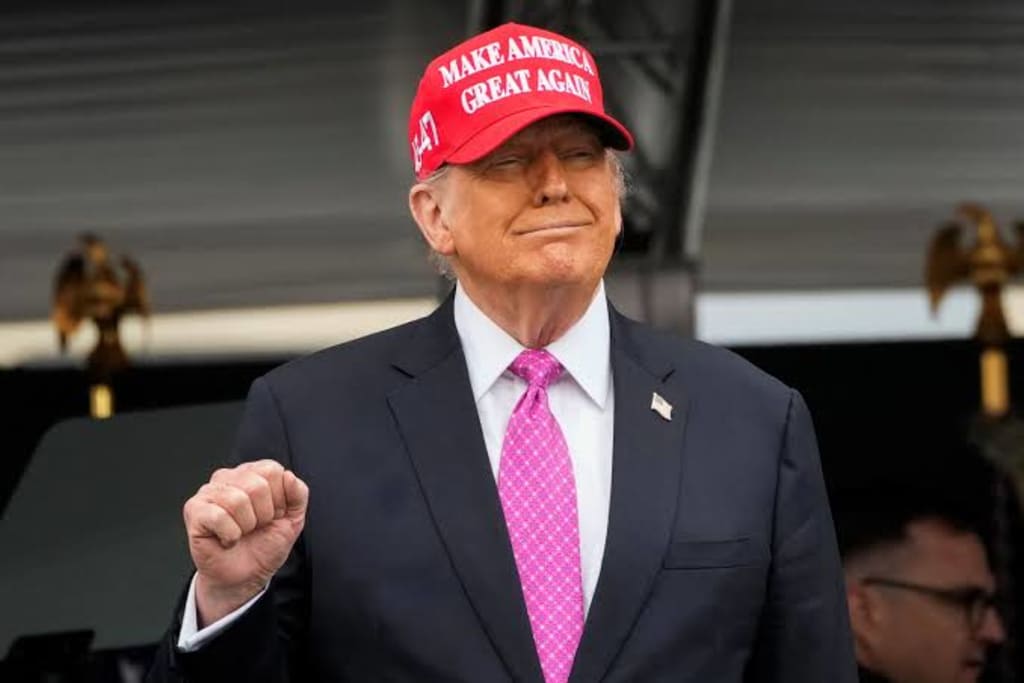
President Trump said on Truth Social that his political operation has spent more than $300 million on the midterms and will push past $400 million by Election Day. The money most likely flows through MAGA Inc., his super PAC. It lands alongside roughly $80 million from Michael Bloomberg on the Democratic side and $50 million in Republican National Committee transfers to party groups. Republican networks enter the final two weeks with a cash edge that Democratic networks cannot match dollar for dollar.
On the same day, Reuters/Ipsos reported that 31 percent of Americans approve of Trump’s job performance. That is a career low. Democrats lead the generic congressional ballot 47 percent to 35 percent, a 12 point margin and the widest of the cycle. Sixty-eight percent disapprove of his handling of the economy, including 37 percent of self-identified Republicans. One number describes what the President is spending. The other describes what he is spending it against.
A party that started retreating before the fight began
The retirement numbers arrived before the money did. Fifty-six House members announced they would not seek reelection in the 119th Congress, the highest total in over three decades. Thirty-five of them, 63 percent, are Republicans. That is roughly 16 percent of the 217 member Republican conference stepping down, including 18 subcommittee chairs and three committee chairs. The average tenure of the retiring Republicans has dropped to five terms. More than half are leaving Congress to run for state or local office rather than pursue a Senate seat.
An open seat is not the same as a defended seat. An incumbent brings a constituent file, a donor network, and a name that appears on mailers without explanation. An open seat is a blank square that both parties must fill from scratch. In a national environment defined by a 31 percent president and $6.50 diesel, the blank square is where the environment enters most directly. The 2018 cycle, when Republicans set the previous retirement record, ended with a Democratic net gain of 40 House seats. The 2026 Republican conference has now exceeded that 2018 mark in raw departures. It did so before a single general election dollar was spent.
The diesel in the tank
The clearest way to understand the Republican position is not a poll cross-tab. It is a fuel receipt.
Diesel in the United States costs about $6.50 per gallon, down a few cents from the September record but roughly 70 percent higher than in February. The easy explanation is the war with Iran and the disruption of the Strait of Hormuz. The mechanics are more stubborn. Crude was trading near $95 per barrel at the time of J.P. Morgan’s October analysis. That price is not high enough, on its own, to justify $6.50 diesel. The binding constraint is refining. Global refinery throughput was running near 78 million barrels per day in the second quarter, roughly 6 million barrels below the seasonal median and almost 8 million below the prior year. Russian refinery runs had fallen 34 percent year over year. Middle Eastern throughput was down 23 percent. Crack spreads, the gap between crude and refined product, sat near all-time highs.
This matters for politics because the price at the pump is not a lever the White House can pull in fourteen days. Reopening the Strait of Hormuz, even if it happened tomorrow, would not restore refining capacity that has been physically damaged in Ukraine, Russia, and the Persian Gulf. When Trump announced $8 billion in farm relief for diesel-stressed agricultural states in Kansas, the money was tied to USDA discretionary funds that may require a new congressional appropriation. It may not reach farmers before November 3. The policy response exists. Its timeline does not intersect with the election.
A president’s party has lost seats in 37 of the past 41 midterms, with an average net House loss of 31 seats over the past five elections. A 31 percent approval rating does not guarantee a wave. It removes the buffer that a 45 percent president might use to localize races. When the price of filling a pickup truck has risen 70 percent since February, the election is no longer about the Republican candidate in the district. It is about the truck.
The Senate map is eroding, not collapsing
The House picture is close to settled in the forecasting consensus. Cook Political Report founder Charlie Cook called Democratic control a “done deal” in late September. By mid-October, Cook’s race ratings had Democrats favored in 208 districts to Republicans’ 205. Democrats need a net gain of three seats, and projections cluster around a five to fifteen seat Democratic gain. The Senate is where the language needs to be more precise.
Democrats need 51 seats because Vice President Vance breaks a 50-50 tie. That means flipping four Republican-held seats. The competitive set runs through territory Trump won by double digits. The most recent NBC News battleground polling shows the shape of it. James Talarico leads Ken Paxton 51 to 49 in Texas. Ashley Hinson leads Josh Turek 48 to 45 in Iowa. Jon Husted leads Sherrod Brown 50.2 to 49.8 in Ohio. Troy Jackson leads Susan Collins 49 to 47 in Maine. Decision Desk HQ calls Ohio a 50-50 toss-up and rates Iowa the Democrats’ hardest lift, with Hinson holding a 52 percent win probability to Turek’s 48 percent.
A four-seat sweep across that map is not the base case. The defensive geometry matters more than the dollar total. When a party is spending late money in Texas, Iowa, Ohio, and Maine, and when Cook is shifting South Carolina from “Likely Republican” to “Lean Republican” and Mississippi from “Solid Republican” to “Likely Republican,” the map has stopped offering a safe rear. Every dollar spent defending a state that voted for Trump by double digits is a dollar not spent expanding the map elsewhere. The $400 million does not change that arithmetic. It is consumed by it.
What the money buys, and what it does not
Trump’s Iran war is costing taxpayers more than $1 billion a day, according to Pentagon figures relayed to lawmakers. The first six days of the conflict alone ran above $11.3 billion. The federal government was in a partial shutdown over immigration enforcement funding when Trump announced the $400 million campaign push. A president who can direct $400 million to a super PAC while the government is partly closed and a war is burning $1 billion a day is demonstrating command of the political apparatus. He is not demonstrating that the apparatus can reach the price of diesel.
Charlie Cook’s phrase for what is happening is “red undertow.” A wave, Cook argued, would be uniform and directionally consistent. An undertow pulls Republicans under in some places more than others. It does so without requiring voters to accept the Democratic brand, which remains underwater itself. That distinction marks the limit of the $400 million. The money can narrow a margin in a district where the Republican candidate is running ahead of the president. It cannot change the direction of the current that the president himself is generating.
Fourteen days before the vote, the Republican Party holds the financial advantage, the retirement disadvantage, the fuel price disadvantage, and a Senate map that requires defending states it once considered safe. The most likely single outcome, according to the models, is not that Republicans hold one chamber. It is that Democrats take both. The $400 million may shave a point or two from a handful of races. It will not change what a voter sees when the pump clicks off at $6.50. It will not change what 35 Republican members of Congress concluded when they decided, months before the money arrived, that the fight was not worth staying for.
The truck pulls away from the station. The number on the receipt is the number that matters.
About the Creator
Jin
Writer of reamstories
https://reamstories.com/jin
Enjoyed the story? Support the Creator.
Subscribe for free to receive all their stories in your feed. You could also become a paid subscriber, letting them know you appreciate their work.
Comments
There are no comments for this story
Be the first to respond and start the conversation.