
Trump Stopped Posting. The Market Fell Apart.
Why his silence after the midterms was scarier than any tweetstorm, and why the bounce won't last.
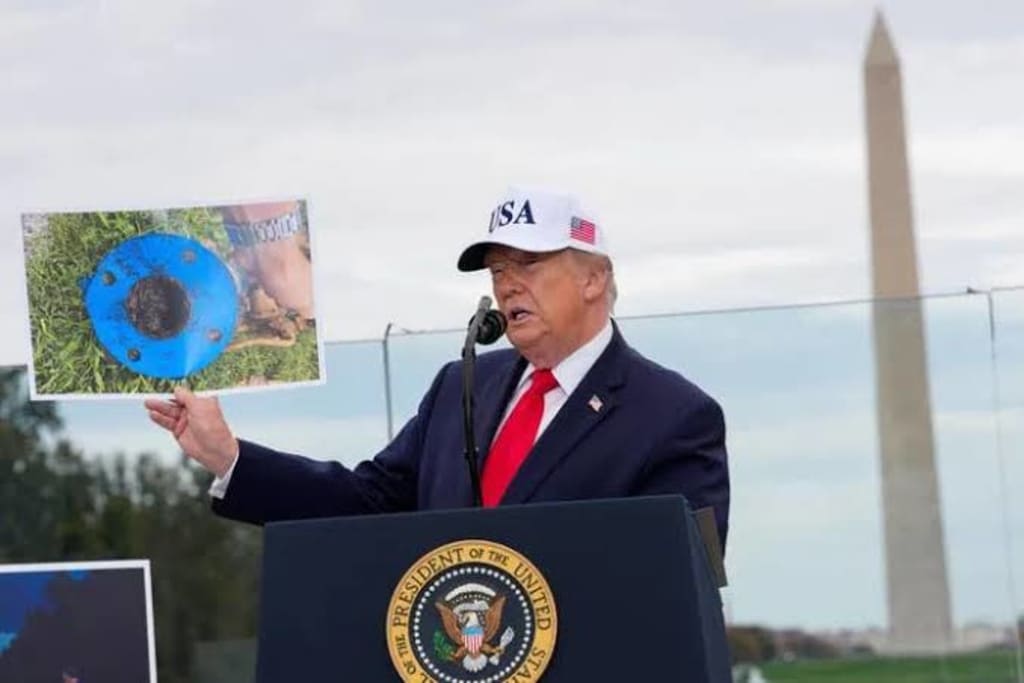
For two days I've made the same point: when the market loses the "Trump factor," the big directional trade loses its anchor. Trump alone supplied a kind of certainty across assets. He spoke, the market had a direction. He called a trade, money had a reason. He created conflict, safe assets got a premium. He offered de-escalation, risk assets bounced. A large part of the tape wasn't trading economic data. It was trading his next post.
After the midterms, that changed. In the 24 hours after the election, Trump posted three times. Before that, he could fire off dozens in an hour. Democrats filled the vacuum with emotion: investigate Musk, ban AI. The impression is that Trump is waiting, letting the market prove him right, letting voters see what Democratic policies do to the economy.
That frame is useful. It is not fact. Trump's silence may be strategy or political weakness, or a pause while the Republican Party regroups. The problem isn't the silence. The market lost its single narrative anchor and had to price four things at once: a correction to AI capex expectations, a loosening of crowded tech positioning, rising policy uncertainty around U.S. data-center construction, and Middle East war risk pushing energy prices higher.
The tape showed the combination clearly: equities down, crude up, gold and the dollar relatively stable. That is not simple risk-off. Large investors were moving away from a single-growth-story emotional trade and back toward a combined pricing of inflation, geopolitics and liquidity risk.
On November 4, Democrats won a major victory in the U.S. midterms. The market read it as lower political uncertainty and bought risk. One trading day later, on November 5, the Dow fell 3.4%, the S&P 500 fell 4.4%, and the Nasdaq dropped 5.5%. The Philadelphia Semiconductor Index fell about 12%, its worst single-day move since March 2020. The Nasdaq closed 11.9% below its October 6 high, entering technical correction.
Part of that was institutional profit-taking. Part was the market re-examining the link between AI returns, data-center buildout speed and energy costs. The market found something simple: lower political risk does not mean lower industrial-policy risk. Lower oil prices do not mean the geopolitical conflict is over.
The market moved from trading the political result to trading what that result does to corporate earnings and the cost of capital. A split between the White House and Congress does not raise U.S. economic efficiency. It adds conflict, adds friction, adds cost.
A wording point first: "Trump lost the midterms" is imprecise. The correct description is that Republicans lost the midterms and Democrats won a major victory or control of Congress. Trump himself was not on the ballot. The White House is still occupied by Trump. Executive power did not change hands. What changed is the policy constraint on Congress and local governance for the next two years. The market will not flip from a "Trump bull market" to a "Democratic bull market" under a highly concentrated narrative. It will recalculate how much of Trump's policy dividend can still be delivered, and how much friction will be added to costs.
A new gap can open between U.S. growth expectations and equity valuations. The structural bid in U.S. equities can still prove Buffett right. But the room to adjust Trump's original policy package is nearly gone in the near term. Watch the Israeli election result and the next wave of economic data for new shocks.
1. The election changed the discount rate on AI investment, not the occupant of the White House
Democrats winning the Senate and House means Trump's legislative and budget agenda for the next two years will face checks. But the new Congress does not take office until January 2027. It will not overturn existing policy immediately. Trump still holds executive power. Tariffs, energy, diplomacy and industrial-policy tools did not disappear. "Trump trades" will not end overnight. They will wait until he decides they are useful. The Republican Party still needs internal political adjustment.
The surface cause of the selloff was also directed precisely at newly elected Democrats. The newly elected Texas governor, Inohosa, promised to pause data-center approvals until the state legislature writes rules on power prices, water use and community protection. That kind of uncertainty over timing and cost hits the U.S. AI buildout directly. But a fast clearing of froth and more rational development is good for AI over the long run. It reduces the social and household impact.
The Democratic push for a "ban on artificial superintelligence" goes further. It would ban any individual or institution from developing and deploying artificial superintelligence, putting ASI on the same footing as nuclear weapons. From a regulatory standpoint, that is defensible. From a capital-expenditure standpoint, it welds shut the next direction of spending.
The layers matter. A bill, a party statement, a governor's commitment and a formal regulation are not the same thing. If the Texas data-center approval pause is only a political commitment, the effect on capex is an uncertainty premium, not an immediate cutoff. If the ASI ban is only a bill, the market is trading expectations, not implementation. The classic mistake in a selloff is treating a bill as policy or a promise as execution.
But the market does not wait for final text. The main support for U.S. equities this year has been AI capex, data centers, power equipment and chip orders. Valuations had priced a continuously expanding growth curve. When projects are delayed or returns fall, the valuation has to be recalculated. One day the market trades "congressional checks improve risk appetite"; the next it trades "policy may jam AI development." Both can be true.
2. The SOX crash: earnings triggered a concentrated stampede
Qualcomm's earnings were one trigger. Its handset business revenue fell 26% year on year to $5.14 billion. Memory-chip costs rose and phone demand was weak, squeezing the traditional business. Its data-center chips are expanding, but not enough to offset the handset pressure. Qualcomm fell about 9.5%, Nvidia about 9.3%, AMD about 17.3%. Selling spread to data-center operators and power-equipment makers.
In the process, Elon Musk lost $91.2 billion of net worth in a day, down 10.50%; Michael Dell lost $20.5 billion, down 9.60%; Jensen Huang lost $15.1 billion, down 8.70%; Larry Ellison lost $13.2 billion, down 8.05%; Mark Zuckerberg lost $12.9 billion, down 5.98%.
A 12% one-day drop in the SOX does not mean AI demand vanished. The market is asking how much sustainable cash flow can come from huge GPU, server, data-center and power investments. Policy risk and earnings doubt stacked together. Institutions cut risk, quant strategies followed with de-risking, and the feedback loop ran: price falls, volatility rises, risk budgets shrink, more selling. U.S. equity volume reached 26.9 billion shares. That is concentrated deleveraging. The first stage of that deleveraging usually produces a bounce during the refill phase, but it rarely lasts more than seven days.
One correction: the "2-to-7 trading day emotional-hedging window" is not a statistical law. It is not seven straight days of gains. It is a window for digesting election information and rebalancing positions. The reverse crash on November 5 shows the window can swing violently in both directions. Use the rule of thumb, but do not treat it as a guarantee.
3. Oil rebounds, gold holds: the geopolitical risk is not gone
Brent crude fell more than 8% on November 4, then rebounded 3.88% to $98.29 a barrel on November 5. WTI rose 2.72% to $90.52. Better demand didn't drive it. Unresolved Gulf shipping risk did. The UK maritime agency said at least five vessels had reported incidents since Sunday, all from mines or Iranian attacks. That put October-related shipping incidents at 35, with nearly 10 already in the first days of November. Under the current political setup, there is no verifiable ceasefire or stable shipping arrangement between the U.S. and Iran. Part of the geopolitical premium squeezed out the day before was put back.
Gold rose about 1% and held near $4,100. Silver was roughly flat. The 10-year Treasury yield fell from 4.90% to 4.84%, reflecting safe-haven buying and growth concerns pushing down long-end yields. The market still priced a high probability of a Fed hike in December, around 65% to 70% in futures, down from above 80% the day before. Nonfarm payrolls are still ahead. Verify that probability against the latest futures pricing before publication.
Safe-haven flows pushing down long-term yields and a still-hawkish policy-rate expectation are different variables. The two can hold at once. The key point: in the early stage of an equity crash, gold has rebound profits, and cash-flow settlement risk needs watching. In my earlier piece, "Has the market reversed?", I made the same point: the post-election spike and plunge in oil, gold, silver and BTC was mainly risk-premium and crowded-position cross-asset reallocation, not a sudden turn in global liquidity. Lower oil does not mean the war is over. Higher gold does not mean the Fed turned dovish.
4. This is not the end of the U.S. bull market, but the market needs a signal
The Nasdaq is in technical correction, but the S&P 500 and Nasdaq are still positive year to date. The risk-reward of high-valuation AI names has changed. In the near term, the market is waiting for three things: Trump to speak, Democrats to explain, and economic data plus Iran to clarify.
Does Trump want to use the stock market to win back public support? Do data-center approvals, power prices and grid connections become real policy constraints? Do cloud providers cut capex guidance? Can AI revenue and cash flow cover investment? Do oil, nonfarm payrolls and inflation push rate-hike expectations back up?
If the October nonfarm payrolls report is strong, it could reinforce a tighter-rate expectation. If it is weak, it adds growth worry. With equities selling off, the Fed will likely be more cautious in its hiking language. Do not treat a hike as the default path. Watch nonfarm payrolls, CPI and oil.
"Wait for Trump to call the market" as a stabilization signal has an internal tension. It puts certainty back on one person, which is consistent with the title's logic, but the risk is that Trump's silence may be strategy or political passivity. A call may rescue the market, or it may add policy uncertainty. Treat it as an event signal, not a fundamental signal.
The 2-to-7 trading day event-pulse window is not seven straight days of gains. It is a window for digesting election information and rebalancing positions. The reverse crash on November 5 shows the window can swing both ways. In the Korean secondary market, yesterday's report repeatedly stressed stability, support and supervision, not the retail reading of "lift, rally, new high." Expect resilience, but watch the DNA.
"East rising, West falling" also needs moderation. Finance is a whole-system fight. No market can stand apart from the world without controlling global liquidity pricing and without a clear institutional tilt toward rising prices. I also wrote yesterday that volume stagnation at high levels is either accumulation or distribution. What does the current level look like? That question is for each person watching the tape.
5. A verification checklist: do not mistake rhetoric for conclusion
The part worth saving and checking: five observation points, not the headline.
First, the official midterm results and actual control of Congress, not emotional judgments on social media.
Second, Trump's and the White House's subsequent executive actions, not the number of posts. Post count is a sentiment indicator. Executive action is the policy variable.
Third, whether data-center approvals, power prices and grid connections become formal regulations. There is a large trading space between a political promise and a formal rule.
Fourth, cloud-provider capex guidance and AI revenue and cash-flow coverage. The AI narrative depends on capital returns. Concepts aren't enough.
Fifth, nonfarm payrolls, CPI, oil, Gulf shipping incidents and Fed pricing. Safe-haven flows and policy-rate expectations are different trades. Do not mix them.
Conclusion: Trump was defeated, not removed
Trump was defeated in the midterms, not removed from office. Executive power remains. Policy tools remain. Tariffs, energy, diplomacy and industrial policy did not disappear. But he did lose part of the legislative and budget tailwind, and the market will discount the probability of delivery.
The risk is four misreadings: silence as a bullish signal, a bounce as a reversal, a bill as implementation, a rule of thumb as a law. Trump's silence isn't the problem.
The market is moving from trading political outcomes to trading what policy does to corporate earnings and discount rates. That framework holds up better than "East rising, West falling," and better than "wait for Trump to call the tape." Watch position size. The first wave of systemic-risk shock has started. All optimism right now is built on an expectation that fundamentals have not changed. U.S. equities face nonfarm payrolls tonight. Every judgment has to pass through the data.
Save this piece. Let the market write the answer, then come back and check it.
About the Creator
Jin
Writer of reamstories
https://reamstories.com/jin
Enjoyed the story? Support the Creator.
Subscribe for free to receive all their stories in your feed. You could also become a paid subscriber, letting them know you appreciate their work.
Comments
There are no comments for this story
Be the first to respond and start the conversation.