
Trump Says He Doesn’t Need the Army for Cuba. The Blockade Is Already There.
On the same day he promised a deal, Cuba’s foreign minister called the U.S. blockade a “collective punishment.” Here’s what that looks like when the lights go out.
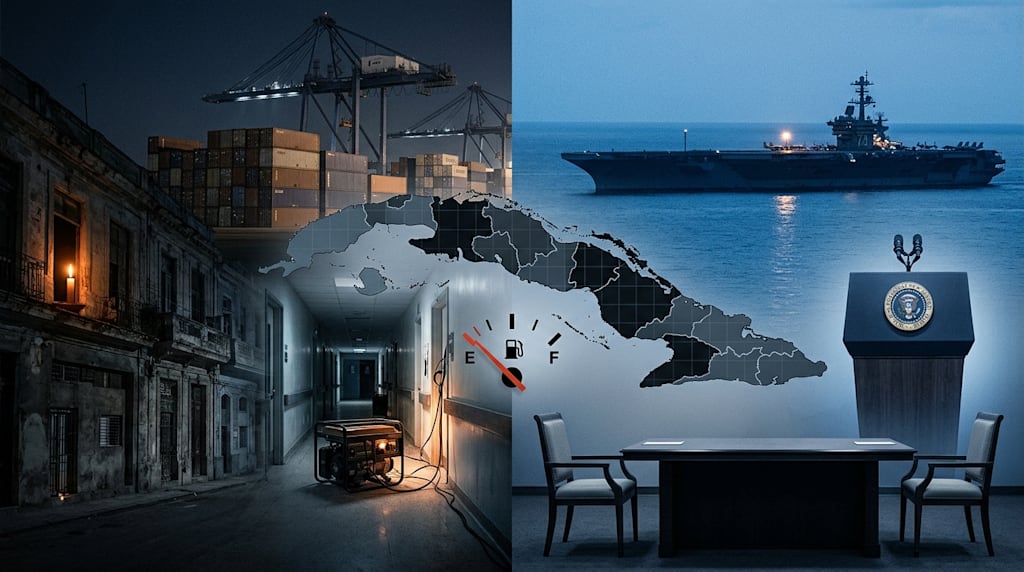
NO ARMY, STILL THE BLOCKADE
On the same day, Trump promised a deal and Cuba’s foreign minister described a collective punishment. The gap between those two sentences is the story.
On September 26, 2026, President Donald Trump stopped on the South Lawn before boarding a helicopter for Tennessee. A reporter asked about Cuba. Trump said he believed the United States and Cuba would reach an agreement. “We don’t need the military,” he said. He added that he wanted to help Cuba, that he wanted to open the country, because Cuban Americans wanted to return. Then he walked to the helicopter.
At the same hour, in New York, Cuba’s foreign minister, Bruno Rodríguez Parrilla, stood at the lectern of the U.N. General Assembly’s eighty-first session. He did not talk about a deal. He talked about more than 7,000 shipping containers stuck in ports. Many held food, medicine, and medical equipment. He called the U.S. blockade a collective punishment. Its purpose, he said, was to create a humanitarian crisis in Cuba. Cuba, he said, does not threaten the United States. The blockade is the threat.
The two statements are not contradictory. They are the two halves of a single policy: pressure without invasion, siege without soldiers. Trump’s “no army” is not a concession. It describes the current method. That method has a history and an architecture. Its body count is measured in darkened hospitals and stopped water pumps.
The January Order
On January 29, 2026, Trump signed an executive order declaring a national emergency. It cited the International Emergency Economic Powers Act. It authorized tariffs on any country that directly or indirectly supplied oil to the Cuban government. The order called Cuba’s policies an “unusual and extraordinary threat” to U.S. national security and foreign policy. Within four months, according to shipping data cited in press reports, only one fuel tanker reached Cuba. On January 11, Trump had already posted: “No more oil or money will go to Cuba.”
The order did not arrive in a vacuum. Venezuela had been Cuba’s main oil supplier since the early 2000s, sending about 27,000 barrels a day. That covered roughly half of Cuba’s oil gap. After the U.S. military operation that removed Nicolás Maduro, the shipments stopped. The Caribbean route that had kept Cuba’s generators running for two decades was cut.
Cuba’s grid was already old. It had been patched and cannibalized. Venezuelan crude kept it alive. When the crude stopped, the patches stopped working. In July 2026, the national grid collapsed three times. On September 18, it collapsed again. In Havana, many neighborhoods had electricity for two to four hours a day. The rest of the day was black. Fuel shortages made every small fault a potential island-wide failure. Water pumps stopped. Hospitals ran on generators. Refrigerators for vaccines and insulin became a daily gamble.
The May Order
On May 1, 2026, the White House signed Executive Order 14404. It expanded sanctions to finance, mining, and energy. It introduced secondary sanctions: third-party individuals and institutions that did business with sanctioned Cuban entities could themselves be sanctioned. Cuba’s foreign ministry rejected the order and said it targeted the pillars of the Cuban economy.
The blockade’s reach became global. A bank in Madrid, a mining company in Toronto, and a shipping insurer in Singapore all had to weigh the cost of a Cuban contract against the cost of a U.S. Treasury designation. Rodríguez described the mechanism as intimidation and coercion. The United States, he said, was telling every country that it could not sell fuel to Cuba, finance Cuba, insure Cuba, or trade with Cuba. The effect, he argued, was a maritime blockade in everything but name. In international law, he said, that is an act of war.
The Carrier and the Reserve
The economic squeeze was accompanied by a military signal. In May 2026, the USS Nimitz carrier strike group entered the Caribbean. In September, CBS News reported that the U.S. Army Reserve was evaluating whether it could send military police, medical personnel, and other support units to Southern Command within 90 to 120 days. The report linked the planning to a possible operation in Cuba. Mark Cancian, a former Pentagon official now at the Center for Strategic and International Studies, said the Nimitz was likely there for deterrence, but could be used if needed.
The carrier’s presence does not contradict Trump’s “no army” line. It makes the line credible. The threat of force is what gives an economic blockade its next step. Without the carrier, the executive orders are just paperwork. With the carrier, they are a countdown. The Army Reserve planning does not mean an invasion is imminent. It means the option is being kept warm. The White House can say it does not need the military while the military prepares for the day it might.
The Island’s Arithmetic
The numbers on the Cuban side are not abstract. Rodríguez put the container figure at more than 7,000. They sat in ports in different countries, he said, many loaded with food, medicine, and medical equipment. The United States pressured entrepreneurs in other countries to stop legal commercial shipments from reaching Cuba. It restricted Cuba’s access to financing, technology, and markets. The United Nations Office for the Coordination of Humanitarian Affairs warned that fuel shortages were affecting the population’s access to basic services. A U.N. representative in Cuba called the energy crisis systemic and expanding.
The cumulative cost is measured by Cuba’s own figures. From March 2025 to February 2026, the blockade cost Cuba $8.083 billion, a record, and a 7 percent increase over the previous year. In July 2026, the U.N. General Assembly voted 136 to 9, with 30 abstentions, to debate ending the U.S. blockade. The United States, Argentina, and Israel voted against. China’s foreign ministry said it supported Cuba’s sovereignty and security and urged Washington to end the blockade. Russia sent the tanker Anatoly Kolodkin with 100,000 tons of crude as humanitarian aid. A second tanker was loading.
The first cargo could be refined into roughly 250,000 barrels of diesel. That is about 12.5 days of Cuba’s needs. Mexico, under U.S. pressure, had sharply reduced its oil exports to the island. The arithmetic is simple and brutal. A tanker buys days. It does not buy a season. It does not repair a grid. It does not empty the containers.
The Talks That Are Not Talks
Trump says a deal is coming. Cuba says there is no formal negotiation. In February 2026, Cuban officials told Agence France-Presse that they had communicated with the Trump administration but had not entered formal talks on ending the pressure campaign. Trump said the United States was negotiating with “the highest levels” of Cuba and was “close” to a deal. Cuban officials said no such process existed.
In May, CIA Director John Ratcliffe traveled to Havana. He carried a message: the United States was prepared for serious engagement on economic and security issues, but Cuba had to make “fundamental changes.” In Havana, that phrase is heard as a demand for regime change, not a menu of reforms. Rodríguez’s speech at the U.N. was the public answer. Cuba, he said, is ready to talk on the basis of sovereign equality, respect for international law, non-interference in internal affairs, and no preconditions. The U.S. condition of fundamental change is itself a precondition. The Cuban precondition of lifting the blockade is the thing Washington says it will not do while pressure is working.
The two sides agree on the agenda. They disagree about the order of surrender. Washington wants Havana to change before the blockade is lifted. Havana wants the blockade lifted before it discusses change. Neither side has offered a bridge. The result is a negotiation that exists only in press statements, while the executive orders remain in force and the ships remain at sea.
The Two Clocks
There are two clocks in this standoff. One is Cuba’s electrical clock. It measures how long the grid can hold before the next collapse, how long a hospital generator can run, how long a container of medicine can sit in port. The other is Washington’s political clock. It measures whether economic pressure produces a visible concession before the cost of the blockade becomes a problem for the White House.
Trump’s “no army” statement belongs to the second clock. It is a tactical move. It responds to the CBS report. It calms allies who do not want a third military front after Venezuela and Iran. It keeps the option of force in the background without putting it on the table. It does not change the architecture of the policy. The executive orders remain. The secondary sanctions remain. The Nimitz remains in the Caribbean. The Army Reserve planning remains.
The strategy rests on an untested assumption: that economic pain will force Havana to negotiate on Washington’s terms. So far, the evidence points the other way. Cuba has not offered political concessions. It has offered dialogue on its own conditions. The 7,000 containers are still in port. The grid is still fragile. The carrier is still at sea.
On the evening of September 26, in Havana, the lights went out again. The container cranes at the Port of Mariel stood still. In New York, Rodríguez left the podium. In Washington, Trump boarded his helicopter. No army crossed the water. The blockade did not need one.
About the Creator
Jin
Writer of reamstories
https://reamstories.com/jin
Enjoyed the story? Support the Creator.
Subscribe for free to receive all their stories in your feed. You could also become a paid subscriber, letting them know you appreciate their work.
Comments
There are no comments for this story
Be the first to respond and start the conversation.