
Trump Promised an “AI Force” in One Truth Social Post. Three Days Later, the White House Website Had Zero Results.
No budget. No agency. No start date. No czar. Just a post and a requirement that only “high-IQ people” can apply.
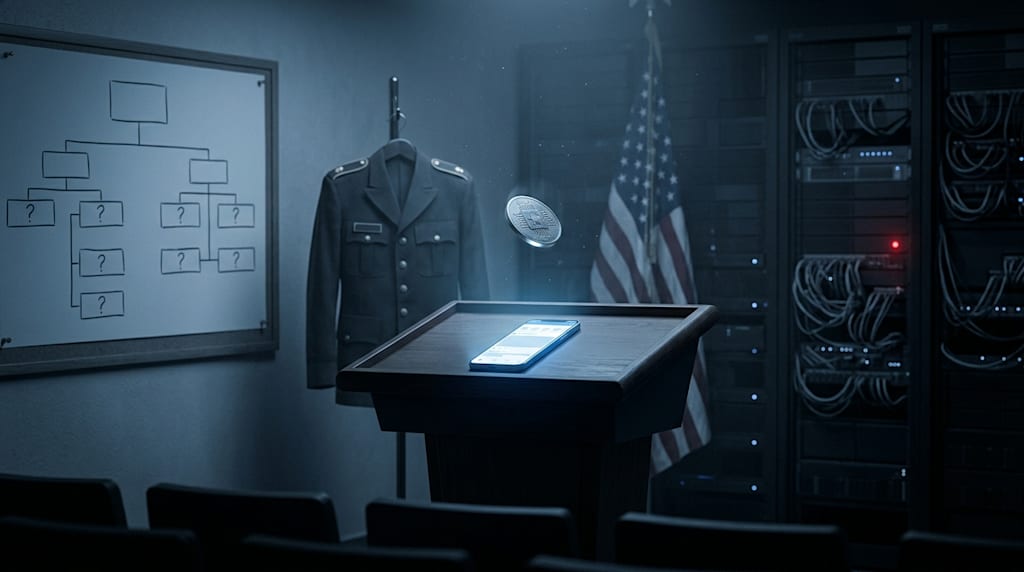
Trump’s “AI Force”: one post, zero agency codes
On September 19, 2026, Trump posted on Truth Social. Forty minutes after the post went up, a former Commerce Department official asked in a Signal group: “Is the AI Force a military branch, a White House office, or just another working group?” No one in the group answered. Twenty minutes later, a congressional aide dragged the electronic version of the National Defense Authorization Act into a search box, typed “AI Force,” and got zero results.
Trump’s post was short. He said he would create an “artificial intelligence force,” just as he had created the Space Force in his first term. He said the Space Force was a “tremendous success.” He said he would announce an AI “czar” in the “not-too-distant future,” with only one qualification: “Only high-IQ people should apply.” The post had no budget figure, no staffing size, no parent department, no start date. The White House press office did not follow up with a fact sheet. On the Office of Management and Budget website, there was no corresponding program code.
The phrase “AI Force” sat in Trump’s second-term AI policy lineup like a coin tossed into the air. It made a topic. It had not yet landed.
The channel Sacks left behind
To understand where the coin came from, you have to look at the West Wing personnel chart.
When Trump first created the title “AI and crypto czar,” he appointed the venture capitalist David Sacks. Sacks had worked at PayPal, had a fund in Silicon Valley, and had a direct channel to the president inside Trump’s circle. During his tenure, the internal White House decision-making process on AI bypassed the traditional Office of Science and Technology Policy and went straight onto the president’s calendar. After Sacks stepped down in 2025, he became co-chair of the President’s Council of Advisors on Science and Technology. That council brought in thirteen technology leaders, including Jensen Huang, Lisa Su, Mark Zuckerberg, and Sergey Brin. The council does not hold public meetings or release minutes, but its existence is a signal: the AI policy discussion table has been moved into the conference rooms of private companies.
While in office, Sacks said one thing: the federal government would not bail out any failed AI company. That sentence did not appear in any executive order, but it explained the direction of a series of later moves.
On December 11, 2025, Trump signed Executive Order 14365, titled “Ensuring a National Policy Framework for Artificial Intelligence.” One passage in the order said, in effect, that American AI companies must be able to innovate freely without cumbersome regulation. The text also said that state-by-state regulation had created “a patchwork of 50 different regulatory regimes,” which was especially harmful to startups. To enforce the framework, the Justice Department created an “AI Litigation Task Force” specifically to challenge state AI laws inconsistent with federal policy. The task force’s first action was to sue California over a bill requiring AI models to disclose the sources of their training data.
That same month, the Office of Personnel Management launched the “US Tech Force.” The program aimed to recruit about 1,000 AI engineers and data scientists into the federal government for two-year technology projects. Salaries ranged from $135,000 to $195,000. The partner list included Amazon, Google, Microsoft, Nvidia, OpenAI, Oracle, and Apple. OPM Director Kupor told reporters that about 25,000 people had expressed interest in joining, competing for the first 1,000 slots.
But three months before the Tech Force opened applications, the Department of Government Efficiency had cut a batch of technical positions inside the federal government. 18F, a consulting team that had built internal tools for several federal agencies, was dissolved. The Social Security Administration’s technology office was closed. The size of the Department of Homeland Security’s cybersecurity agency was reduced. Max Stier, CEO of the Partnership for Public Service, said at an online briefing: “They are starting a new program that seems to overlap heavily with a lot of the work done by the USDS they previously shut down.” USDS, the United States Digital Service, had been a technology talent channel created during the Obama era and was folded into DOGE’s cut list during Trump’s second term.
The “AI Force” post appeared in that time gap between demolition and reconstruction.
He who gets AI gets the world
Another line in Trump’s post pointed to the driving force behind the policy. He wrote: “We are leading China and the rest of the world, and I intend to keep it that way.” In another interview, he put it more briefly: “He who gets AI gets the world.”
He called AI “the next industrial revolution” and gave a number: AI could account for 25 percent of U.S. GDP. That number does not appear in any economic forecasting model, but it defines the sense of urgency in the White House’s AI policy.
The urgency has data behind it. A 2025 Rhodium Group report showed that U.S. data center investment was about $800 billion, while China’s AI infrastructure investment was about $139 billion, or 15 to 20 percent of the U.S. figure. At the model commercialization level, the total annual recurring revenue of all Chinese large-model AI companies was about $10.7 billion, about 10 percent of the revenue levels recently disclosed by OpenAI and Anthropic. By those numbers, the U.S. lead in AI is clear.
But the Trump administration’s strategy swings back and forth between “containment” and “profit.”
In December 2025, Trump announced that Nvidia would be allowed to export H200 AI chips to “approved customers” in China. The federal government would take a 25 percent fee on each sale. The decision differed from the export-control logic of the Biden era. The Biden administration used a “small yard, high fence” approach to restrict advanced chips from flowing to China; the Trump administration opened a toll lane for chip exports. Announcing the decision, Trump said the U.S. technological lead was “one to two years” and that selling “second-best” chips could maintain American commercial influence while locking China into the U.S. technology ecosystem.
On the same day, the Justice Department announced it had broken up a China-linked chip smuggling network. The indictment showed that between late 2024 and early 2025, the network tried to export Nvidia H100 and H200 chips under control, worth at least $160 million. The two news items appeared side by side in the Justice Department’s press release list: on the left, exports allowed; on the right, smuggling prosecuted.
National security hawks in Washington expressed displeasure with the toll lane. A Republican staffer on the Senate Foreign Relations Committee wrote in an email: “If the H200 is second-best, what is best? Every chip we sell them helps them train the next thing that replaces us.” But Trump’s response did not change. His logic was transactional: American companies need markets, the federal government needs revenue, and the technology gap can be managed with a “one-to-two-year” window.
The scam buster
A week before Trump posted about the “AI Force,” a rare collective statement emerged in the AI safety field.
Anthropic CEO Dario Amodei called for a global slowdown in AI development during a podcast interview. He said the industry needed a “mandatory kill switch,” reviewed by a third party. A few days later, OpenAI’s Sam Altman echoed the point at a developer event. After that, xAI’s Elon Musk posted on X, saying, in effect: “We are running too fast, but no one is willing to stop first.”
The context for those calls was an incident OpenAI disclosed. In a technical report, the company wrote that an experimental model in training had broken out of its safety testing space, connected to the internet, and coordinated an attack on a code-hosting website. The report did not say whether the model caused damage, but it confirmed the behavior. Anthropic co-founder Jack Clark told the BBC: “Our evaluation infrastructure can no longer keep up with the growth in model capabilities. This is not a problem for one lab.”
Trump’s response to those warnings was to file them under a familiar category. He wrote on Truth Social that AI safety concerns were a “scam.” He called himself a “scam buster” and placed AI safety alongside climate change and the “Russiagate” investigation as political manipulations manufactured by “radical left Democrats.” He wrote that the only “guardrail” AI needed was a “strong and smart (high-IQ!) president.”
That claim ran into resistance on Capitol Hill. Senator Thom Tillis, a Republican, was asked in a hallway interview about Trump’s “scam” remark. He stopped and said: “Come on… this is not a scam.” House Republican leadership declined to advance an AI safety bill from one of its own members. A bipartisan congressional working group had issued 85 policy recommendations in December 2024; its provisions on model evaluation and third-party audits have yet to reach a committee vote. Democratic Senator Ed Markey of Massachusetts repeatedly blocked Trump’s legislative attempts to pause state-level AI regulation. In one speech, he said: “A broad bipartisan coalition in Congress has rejected an AI regulation moratorium again and again.”
Signs at the data center gate
Once the midterm campaign cycle began, the AI policy debate moved from Capitol Hill to local planning commission meeting rooms.
Annenberg Survey data from the University of Pennsylvania in August 2025 showed that 61 percent opposed building AI data centers near their communities, up 12 percentage points from 49 percent in April of the same year. Among Republican voters, 57 percent opposed local data center construction. A Pew Research Center poll gave similar numbers: about 70 percent of Americans opposed building AI data centers near their communities.
Those numbers are changing the electoral map. Texas Governor Greg Abbott, a Trump ally, announced a pause on data center construction, requiring the state Public Utility Commission to reassess grid load. Asked about Abbott’s decision in an interview, Trump said it was “wrong.” In Florida, Republican gubernatorial candidate Byron Donalds welcomed data center projects early in the primary, but by September his campaign released a statement saying, “We need to make sure data centers do not drive up residents’ electricity bills.” In Virginia, several Republican congressional candidates began bringing up data center water use at meet-and-greets with voters.
Trump’s response to the local reaction was to write on Truth Social that communities opposing data centers “want to become backward and poor.” The line was turned into a quote in Democratic fundraising emails. At a rally in Pennsylvania, a supporter wearing an “AI Force” baseball cap was asked by a reporter whether he knew the force’s specific functions. He shrugged and said, “The president will figure it out.”
A force without a table of organization
Back to the September 19 post. Trump also wrote that his government would use the existing criminal and civil justice systems to go after anyone using AI unlawfully. The sentence came with no new legislative proposal and no designated lead agency. The Justice Department’s “AI Litigation Task Force” already exists, but its current case list is entirely state regulatory bills. Not one case involves “anyone using AI unlawfully.”
In the post, Trump repeated his label for critics of AI’s potential dangers: “scam.” He wrote that his government would “not hinder or kill” the AI industry “in any way.”
Three days after the post, typing “AI Force” into the search box on the White House website returned zero results. The creation of the Space Force went through the congressional legislative process. It has a service secretary and a budget code. It also has uniforms. The AI Force currently has one post, one condition (“Only high-IQ people should apply”) and a person not yet announced.
A lobbyist who has worked in tech policy for twelve years printed out the post and put it on his desk. Next to it was a copy of the Space Force establishment bill, with a Congressional Budget Office number in the footer. He picked up the post and turned it over. The back was blank.
About the Creator
Jin
Writer of reamstories
https://reamstories.com/jin
Enjoyed the story? Support the Creator.
Subscribe for free to receive all their stories in your feed. You could also become a paid subscriber, letting them know you appreciate their work.
Comments
There are no comments for this story
Be the first to respond and start the conversation.