
Trump Just Gave Europe a July 4th Ultimatum: Sign the Trade Deal — or Pay the Price
The U.S. has handed the European Union a hard deadline to ratify their trade agreement. With tariffs, court rulings, and economic anxiety all colliding at once, here’s what’s really at stake for both sides.
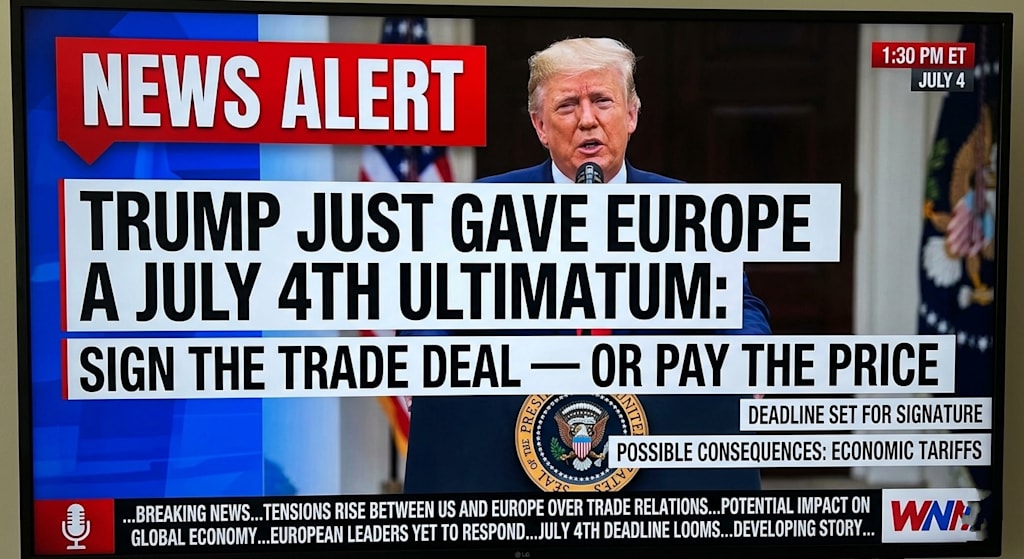
Donald Trump has delivered many ultimatums throughout his political career — to rivals, allies, corporations, foreign governments, and even institutions inside the United States itself. But this latest warning to the European Union carries a deadline loaded with symbolism and political theater: July 4, 2026 — the 250th anniversary of America’s independence.
The message was unmistakable.
Following a phone call with Ursula von der Leyen, Trump took to his social media platform, Truth Social, to issue a sharp public warning. The European Union, he said, must finalize and ratify the sweeping trade agreement negotiated in Turnberry, Scotland in July 2025 — or face an immediate escalation in tariffs.
“I’ve been waiting patiently for the EU to fulfil their side of the Historic Trade Deal,” Trump wrote. “A promise was made that the EU would cut their Tariffs to ZERO!”
The statement instantly reignited tensions across the Atlantic and signaled that Trump’s aggressive “America First” trade strategy remains central to his economic vision heading into the symbolic 250th year of the United States.
The Trade Deal That Could Reshape Global Commerce
The U.S.-EU agreement reached in Turnberry last year was celebrated as one of the most ambitious trade understandings in modern Western history.
If fully ratified, the deal would gradually reduce European Union tariffs on American goods to zero. Such a move would dramatically reshape transatlantic commerce, affecting industries worth trillions of dollars. American automobile manufacturers, pharmaceutical companies, agricultural exporters, steel producers, and technology firms would all gain expanded access to European markets with fewer financial barriers.
In return, the United States agreed to ease certain tariffs on European imports. However, Washington retained a baseline 10% tariff on many foreign goods — a compromise that reflected Trump’s continued preference for protective economic measures even while negotiating broader market access.
The agreement also stretches beyond traditional trade.
Negotiators have been working through highly sensitive issues involving digital commerce, artificial intelligence regulations, semiconductor exports, and technology controls tied to China. This means the deal is not only about economics; it is also about geopolitical influence in a rapidly shifting global order.
For both Washington and Brussels, the agreement represents an attempt to redefine Western economic cooperation in an era increasingly shaped by Chinese manufacturing power and technological competition.
Europe Is Moving Slowly — and Trump Is Losing Patience
European Commission President Ursula von der Leyen has publicly insisted that negotiations are progressing positively. According to EU officials, discussions on tariff reductions are advancing steadily, and European leaders remain committed to honoring the broad framework established in Scotland.
But diplomacy often moves slower than politics.
The EU’s chief trade negotiator admitted there is “still some way to go” before the agreement can be fully implemented. Behind those carefully chosen words lies a complicated political reality: the European Union is not a single country. Every major trade arrangement requires coordination among multiple governments, industries, legal systems, and political interests.
Some European nations worry that completely eliminating tariffs could hurt local manufacturers and farmers. Others remain cautious about giving the United States too much leverage in strategic sectors like technology and pharmaceuticals.
Trump, however, appears unwilling to tolerate further delays.
By attaching his ultimatum to July 4, 2026, he transformed the deadline into something larger than a trade negotiation. The date itself turns the issue into a symbolic test of American strength, independence, and negotiating power.
A Legal Crisis Complicates Trump’s Threat
Yet the timing of Trump’s warning is particularly complicated — because his own tariff policies are facing serious legal challenges inside the United States.
Only hours after Trump threatened higher tariffs against the EU, a U.S. trade court ruled that his existing 10% global tariff structure may not be legally justified under American law. The ruling marked the second major legal setback for Trump’s trade agenda this year.
Earlier in 2026, the U.S. Supreme Court had already limited portions of Trump’s broader tariff authority, questioning the scope of presidential power in imposing sweeping trade restrictions without congressional approval.
This creates a remarkable contradiction.
Trump is threatening Europe with higher tariffs while American courts are simultaneously questioning whether he has the legal authority to maintain some of the tariffs already in place.
The likely result is a prolonged legal and political battle that could stretch for months, potentially even years.
Critics argue that the uncertainty could weaken America’s negotiating credibility. Supporters, however, see Trump’s aggressive stance as a strategic pressure tactic designed to force faster concessions from European leaders.
Why the Entire World Is Watching
The stakes extend far beyond Washington and Brussels.
The U.S.-EU economic relationship represents the largest bilateral trading partnership in the world, involving more than $1.5 trillion in annual trade flows. Any disruption could send shockwaves through global supply chains, financial markets, manufacturing industries, and consumer prices.
A major escalation in tariffs would likely increase costs for businesses and consumers on both sides of the Atlantic. Automobiles, electronics, machinery, food products, and pharmaceuticals could all become more expensive.
The recently signed U.S.-UK Economic Prosperity Deal offers a glimpse of what Trump hopes to achieve. That agreement, signed on May 8 — the 80th anniversary of Germany’s surrender in World War II — included targeted tariff reductions, expanded agricultural access, and limited industrial concessions while still preserving baseline protective tariffs.
But the European Union is far more economically and politically complex than Britain alone.
Negotiating with the EU means negotiating with an entire bloc of competing national interests, regulatory philosophies, and political pressures.
And now, with July 4, 2026 approaching, the pressure is intensifying.
The countdown has officially begun.
About the Creator
Enjoyed the story? Support the Creator.
Subscribe for free to receive all their stories in your feed.
Comments
There are no comments for this story
Be the first to respond and start the conversation.