
Trump Got Clipped Again. The Real Story Is Two Kinds of Truth.
How a single quote, two media machines, and the fight over context explain the U.S.-China AI split.
Trump stood on a rally stage in Nebraska, jacket open, Jos. A. Bank label visible. That suit costs two or three hundred dollars at full price and often half that on sale. A billionaire wearing it sends a message to the crowd, just as Biden wearing Hugo Boss would.
He was talking about Iran. The speech matched one he had given two days earlier in Mobile, Alabama. In Mobile, he said that when the war ends, oil prices will fall. He told the crowd to remember oil prices. They were paying a price, but compared with letting lunatics get a nuclear weapon and use it on Mobile, it was a small price. In Nebraska, he swapped Mobile for Los Angeles and San Diego. Same argument: higher oil prices are a cost; nuclear weapons are a larger cost.
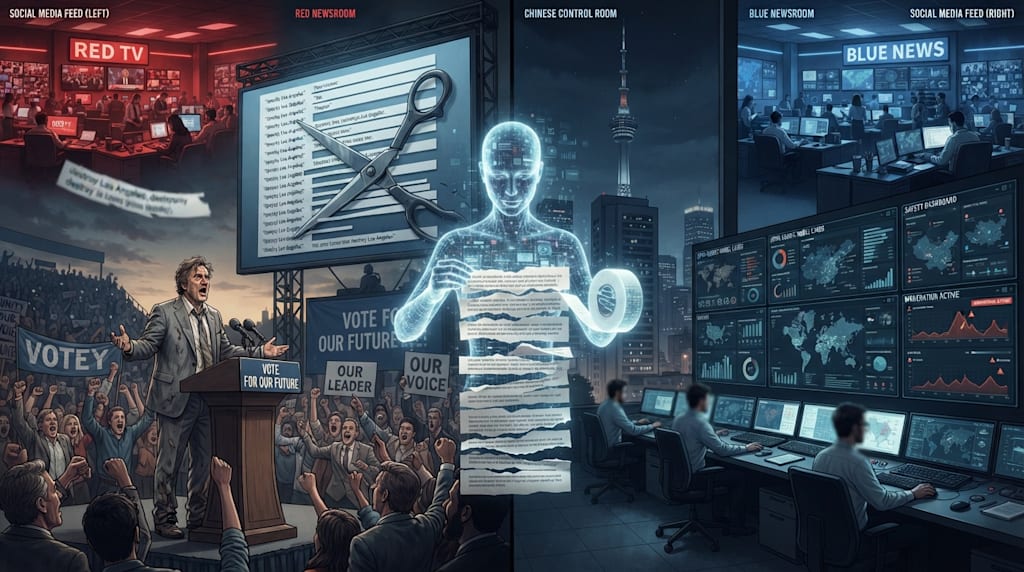
The next day, CNN ran a headline: “Trump hints he might destroy Los Angeles.” MSNBC’s clip dropped the word “price.” Only “destroy Los Angeles” and “destroy San Diego” played on a loop. On Twitter, Democratic accounts posted short videos with thriller strings: “Trump is willing to sacrifice American cities.”
This had happened before. In April 2020, at a White House coronavirus briefing, Trump said disinfectant kills the virus in a minute. He asked whether there was a way to inject it into the body or clean the lungs. The original words included “inject” and “clean.” The next day, headlines read: “Trump suggests drinking disinfectant to cure Covid.” He later said he was being sarcastic. Few listened.
Both operations share a structure. Cut a sentence from its context. Put the most provocative words in the headline. Drop the qualifiers like “price” or “sarcasm.” The cutting room of American political news flattens complex sentences into emotional buttons.
Trump’s side is not innocent. His team knows plausible deniability. “Many people are saying.” “I was told.” “I was just joking.” His influencer allies on YouTube and TikTok make conspiracy theories: the Epstein “Lolita Island” list, Democratic elites eating children, chips in vaccines. These rumors circulate in the conservative information ecosystem. Some mainstream Chinese media pick them up and recycle them as the truth about America.
Both sides cut. Both sides accuse the other of cutting. Supporters see only the other side’s cuts. Daily American political information is not one side lying while the other corrects the record. Two cutting rooms run at once, each producing its own version, each feeding its own audience.
American mainstream media is disproportionately liberal. At the New York Times, CNN, and NBC, the share of registered Democrats among journalists is far higher than among Republicans. But “the Democratic Party controls the mainstream media” is too crude. Fox News regularly beats CNN in ratings. The Wall Street Journal’s opinion page is a major Republican voice. The New York Post’s Hunter Biden stories before the 2020 election were suppressed by mainstream outlets for a month before they followed. America has multiple narrative centers competing to define what is true.
The legal foundation is the First Amendment. American law protects political speech broadly. False or misleading political speech is often protected unless it meets the high bar of defamation. The actual malice standard from New York Times v. Sullivan makes it nearly impossible for public figures to win lawsuits against media. Political attacks, negative ads, and out-of-context quotes are part of the game, not absolute taboos.
Another layer is critical thinking education. From elementary school, American students are taught not to trust any side blindly and to check facts themselves. Many people assume political speech is biased and that the audience must sort it out. Even when they know one side is distorting something, many say both sides do it, then vote along their original party line. The system makes it hard for power to monopolize the narrative. It also turns truth into fragments and trust into a consumable.
Pew Research data shows American trust in media fell from over 70 percent in the 1970s to around 30 percent today. Trust in government hovers around 20 percent. Supporters of both parties distrust the media controlled by the other side.
China’s underlying logic is different. In the Confucian tradition, trust is one of the five constant virtues. Public discourse emphasizes authority and collective consensus. Integrity, responsibility, and consistency between words and actions are moral requirements. There is stronger negative moral judgment against deliberately distorting facts, especially when aimed at public authority. People expect public figures and media to tell the truth and be responsible. They are less likely to accept obvious distortion and smearing.
China has out-of-context quoting too. Every society does. But Chinese society has stronger moral condemnation of deliberate distortion and a higher expectation that authority should be honest. American society tolerates politically weaponized distortion more because it is part of the political game.
Each approach has trade-offs. The American model is pluralistic and hard to monopolize. It can fall into truth decay and permanent polarization. The Chinese model forms collective action and a stable narrative more easily. It is harder to supervise authority, and the systemic risks of authority are greater.
In corporate management, this difference becomes two ways of handling conflict. In American companies, when a meeting has gone back and forth enough, someone says: Let’s agree to disagree. Then they move forward through process. Everyone has the right to hold a view, even if it differs from the boss. The final decision follows hierarchy or process, but no one needs to agree inside. It acknowledges disagreement while avoiding a broken relationship.
In Chinese companies, the more common phrase is unify thinking. When opinions diverge, people execute first, keep reservations but do not say them aloud, or align slowly through private conversations. Saying “we agree to disagree” would be seen as not smooth enough. Directly challenging a leader or publicly holding a different view is seen as immature or disloyal.
The American model is flexible and tolerant of dissent. It can lead to endless debate, delayed execution, and diluted responsibility. The Chinese model has strong execution and organizational stability. It creates information cocoons, discourages bad news from traveling upward, and allows systemic risks from major decisions to be hidden longer. A better middle ground is not to pick a side. Before a decision, let the red team argue fully. After the decision, execute without erasing the record of dissent. Allow disagreements to be documented, minority views to be preserved, and after-the-fact reviews to trace who raised what risk and when.
The impact on AI design is direct. In American AI development, frontier models are mainly closed-source competition, sprinting on market and technical advantage. Open source is a supplement. There is more space for free information and pluralistic trial and error. In Chinese AI development, the emphasis is on controllability: large-scale open sourcing of high-performance models within controllable boundaries, using openness to accelerate diffusion and ecosystem positioning, while strengthening content and safety alignment.
Both shape model behavior. American models may speak more freely and pluralistically, but they are easier to weaponize with conspiracy theories and out-of-context quotes. Chinese models are steadier and more controllable, but they may amplify authority bias and information cocoons. What needs to be designed is not just value alignment. It is verifiability alignment. AI summaries must preserve context. They cannot just extract the most provocative sentence. Citations must be traceable to the original text, letting users see the full context with one click. Systems should detect selective editing, emotional headlines, and broken source chains. Corporate meeting AI should not only output a unified conclusion. It should preserve minority opinions and dissent logs. Public communication AI should flag when a sentence may be taken out of context and provide the original context. Platforms should offer appeal mechanisms so that a party that has been distorted can supplement the record.
Otherwise, AI will automate and scale the defects of each society. The American competitive truth market will become a truth-fragment factory. The Chinese authoritative-consensus model will become an information-cocoon machine.
Trump’s Jos. A. Bank suit and a president saying higher oil prices are a small price are the same political grammar. Use a concrete action to convey an abstract position. Let the audience fill in the meaning. The media cutting his “destroy Los Angeles” line also uses a concrete fragment to convey an abstract judgment. It lets the audience fill in the fear. Both sides compress complex reality into transmissible fragments. America’s system allows two cutting rooms to operate at once. China’s system is more inclined to have one cutting room set the tone. The former leaves the audience arguing forever. The latter may leave the audience unaware that another version exists. AI should avoid choosing a cutting room. Its job is to let every fragment return to the full tape with one click.
About the Creator
Jin
Writer of reamstories
https://reamstories.com/jin
Enjoyed the story? Support the Creator.
Subscribe for free to receive all their stories in your feed. You could also become a paid subscriber, letting them know you appreciate their work.
Comments
There are no comments for this story
Be the first to respond and start the conversation.