
Trump Flies to Beijing This Week — With No Iran Deal, $4.52 Gas, and a Failed Ceasefire in His Pocket. What the Trump-Xi Summit Actually Needs to Accomplish.
Taiwan. Iran. Hormuz. Tariffs. Ukraine. The Beijing summit this week carries more geopolitical weight than any US-China meeting in decades. Trump says Xi will give him a "big, fat hug." The world says: prove it. Here is what is actually at stake — and why the outcome matters for everyone on earth.
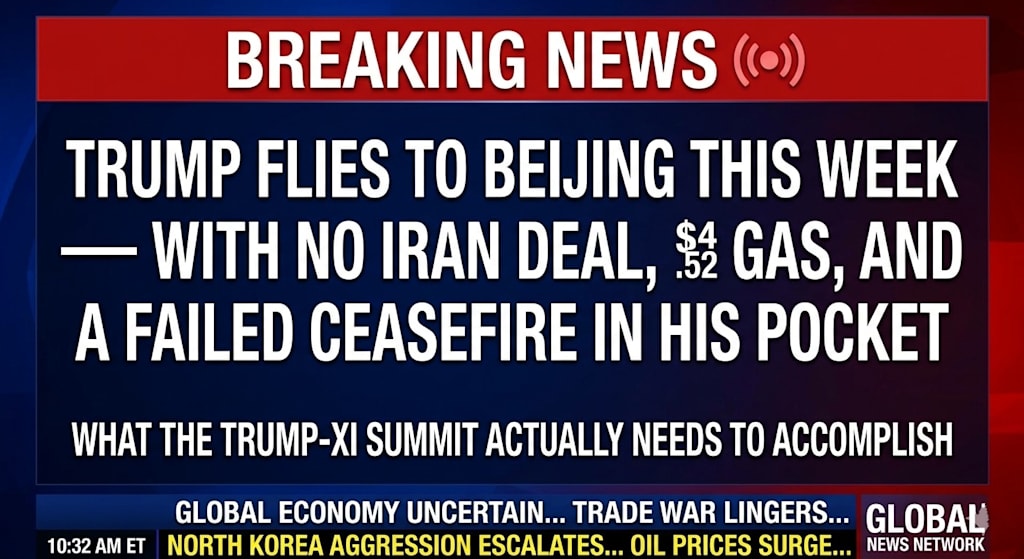
On Wednesday, May 13, President Donald Trump is scheduled to board Air Force One for Beijing — where he will sit down with President Xi Jinping for a two-day summit covering the most consequential collection of global crises in decades. Taiwan. The Iran war. The Strait of Hormuz. The U.S.-China trade relationship. China's support for Russia. Ukraine's future. Trump has publicly predicted a warm welcome, telling reporters he expects Xi to offer him "a big, fat hug." The diplomatic reality is considerably less cuddly. Trump arrives in Beijing with no Iran peace deal — having just called Iran's counter-proposal "totally unacceptable." He arrives with U.S. gasoline prices at $4.52 per gallon and Brent crude above $100 a barrel. He arrives with a Russia-Ukraine ceasefire that has already collapsed. He arrives with a July 4 trade ultimatum hanging over the European Union. He arrives, in short, with an agenda so overloaded and a negotiating hand so complicated that even Trump's most ardent admirers would struggle to describe it as a position of strength.
The summit's agenda is defined by its most immediate flashpoint: Iran and the Strait of Hormuz. China is the world's largest oil importer and receives approximately one-third of its crude oil through the Strait of Hormuz under normal conditions. The closure of the strait is the largest supply disruption in the history of the global oil market, removing around 20 million barrels of oil per day from normal transit — roughly 20 percent of global seaborne oil trade. China has been drawing down strategic reserves and scrambling for more expensive alternative supply routes since February 28. Every day the Strait remains closed costs China billions of dollars and puts additional pressure on Xi's economy — which is already managing significant headwinds from U.S. tariffs, a slowing property sector, and the costs of sustaining what Washington calls Chinese "support" for Russia's war effort in Ukraine.
"Trump has predicted a warm welcome from Xi, even expecting to be offered a 'big, fat hug.'" — The Vindicator, May 11, 2026
Washington has sanctioned Chinese refiners for purchasing Iranian crude in violation of U.S. sanctions — a move that Beijing has responded to with its own countermeasures. Top officials including Chinese Vice Premier He Lifeng and U.S. Treasury Secretary Scott Bessent will meet in South Korea on Wednesday to discuss economic and trade issues before the Beijing summit, seeking to ensure recent escalations don't derail the trade truce reached in South Korea last year. The pre-summit meeting is designed to create a floor of minimum stability — an acknowledgement by both sides that arriving in Beijing with actively escalating tariff and sanctions disputes would undermine the summit before it begins.
Taiwan sits atop the formal agenda for both sides. Both the U.S. and China have said Taiwan will sit atop the agenda. Beijing has reportedly pressed the Trump administration to scale back its security commitments and revise U.S. official policy toward the island. Taiwan's ruling Democratic Progressive Party rejects China's claim over the island, and the United States — under both Democratic and Republican administrations — has maintained a policy of "strategic ambiguity" that neither confirms nor denies a commitment to defend Taiwan militarily. Any shift in that posture — in either direction — would have immediate and massive consequences for Taiwan, for Japan and South Korea, and for the entire security architecture of the Indo-Pacific region.
The Ukraine dimension of the summit may prove more tractable than others. It is possible that one outcome of the summit would be a reduction in China's support for Russia's war effort in Ukraine, which Wilder said could be a concession Beijing might offer in exchange for something the U.S. values. What that "something" is — tariff relief, Taiwan policy moderation, sanctions carve-outs for Chinese firms — is the subject of the pre-summit positioning underway this week. Russia is watching the Beijing summit with particular anxiety: the last in-person Trump-Xi meeting, in October, prompted Russian officials to move quickly to reaffirm Moscow's alliance with Beijing, signalling concern that a U.S.-China rapprochement could erode the Chinese economic support that has kept Russia's war economy functioning.
Trump's bet is that Xi wants the Strait of Hormuz open badly enough to help pressure Iran toward a deal, and that trade concessions are the currency that buys that Chinese pressure. Xi's bet is that Trump needs a win badly enough — at home and internationally — to offer real concessions on Taiwan, tariffs, and sanctions. Both bets may be correct. The world finds out this week.
About the Creator
Enjoyed the story? Support the Creator.
Subscribe for free to receive all their stories in your feed.
Comments
There are no comments for this story
Be the first to respond and start the conversation.