
Trump Called Iran's Peace Proposal "TOTALLY UNACCEPTABLE." Full-Scale Bombing Is Back on the Table. Here Is Exactly What Went Wrong — and What Happens Next.
Iran submitted its counter-proposal to Pakistani mediators on Sunday. Tehran demanded compensation, sovereignty over the Strait of Hormuz, and a right to enrich uranium. Trump went on Truth Social and called it totally unacceptable. National Security Advisor Waltz confirmed the US is fully prepared to resume bombing. Here is where the deal stands.
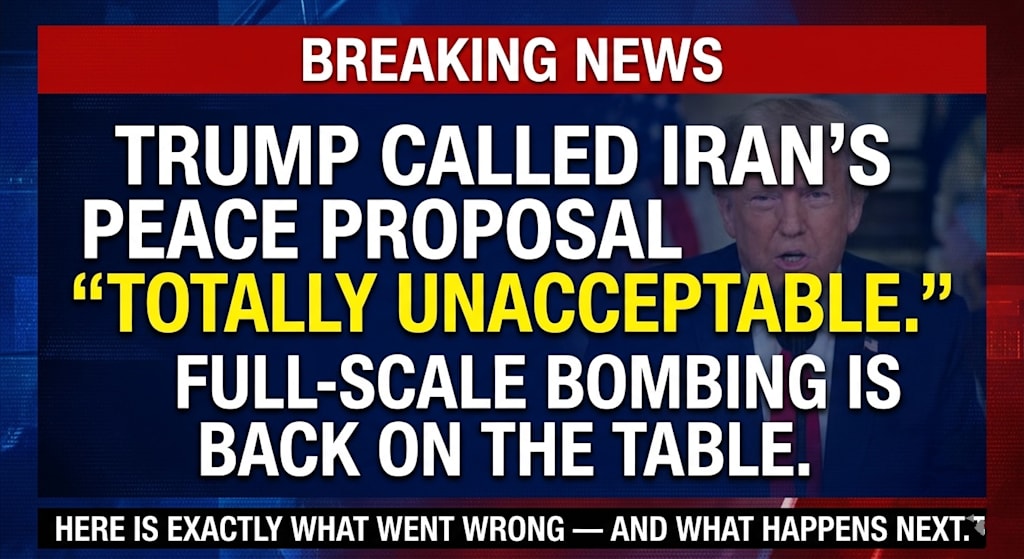
Sunday, May 10, 2026, was supposed to be the day hope crystallised into a framework. Iran had promised a response to the U.S. 14-point peace memorandum. Pakistani mediators had confirmed receipt. Diplomatic channels were open. The world was watching. Instead, what came back from Tehran was, in the characterisation of President Donald Trump on Truth Social in capital letters on Sunday night: "TOTALLY UNACCEPTABLE!"
Iran's counter-proposal — reported in detail by Iranian state media and confirmed by regional sources to CNN — included demands that fundamentally diverged from the American framework in three key areas. First, Tehran demanded financial compensation for the damage inflicted by U.S. and Israeli strikes since February 28 — a demand Washington views as a non-starter. Second, Iran demanded formal recognition of its sovereignty over the Strait of Hormuz — a claim the United States has never accepted and which would effectively give Iran a legal right to close the waterway at will. Third, and most critically, Iran insisted it retain the right to enrich uranium — a direct contradiction of the U.S. demand for zero enrichment for at least 12 years that sits at the heart of the entire negotiating framework.
"President Trump has been clear: they will never have a nuclear weapon and they cannot hold the world's economies hostage." — National Security Advisor Mike Waltz, Fox News Sunday, May 10, 2026
National Security Advisor Mike Waltz, appearing on Fox News Sunday, confirmed that the United States had reviewed Iran's counter-proposal overnight and was deeply dissatisfied. "We'll see what the Iranians just came back with overnight in terms of their response to our very clear red line," Waltz told the programme. He confirmed Trump's position: Iran will never be permitted to have a nuclear weapon, and Iran will not be allowed to continue holding the world's economies hostage by blocking the Strait of Hormuz. But Waltz also made clear that Trump was not immediately ordering a resumption of military strikes. "He is giving diplomacy every chance that he can before going back to hostilities," Waltz said on ABC's This Week. That framing — "before going back" rather than "if we go back" — signals that a military resumption is viewed inside the White House not as a last resort but as a scheduled alternative that moves closer with each failed negotiating round.
The human stakes of this diplomatic failure are measured directly in barrels of oil and dollars per gallon. Brent crude prices rose on Sunday to $104.50 a barrel and U.S. crude climbed to about $98.48 a barrel. Average gas prices hit $4.52 a gallon, according to AAA. Every day without a deal keeps those prices elevated, keeps the Strait of Hormuz restricted, keeps 1,600 vessels stranded in the Persian Gulf, and keeps the global economy absorbing a supply shock the International Energy Agency has characterised as the largest in the history of the world oil market. The IEA estimates the war is removing approximately 14 million barrels per day from global supply — a number that is not diminishing with the passage of time but compounding, as strategic reserves in Europe, Asia, and the United States continue to be drawn down against a disruption that shows no sign of ending.
Iran's decision to demand sovereignty over the Strait of Hormuz, in particular, suggests that at least some factions within Tehran's fractured post-Khamenei political leadership view the negotiations not as an opportunity to end an economically devastating war but as an opportunity to extract concessions they could never have obtained before the war began. If that reading is accurate, it has profound implications for the entire diplomatic framework: it means Iran is not trying to end the war on terms both sides can accept. It means Iran is trying to win the peace on terms only one side benefits from. That is not a negotiation. That is an ultimatum dressed as diplomacy.
Trump departs for Beijing on Wednesday for his summit with President Xi Jinping. He will arrive without a deal. Whether Xi can use the summit to provide the pressure or inducement that Pakistani mediation alone has been unable to produce is the central diplomatic question of the week. The world is running out of time — and out of buffer stocks.
This is the most important story in the world right now.
About the Creator
Enjoyed the story? Support the Creator.
Subscribe for free to receive all their stories in your feed.
Comments
There are no comments for this story
Be the first to respond and start the conversation.