
Troops and fighter jets in live fire exercise on Falklands
Exercise Cape Upholder demonstrates how British ground forces, Typhoon fighter aircraft and local defence personnel are training together in the South Atlantic.
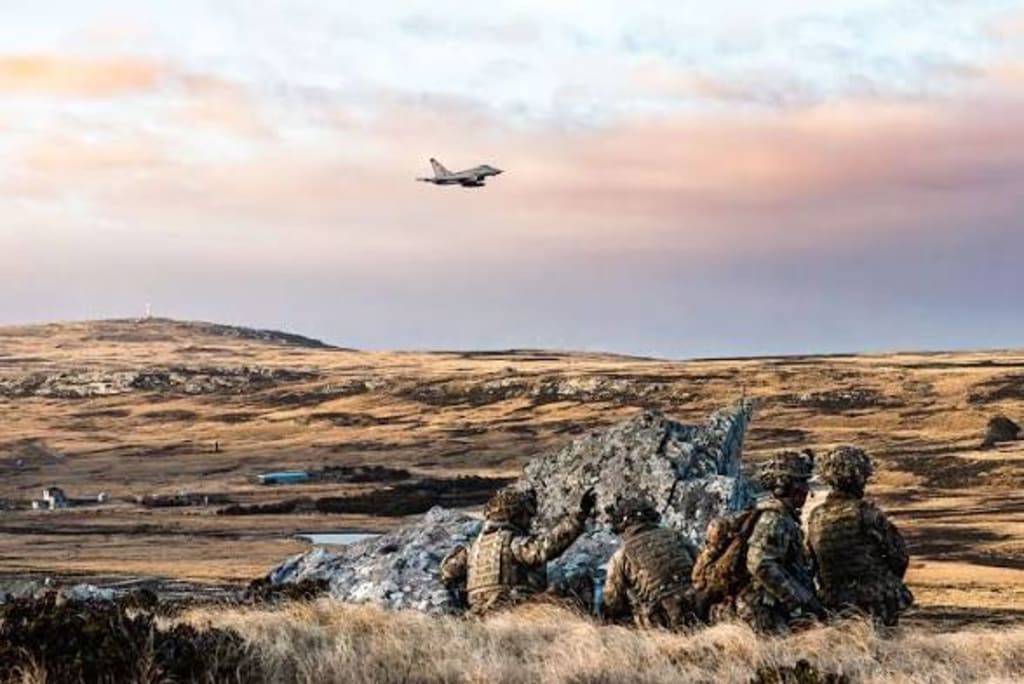
The Falkland Islands have once again become the setting for a major military training exercise designed to test how troops and combat aircraft can operate together under realistic battlefield conditions. Known as Exercise Cape Upholder, the activity brought together British Army infantry, the Falkland Islands Defence Force (FIDF) and Royal Air Force Typhoon fighters.
The exercise took place from 29 June to 3 July 2026 and was designed to improve operational readiness in the demanding South Atlantic environment. According to reporting on the exercise, Typhoon aircraft provided simulated close air support for infantry forces conducting assaults against enemy positions.
A Realistic Test of Modern Warfare
Military exercises are essential for preparing forces for situations that cannot be completely replicated in ordinary training. Exercise Cape Upholder gave soldiers and aircrew an opportunity to practice coordination between ground manoeuvres and air power.
The exercise involved the 5th Battalion, The Rifles, the Falkland Islands Defence Force and 1435 Flight, the RAF Typhoon detachment assigned to the islands within 905 Expeditionary Air Wing.
The integration of aircraft and infantry is particularly important in modern warfare. Ground troops may need rapid air support while advancing against simulated positions, while pilots must understand the location and movements of friendly forces before conducting any simulated engagement.
The Role of RAF Typhoons
The Eurofighter Typhoon is a multirole combat aircraft capable of performing air-to-air and air-to-ground missions. On the Falklands, the aircraft provide an important element of Britain's standing military presence in the South Atlantic.
During Cape Upholder, Typhoons simulated close air support rather than conducting an actual combat operation. This allowed pilots and ground personnel to practice communication, coordination and tactical decision-making in a controlled training environment.
The presence of Typhoons at RAF Mount Pleasant also provides the UK with a rapid-response combat-air capability in the region. Their role extends beyond routine flying, as aircraft, ground crews, engineers and support personnel must remain prepared to respond to changing circumstances.
Why the Falklands Remain Strategically Important
The Falkland Islands occupy an important position in the South Atlantic. Britain maintains a military presence there, including RAF Mount Pleasant, to support the defence of the islands.
The UK's defence posture in the South Atlantic remains a subject of parliamentary interest. In March 2026, the British government was asked about military capability and force levels in the Falklands. The Ministry of Defence said precise force levels were not disclosed for operational and personnel security reasons.
This policy highlights the sensitive nature of military deployments in the region. While the UK regularly conducts training activities, details about exact personnel numbers and operational capabilities are not always made public.
Training With Local Defence Forces
One of the important features of Cape Upholder was the participation of the Falkland Islands Defence Force.
Local forces have an important role in supporting the wider defence structure of the islands. Training alongside British Army personnel allows the FIDF to develop interoperability and gain experience working with larger military formations.
For British troops, cooperation with local personnel also provides valuable knowledge of the environment. The Falklands present unique challenges, including rapidly changing weather, open terrain and long distances between populated areas.
The Importance of Live-Fire Training
Live-fire training provides military personnel with a more realistic experience than classroom exercises or computer simulations. It allows troops to practice procedures while dealing with the sound, movement and pressure associated with actual weapons training.
However, such exercises are carefully controlled. Training areas are managed to reduce risks to civilians, shipping and aircraft, while safety procedures govern the use of live ammunition.
The Falkland Islands Government, for example, publishes navigation warnings when live gunnery firing takes place. A July 2026 notice warned vessels to avoid the Rookery Bay range during scheduled live firing by the Falkland Islands Defence Force.
A Harsh Environment for Military Training
The South Atlantic environment makes the Falklands a particularly useful location for realistic military preparation.
Weather conditions can change quickly, while the islands' remote location creates logistical challenges. Personnel and equipment cannot always be supported as easily as they could at a major military base in the United Kingdom.
These conditions force military planners to consider transportation, communications, maintenance and medical support as part of their exercises.
The ability to sustain operations far from mainland Britain is itself an important element of readiness.
A Broader British Defence Strategy
Exercise Cape Upholder forms part of a wider pattern of British military training designed to maintain combat readiness and strengthen the ability of different services to work together.
The RAF has also participated in major international exercises during 2026, including Red Flag in the United States. Those exercises have focused on integrating fighter aircraft, intelligence, command-and-control and support capabilities in demanding combat scenarios.
Although the Falklands exercise is much smaller in scale, its purpose is similar: ensure that personnel can coordinate effectively when operating under realistic conditions.
What the Exercise Signals
Exercise Cape Upholder should not automatically be interpreted as preparation for an imminent conflict. Military forces routinely conduct exercises to maintain readiness, test procedures and identify weaknesses.
Nevertheless, the exercise demonstrates that Britain continues to take the defence of the Falkland Islands seriously. The combination of infantry, local defence personnel and Typhoon aircraft demonstrates an integrated approach to regional security.
For residents of the islands, maintaining a credible defence capability can provide reassurance. For military planners, exercises provide an opportunity to evaluate whether personnel and equipment can operate effectively in a remote environment.
Conclusion
The 2026 Exercise Cape Upholder demonstrates the continuing importance of military readiness in the Falkland Islands. By combining British Army troops, the Falkland Islands Defence Force and RAF Typhoon fighters, the exercise tested the coordination required for modern military operations.
The South Atlantic presents unique geographical and logistical challenges, making realistic training particularly valuable. While the exercise was not evidence of an immediate conflict, it showed that Britain continues to maintain a capable and integrated defence posture in the region.
As global security conditions evolve, exercises such as Cape Upholder will remain important for ensuring that personnel are prepared, aircraft are ready and different military units can operate together when required.
About the Creator
Enjoyed the story? Support the Creator.
Subscribe for free to receive all their stories in your feed.
Comments
There are no comments for this story
Be the first to respond and start the conversation.