
The Vice President Who Opposed the War and Still Kept the Base
J.D. Vance’s distance from Trump looks like a break. It is better understood as a 2028 campaign move hiding in plain sight.
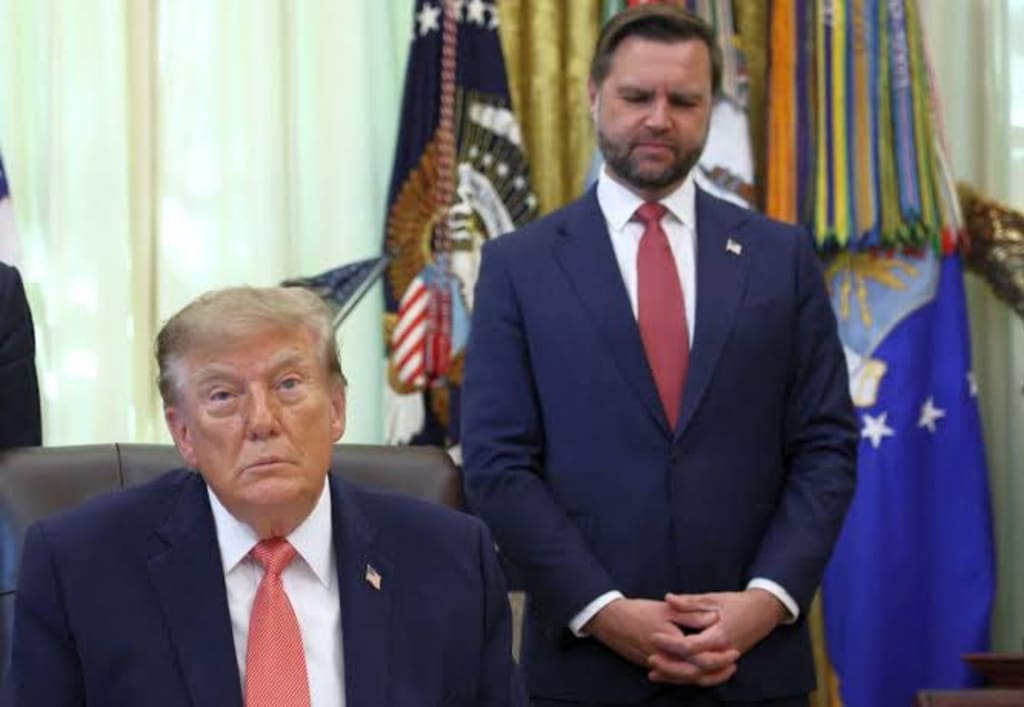
I. The Third Page in the Situation Room
February 2026, White House Situation Room. Vance turned an assessment report to page three. He pressed his pen on one line and did not look up. “I disagree with this one,” he said.
Trump leaned back and tapped the table twice. “Good.”
This scene comes from anonymous White House sources. It cannot be independently verified. It still captures the shape of the story better than “Vance turns on Trump.” A vice president pressing a pen on a line is not pounding the table. Pounding is a break. Pointing is distance.
Remove the unverified details and the political logic holds. Before the midterms, a vice president needs visible distance from a president’s high-risk decisions. He cannot move so far that MAGA thinks he is building a separate camp. War with Iran gives him the right amount of space.
II. Why Iran
The economy, immigration and the courts are MAGA’s home ground. Touch them and you shake the base. Iran is different.
War has a clear policy edge. Vance can say “I oppose this war” without saying “I oppose Trumpism.” A policy disagreement can be sold as a technical judgment. A line disagreement cannot.
War also comes with ready-made opposition. The text’s version of Vance’s objections includes regional disaster, heavy casualties, a broken promise not to start new wars, and Iranian retaliation that drains U.S. ammunition. Those four points do not sound like a vice president working alone. They sound like Republican anti-war offices, Pentagon technocrats and supply-chain briefers arriving at the same table. Vance’s job is to collect those objections into one position he can state, record and cite later.
The air conditioning was broken. Someone turned a knob. No one filled the silence. Vance closed the report. “I’ll put it in the memo,” he said.
III. The Pencil Line
If Vance had produced the whole case alone, it would be less credible. The reasons came from different rooms: Senate offices, Pentagon hallways, defense-supply briefings. He put the paper from those rooms in one folder.
In a small meeting he laid out three documents: a Central Command risk assessment, a memo from party opponents, a quarterly ammunition report. He drew a pencil line down the margins and connected them. He said nothing. The line was the position. A sentence calling him a “master of resource integration” would be less honest than that line.
IV. The Fourteen Points and the Electronic Signature
The June 14-point U.S.-Iran memorandum, known as “the Fourteen Points,” caused a public uproar. In the text’s version, Trump sent Vance to lead the signing and placed Kushner and Witkoff on either side of him. High-level diplomacy usually runs through the secretary of state. A vice president’s presence signals political cover.
Vance said he would not fail the mission. In practice he held his ground and produced an electronic signature.
Without public documents, this remains narrative setup. The act still works as a metaphor. Signed, but not fully. Committed, but not fully. Present, but at a distance.
According to the text, his hand stopped on the mouse for three seconds. He clicked, leaned back and said, “Done.” No handshake. No photo. A week later the deal was in crisis, and each side accused the other of breaking promises. Vance blamed new Iranian attacks in the Strait of Hormuz and “false information.” If that sequence is true, he knows how to distance himself and how to frame the mess afterward. The story becomes: I signed, but the situation changed. I cooperated, but the other side broke it first.
V. Timing
Two guesses circulate. One says Vance and his allies are guarding against Trump’s impeachment. They want an early cut to protect the party and prepare for 2028. The other says Vance wants the Frank Underwood route: slip in while the lights are low.
The first is more plausible. If Trump faces impeachment risk late in his second term, a vice president who stays fully bound burns his own assets. A record of “I opposed it” on one war is cheap insurance.
The second overestimates a vice president’s ability to mobilize alone. Vance cannot run in 2028 without MAGA. He cannot abandon the base or expect Democrats to follow his rhythm. Betting on impeachment means handing his future to the opposition.
So the timing is deliberate. Before the midterms, he makes the disagreement visible. He does not make it permanent. At the October 29 Texas rally, he paused at Iran and said, “We could have avoided this.” He looked down at the speech, turned the page and went to the border. The pause was the message.
VI. Distance Without Departure
Vance wants “I opposed this war.” He does not want “I oppose Trump.” That sets three rules.
First, keep the disagreement specific. Talk about Iran. Do not talk about the MAGA line or Trump’s character. Policy can be argued. The line cannot.
Second, keep loyalty visible. “I think this is a bad idea, but if you want to do it, I will support you.” The objection is on record. The support is on record. If the war goes well, he backed it. If it fails, he warned first. After he said it, he pushed his water glass one inch toward Trump. That gesture says more than the word loyalty.
Third, gather resources without forming a camp. Republican critics, Pentagon technocrats, anti-war voters, voters tired of Trump’s style but unwilling to leave MAGA: these groups cannot be organized in public. They can be collected under “judging the matter on its merits.” He repeats the same line: “The president is still good. The MAGA line is right. I am judging this issue on its merits.” Said enough times, listeners split. One group hears “the president is still good.” The other hears “I am judging this issue on its merits.”
VII. Pence Broke. Vance Is Keeping Distance.
Pence refused Trump’s demand to overturn the 2021 election. In the 2024 cycle he challenged Trump in the primaries. He became the first former vice president in more than 80 years to run against the president he had served. That was a constitutional break.
Vance cuts over policy. Pence cut over a bottom line. Pence paid with MAGA. Vance wants to avoid that price.
Pence proved a vice president can say no. Vance wants to prove a vice president can say no without losing the base. That gap is his political room.
VIII. The Drawer
After the rally, Vance carried his jacket over one arm and loosened his tie. Backstage, he passed a folding table. He took the printed “Fourteen Points” out of its folder, put it in a drawer and left the drawer unlocked. He checked his phone and put it away.
The drawer was unlocked. He could take the paper out again. He could also deny he ever put it there.
2028 does not start on voting day. It starts with a hand that stops on a mouse for three seconds and with a drawer left unlocked.
About the Creator
Jin
Writer of reamstories
https://reamstories.com/jin
Enjoyed the story? Support the Creator.
Subscribe for free to receive all their stories in your feed. You could also become a paid subscriber, letting them know you appreciate their work.
Comments
There are no comments for this story
Be the first to respond and start the conversation.