
The U.S. and China Have Changed the Language of Their Rivalry. Here’s What “Strategic Stability” Means
The new formula does not end competition. It is an attempt to make competition more predictable, and to put limits on how far disputes can escalate.
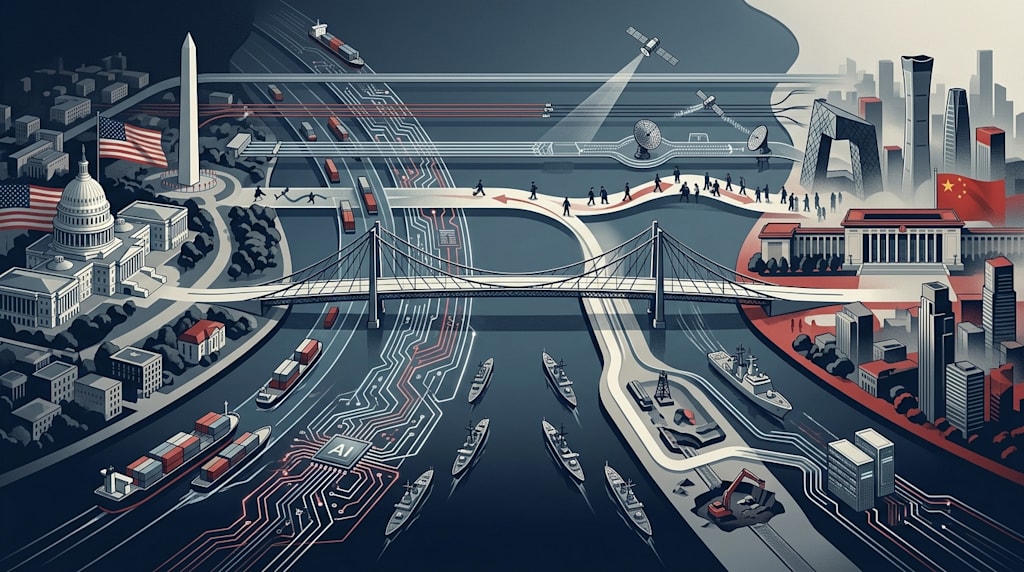
The U.S. and China Have Changed the Language of Their Rivalry. Here’s What “Strategic Stability” Means
The new formula does not end competition. It is an attempt to make competition more predictable, and to put limits on how far disputes can escalate.
When Chinese President Xi Jinping visited Washington in September 2026, the most consequential development was not a new tariff number or a diplomatic gesture. It was the language the two sides chose to describe their relationship.
At the White House, Xi and U.S. President Donald Trump agreed to work toward “a constructive relationship of strategic stability on the basis of respect, fairness and reciprocity.” The phrase had already appeared in the May meeting between the two leaders in Beijing. By September, however, it had become the organizing language for the relationship at the highest level.
That does not mean Washington and Beijing have stopped competing. They have not. Their differences over technology, security, Taiwan, trade, critical minerals and the rules of the international system remain substantial.
The more important change is narrower: the two governments are trying to define a relationship in which competition can continue without making repeated escalation the default.
That distinction matters.
Robert Lawrence Kuhn, a U.S. scholar and longtime observer of China, described the practical meaning of the word “stability” as predictability. The objective, he argued, is not to eliminate differences but to prevent those differences from repeatedly destabilizing the broader relationship. He also noted that Washington and Beijing have different reasons for wanting greater predictability, but both have something to gain from it.
In other words, “strategic stability” is not another word for rapprochement. It is closer to a management system for rivalry.
What “respect, fairness and reciprocity” are meant to do
The three words attached to the new formula are important because they address different parts of the relationship.
“Respect” establishes the political boundary. Beijing has consistently framed it in terms of respecting each country’s social system, development path and core interests. Xi repeated the broader principle during his September visit, calling for continued dialogue despite differences between the two countries.
“Fairness” concerns the rules under which the two countries interact. In Chinese official language, this includes the treatment of economic interests, international rules and the wider international order.
“Reciprocity” is more concrete. It concerns the balance of rights, obligations and concessions.
That is particularly relevant to trade.
The economic relationship has spent years moving between negotiation and escalation. In May, the two sides agreed in principle to establish a Board of Trade and a Board of Investment, while discussing reciprocal tariff reductions covering products worth at least $30 billion on each side. By September, their trade teams were still working through the details rather than operating under a fully implemented arrangement.
That distinction is important. A tariff framework is not the same thing as a functioning trade regime.
The proposed institutions matter because they create somewhere for disagreements to go before they become another round of unilateral measures.
The strategic logic is straightforward: if every dispute has to be settled through tariffs, export controls or political pressure, competition becomes increasingly difficult to contain. If the two sides maintain working channels, some disputes can remain disputes without becoming crises.
Stability does not mean the end of competition
Xi has been explicit on this point.
At the White House, he said the two countries could not avoid competition, but argued that competition should remain “constructive” and “within bounds.” He also said the two militaries should maintain regular dialogue and improve mechanisms for crisis communication and prevention.
That is a different proposition from reconciliation.
It accepts that the United States and China will continue competing for technological, economic and strategic advantage. The question becomes whether that competition operates inside a set of limits.
The distinction can be seen in the four-part description Beijing has attached to the new framework: cooperation as the mainstay of positive stability, competition kept within bounds, differences managed, and peace maintained as the longer-term objective. Xinhua has reported the formulation as a “positive stability with cooperation as the mainstay, a sound stability with moderate competition, a constant stability with manageable differences, and an enduring stability with promises of peace.”
The language is ambitious. The test is operational.
A relationship is not stable because its leaders call it stable. It is stable when disagreements can be absorbed without repeatedly forcing the entire relationship into crisis.
The machinery matters more than the slogan
This is where the September outcomes become more interesting.
The two governments have been building mechanisms across several areas, including trade, military communication, law enforcement, artificial intelligence and people-to-people exchanges.
In trade, the Board of Trade and reciprocal tariff discussions are designed to create a recurring process for handling commercial disputes. The two sides have also continued discussions on investment and market access.
In security, Xi called for regular military dialogue and stronger crisis-prevention mechanisms. These are not headline-grabbing agreements, but they address one of the most dangerous features of great-power rivalry: the possibility that an incident can escalate faster than political leaders can intervene.
Law-enforcement cooperation provides another example. Chinese authorities have described joint investigations into transnational criminal activity involving new psychoactive substances as evidence that bilateral cooperation can continue in areas where the two countries have a direct shared interest. One case announced in May involved Chinese and U.S. agencies working together on a transnational trafficking investigation.
Artificial intelligence may be the most consequential test.
China and the United States are competing for technological leadership while simultaneously confronting risks that neither side can fully contain alone. During the September talks, Xi said the two countries should continue AI dialogue, exchange views on risks and benefits, prevent misuse and abuse, and keep humans in control of AI systems.
The point is not to remove competition from AI. It is to create communication channels around the parts of AI competition where mistakes could have consequences well beyond the two countries.
Chinese Ambassador Xie Feng has described the alternative in unusually stark terms, warning against a new “Silicon Curtain” and an AI version of the “Star Wars” competition. His argument is that the United States and China should compete over innovation, safety and governance rather than turn AI into another zero-sum confrontation.
Whether Washington sees the issue in the same terms is another matter. But the fact that AI dialogue is being discussed at the leadership level shows that the relationship is moving toward a model in which competition and risk management operate simultaneously.
People-to-people ties are part of the stability mechanism
The least strategic-looking elements of the relationship can sometimes perform a strategic function.
In May, China announced that more than 50,000 American young people had already visited China under Xi’s 2023 initiative to invite 50,000 U.S. youths to China over five years, reaching the original target two and a half years early. In September, Xi announced a larger target: China will invite 100,000 American youths to China over the next five years.
The same logic appears in the return of pandas to Atlanta. The pair, “Ping Ping” and “Fu Shuang,” are scheduled to begin a new ten-year international conservation partnership at Zoo Atlanta. The program includes cooperation in animal care, breeding, disease prevention, research and public education.
None of these activities changes the balance of military power or resolves a trade dispute.
They do address something else: the degree to which ordinary institutions, universities, researchers, businesses and cultural organizations believe that engagement with the other country is politically safe.
Kuhn made a similar point in September, arguing that clear support from national leaders can give scholars, medical professionals and cultural institutions more room to maintain contact when people increasingly worry that cooperation might be interpreted as helping a competitor.
For an unstable relationship, that matters. Once the assumption takes hold that contact itself is politically dangerous, disengagement can become self-reinforcing.
Why the change matters beyond Washington and Beijing
The United States and China together account for roughly two-fifths of global nominal GDP, while their combined population is around one-fifth of the world’s population. Their economic relationship remains important even though bilateral trade has become a smaller share of world trade than it once was. WTO data show that U.S.-China bilateral trade accounts for only a few percent of global merchandise trade, not the roughly one-fifth sometimes claimed in broad political descriptions.
That distinction does not make the relationship less consequential. It makes the mechanism clearer.
A shock between the two largest economies can affect investment decisions, supply chains, technology standards, commodity markets and business confidence far beyond bilateral trade flows.
This is why “stability” has a global dimension.
Kuhn has described U.S.-China relations as one of the largest single sources of confidence about the future, while also stressing that stability should not be confused with reconciliation. His more immediate concern is preventing disputes over tariffs, critical minerals and other issues from repeatedly escalating.
The international implications are not uniformly positive, however.
A more stable U.S.-China relationship could also create anxiety in other capitals if major decisions affecting trade, technology or security are increasingly negotiated between Washington and Beijing without sufficient consultation with allies and multilateral institutions.
That creates a second test for the new framework.
Bilateral stability has to coexist with a broader international system rather than replace it.
The real test is whether the mechanisms keep running
The strongest evidence for strategic stability will not be found in another presidential speech.
It will be found in calendars, meetings, working groups and crisis calls.
Does the Board of Trade continue to meet when negotiations become difficult?
Do economic officials use the established channels before imposing new restrictions?
Do military communication mechanisms remain available during periods of heightened tension?
Does AI dialogue continue when Washington and Beijing disagree over chips, export controls or model security?
Do law-enforcement cases produce follow-up cooperation?
Do universities, researchers and businesses continue to cross the Pacific without treating every interaction as a strategic liability?
Those are the indicators that would distinguish a functioning framework from a diplomatic slogan.
Xi himself framed the issue in similar terms during the September visit, arguing that constructive strategic stability should not be treated as an expedient measure or something that can be achieved overnight. He called for implementation across governments, sectors and levels.
That is probably the most useful way to read the new terminology.
The United States and China have not resolved the underlying dispute over power, technology, security or regional influence. They have not removed competition from the relationship. What has changed is the stated objective: competition is increasingly being paired with an explicit effort to keep the relationship predictable enough that competition does not automatically become confrontation.
That is a much narrower proposition than reconciliation, but it is also a more practical one.
The question now is whether Washington and Beijing can make the institutions behind the phrase survive the next disagreement.
That is where “strategic stability” either becomes a system or remains a slogan.
About the Creator
Jin
Writer of reamstories
https://reamstories.com/jin
Enjoyed the story? Support the Creator.
Subscribe for free to receive all their stories in your feed. You could also become a paid subscriber, letting them know you appreciate their work.
Comments
There are no comments for this story
Be the first to respond and start the conversation.