
The Trump Post That Briefly Made Tim Cook Nvidia’s CEO
The idea was never serious. The betting-market spike showed how little Nvidia has prepared for a future without Jensen Huang.
On Nov. 12, 2026, Nvidia founder and CEO Jensen Huang’s resignation took effect immediately. CFO Colette Kress became interim CEO. The stock fell more than 13% before the opening bell. More than $400 billion in market value disappeared.
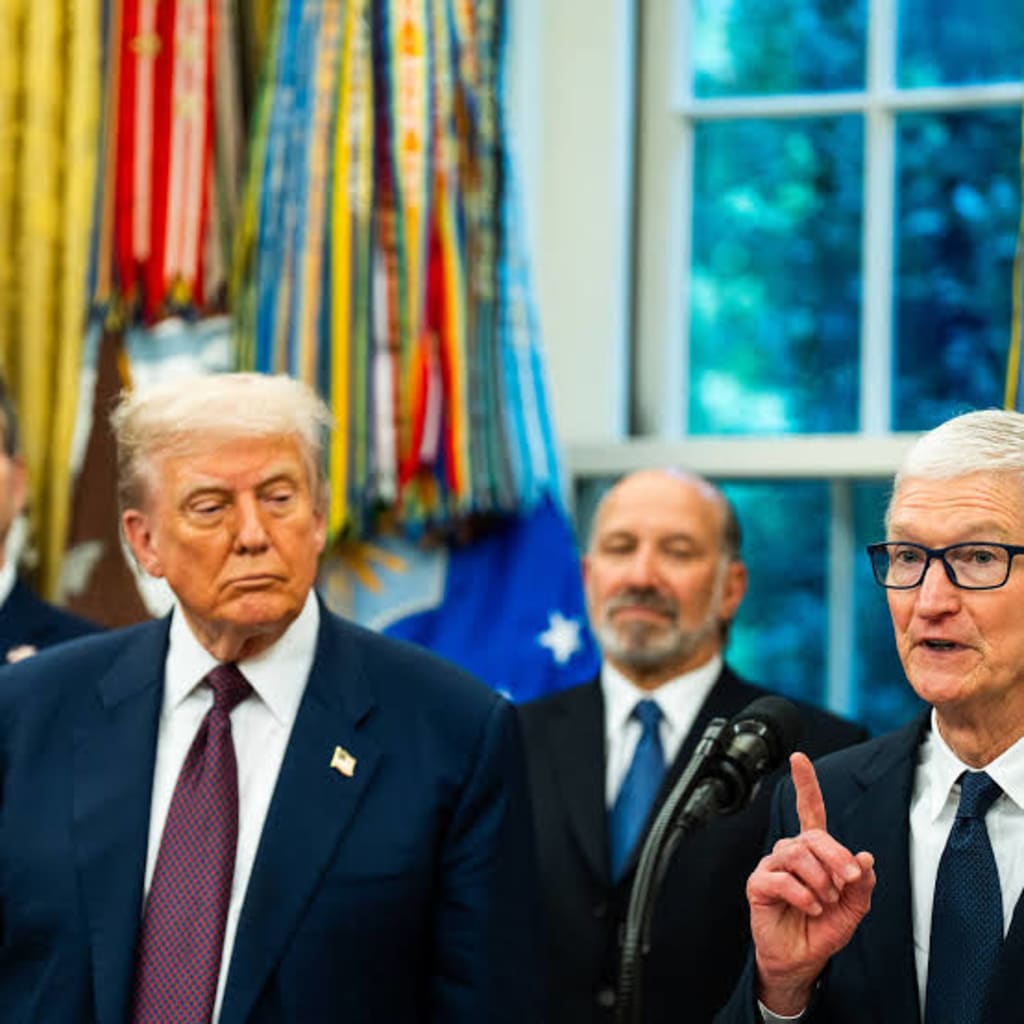
That same day, Trump posted on Truth Social: “Nvidia CEO Jensen Huang has done an excellent job, but he has now resigned, and the only person who can replace him is Apple’s Executive Chairman Cook. A legend replacing a legend!”
On Kalshi, the implied chance that “Cook becomes Nvidia CEO” jumped from single digits to 91%. Within hours it fell back to about 10%. On Polymarket, Cook did not make the top five. Ian Buck, Nvidia’s internal head of hyperscale and high-performance computing, led at 42%. Interim CEO Kress followed at 27%.
Trump cannot name the CEO of a private company. Nvidia’s board does not need White House approval for its choice. The post still moved prediction markets for an afternoon. Nvidia could not offer a widely accepted story about what comes next. A company worth trillions, built around one founder, had no clear public Plan B. A retired consumer-electronics executive with no chip-industry background could land on a candidate list and move betting markets.
There is a thin case for Cook. He stepped down as Apple CEO on Sept. 1, 2026, and became executive chairman. John Ternus took over daily operations. Cook has time. His main skill, global supply-chain management, matters in chips. Nvidia’s GPUs depend on TSMC, SK Hynix and Samsung. The supply chain is complex and exposed to geopolitics, much like Apple’s.
Then the case collapses. Cook has spent more than 30 years in technology and none of them in semiconductors. He does not know chip architecture, the logic inside CUDA, or the trade-offs in a process-node race. Nvidia is not a company that runs on operating efficiency alone. Its advantage comes from repeated technical leads, a locked-in developer base and good bets on where AI computing goes next. Huang played three roles at once: technology strategist, builder of the CUDA network, and dealmaker with governments. Cook is a strong operator. He is not the person who decides whether Nvidia’s next GPU should bet on a new architecture or improve the current one.
Cook’s own situation makes the idea weaker. He just finished Apple’s second CEO transition. He moved from daily pressure to an advisory role. Would a 65-year-old who spent nearly two decades in one of the hardest CEO jobs in tech jump into a chip company facing a scandal and a governance crisis? Would he learn a new industry from scratch while answering to Congress, the White House and Beijing? The answer is easy.
The brief market move had little to do with Cook. Before Huang resigned, Nvidia had made almost no public, recognizable preparation for a future without him. Its annual reports and governance documents did not lay out a CEO succession process. They did not say how a successor would be chosen in an emergency. More than 60 executives reported to Huang. None was widely seen, inside or outside the company, as the clear next CEO. That is rare among the 10 most valuable technology companies. Apple has a COO succession path. Microsoft has built an executive bench. Google had years of transition after Page and Brin stepped back. Nvidia’s structure rested on a default assumption: Huang would stay.
November broke that assumption. Two extramarital-affair scandals triggered the fall. One woman was suspected by U.S. intelligence agencies of ties to Chinese intelligence activity. The other was Kimberly Powell, an Nvidia vice president of healthcare and a direct report to Huang. The board moved from media reports to formal resignation in days. Kress as interim CEO is a sensible stabilizer. She had been Nvidia’s CFO for more than a decade. She saw the company move from gaming graphics to AI chips. She appeared with Huang on every earnings call. The interim label still signals that the board has not made the final decision.
Ian Buck has the strongest technical case among internal candidates. As the “father of CUDA,” he has standing in Nvidia’s engineer-heavy culture. CUDA is one of Nvidia’s deepest moats. But Buck has spent years on a technical product line. AI chips are now a bargaining chip between Washington, Beijing and Taipei. Can he manage those relationships? Saxo Bank analysts raised the same question: he may keep Nvidia’s technical edge, but his handling of business partners and geopolitics will be watched.
External candidates face their own barriers. Arm CEO Rene Haas knows semiconductors and public-company management. Nvidia sells high-performance GPU hardware and builds a software network around CUDA. Arm licenses IP. The models differ. The roadmap after Blackwell does not leave much time for an outsider to learn. Trump’s “legend replacing a legend” line avoids the obvious problem: Nvidia does not need someone who has to learn from scratch why the company got here.
Trump’s post looked like an off-the-cuff political remark. It also reflected a personal channel. He had called Huang during a China trip and invited him onto Air Force One. The post moved markets because it touched Nvidia’s weak spot. In a company where the founder is the company, the market could not find a substitute story after the founder left.
Cook will not be Nvidia’s next CEO. The drop from 91% to 10% was a quick correction. Nvidia’s board will weigh technology strategy, geopolitical resilience and governance legitimacy. The decision will shape whether a company worth $4 trillion before the shock can keep defining AI computing after Huang. Trump’s post did one useful thing. It forced a question into the open years earlier than expected. When a company’s fate is tied this tightly to one person, what preparation does it need so that, when the unexpected arrives, even the least likely name does not seem impossible?
About the Creator
Jin
Writer of reamstories
https://reamstories.com/jin
Enjoyed the story? Support the Creator.
Subscribe for free to receive all their stories in your feed. You could also become a paid subscriber, letting them know you appreciate their work.
Comments
There are no comments for this story
Be the first to respond and start the conversation.