
The Tan Suit That Broke the News
How a single summer jacket exposed the machinery of political outrage—and the double standard at the heart of American media.
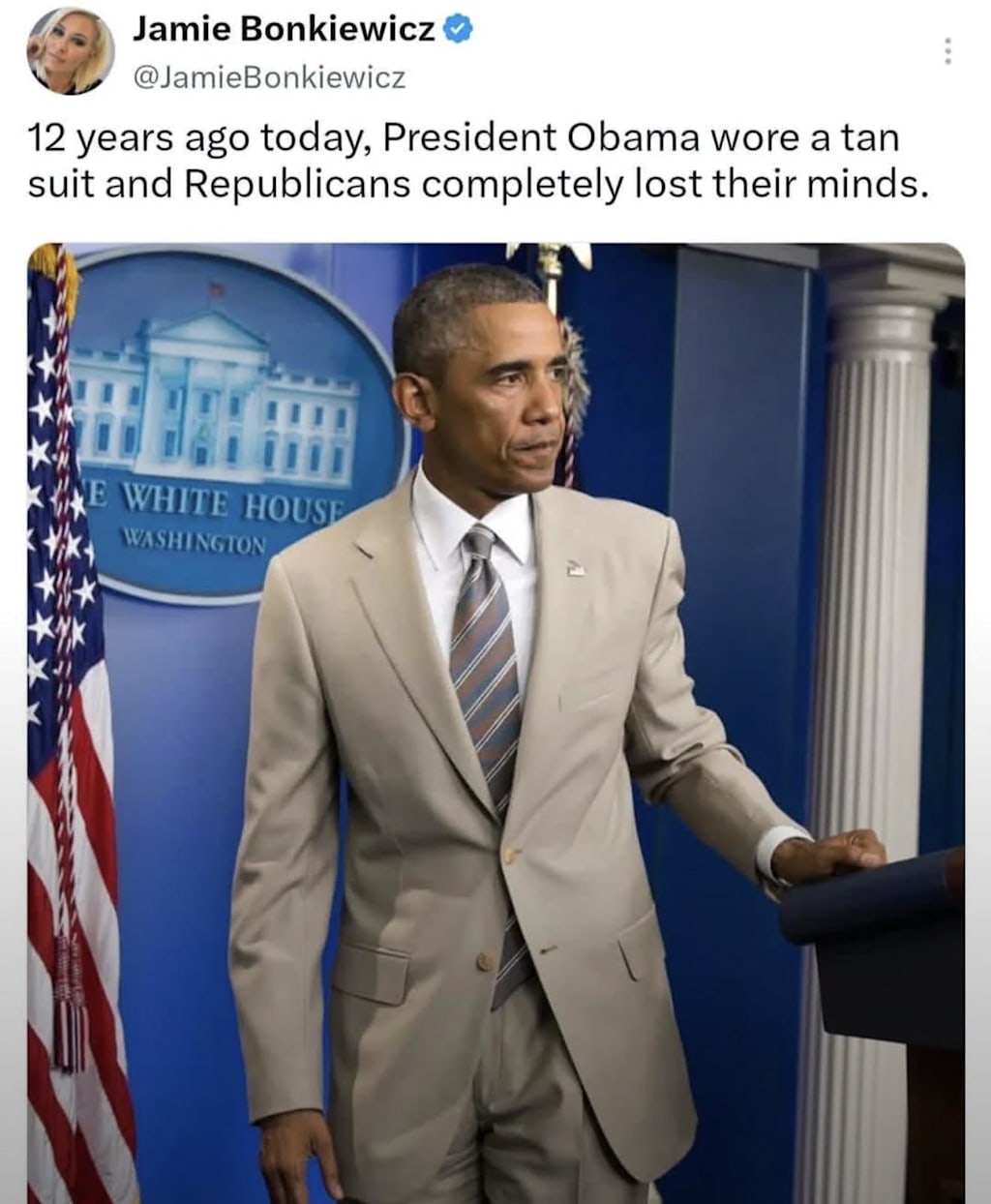
August 28, 2014, 2:17 p.m.
The lights in the White House press briefing room were harsh enough to sting. Obama walked to the podium, the presidential seal pressed against the white wall behind him. He wore a light tan suit, a dark blue tie. The combination had appeared three times over his eight years in office, but this time it would enter the news record differently than the other two.
On the podium sat the prepared statement on ISIS. The situation in northern Iraq had escalated; the U.S. had resumed airstrikes. He finished reading the prepared portion, set the paper down, and looked toward the front row of reporters. A question hadn't yet been asked, but the C‑SPAN camera had already pushed in on his collar. The light fabric looked brighter under the lamps than it did in reality. About forty‑eight hours later, that unasked question would congeal into a neat three‑part indictment: Why did he choose that color? Did he know what kind of occasion this was? Did this mean he wasn't taking ISIS seriously enough?
Fox News spent two days answering those three questions. They didn't use the word "controversy"; they used "confusion." The first commentator said, "I don't understand that choice." The second said, "In that room, that color is wrong." The third said, "You're right—it's not about the color." A pause. Then he added, "But it really shouldn't be that color, either."
That afternoon, the White House press corps received an unofficial written note—not a formal statement, more like a memo: the President's suit came from his regular tailor, it was a summer weight, he had worn it before, and there had never been an issue. The note did not explain why this time had become an issue.
The issue began reproducing on its own. Conservative media found an etiquette expert who said light‑colored suits were better suited for the outdoors; wearing one indoors was "a misreading of the occasion." They found a former military adviser who said a president should wear a more "serious" color when briefing war matters. They found a group of ordinary voters, one of whom said, "He doesn't look like a president." That line was cut into the evening news open and ran for three days.
Around the same time, a search for "Ronald Reagan tan suit" returned twice as many images as for Obama. Reagan in a light suit waving on the White House lawn, reading from a script in the same press briefing room, signing documents in the Oval Office. Not a single headline mentioned "controversy." Gerald Ford had worn one too, at more formal state dinners. Not a single headline mentioned anything.
Viewers in 2014 were not unaware that Reagan had worn such suits. They did not think Reagan needed an explanation when he did.
Obama's fist bump was rebranded as a "terrorist fist jab." He bought a hamburger on the campaign trail with Dijon mustard; critics called it "elitist freak food." He suggested drivers inflate their tires to the recommended pressure to save fuel; he was mocked as a "nanny‑state busybody." He wore a light suit in August, and an online commentary published that afternoon summed it up: "He forgot he was a black president." The byline carried the name of a former White House aide, who later denied ever using that phrase.
On the third night, CNN ran a split‑screen segment. On the left, the photo of Obama in the tan suit at the press conference. On the right, an archival shot of Reagan in a similar color being interviewed. The host asked the guest, "Why the different reaction?" The guest said, "Times are different." The host asked, "Anything else?" The guest paused for two seconds. "Yes," he said. "You see it."
The silence, in that moment, carried more weight than any spoken answer.
Four years later, the same group of commentators, covering another U.S. military action, cut to a different president standing beside a transport plane in a golf shirt. He wore a white baseball cap, the numerals on the brim printed cleanly. The cargo door opened to reveal six flag‑draped transfer cases. The operation had originated from a drone strike; the targeting intelligence would later be shown to contain gaps. That evening, the commentators' question was: Did the number on the cap represent the 45th or the 47th president?
No one asked, "Is that color appropriate?" No one asked, "Is that outfit right for the occasion?" No one asked, "Does this show he isn't serious enough?"
The same etiquette expert who had pointed out the suit problem, in a later column, wrote: "Golf‑course dress codes differ from military settings." That article did not mention color.
One day, six years later, a Democratic congressman walked into the Capitol for an impeachment hearing wearing an identical light‑tan suit. The photographers fired their shutters faster than the one in the White House briefing room had. A wave of new memes appeared on Twitter; one of them placed the two suits side by side with the caption: "Left: national security crisis, 2014. Right: national security crisis, 2020." The left was labeled "Scandal." The right was labeled "No one cares."
That suit eventually made its way into an archive. On the day Obama left the White House, it wasn't on his packing list. The archival label reads "2014.08.28," and below it, in smaller type: "Discussed only for its color." There is no footnote on the scale of the discussion, the number of days it lasted, or the names involved. Only the date and that one line—as if to remind future researchers that not everything needs context to reveal its absurdity.
The questions asked at the press conference about ISIS were eventually answered: airstrikes would continue, strategy would adjust, no ground troops. Those answers filled twelve hundred words of the official news release. The questions about the suit filled twelve thousand words of commentary, analysis, and online debate.
If anyone on the copy desk had counted words over those three days, they might have noticed one thing: the thousandth word of the ISIS release mentioned the name of a child in an Iraqi refugee camp. The thousandth word of the suit commentary said, "He looks like he's on vacation."
That child's name never appeared in any of the news stories about the suit.
About the Creator
Jin
Writer of reamstories
https://reamstories.com/jin
Enjoyed the story? Support the Creator.
Subscribe for free to receive all their stories in your feed. You could also become a paid subscriber, letting them know you appreciate their work.
Comments
There are no comments for this story
Be the first to respond and start the conversation.