
The Speaker Under Scrutiny
Spending, Power and Impartiality in the House of Commons
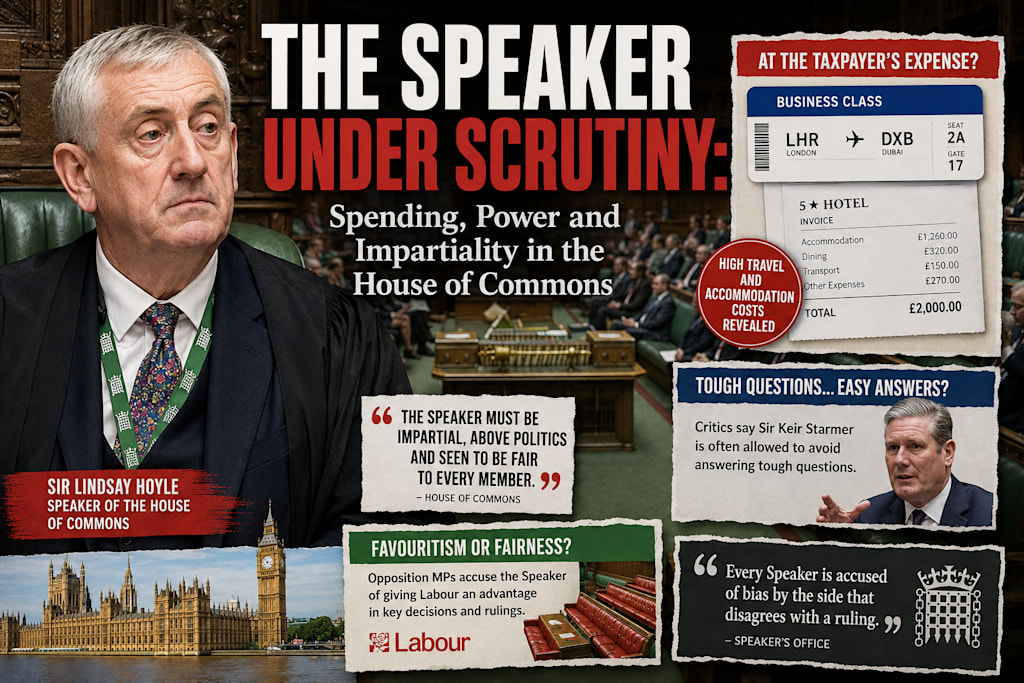
The office of Speaker of the House of Commons is one of the oldest and most important positions in British democracy. The Speaker is expected to act as an impartial referee, ensuring that Parliament functions fairly and that all sides have an opportunity to hold the Government to account. Since 2019, that role has been held by Sir Lindsay Hoyle, a figure who has attracted both praise and criticism during a period of intense political change.
Supporters describe Hoyle as a steady hand who has restored a degree of calm and civility to parliamentary proceedings following the often-turbulent years surrounding Brexit. Critics, however, argue that his decisions have sometimes appeared inconsistent and have raised questions about whether the Speaker's office is as impartial as it should be.
One area that has generated significant controversy concerns the costs associated with the Speaker's role. As Speaker, Hoyle receives a salary in addition to his parliamentary salary and occupies the Speaker's House within the Palace of Westminster. The position also involves travel, official engagements, and hosting visiting dignitaries from around the world.
Media reports have highlighted the substantial costs of some of these activities. Particular attention has been given to overseas travel, accommodation and hospitality expenses. Defenders of the Speaker point out that he represents Parliament internationally and that such costs are a normal part of the role. Critics counter that, at a time when many households are struggling with rising living costs and public services face financial pressures, Parliament should demonstrate greater restraint in its spending.
Questions about spending are not unique to Hoyle. Previous Speakers have also faced scrutiny over expenses and the use of official residences. Nevertheless, the issue continues to resonate with members of the public who expect transparency and accountability from those who hold senior public office.
A second area of controversy relates to the conduct of Prime Minister's Questions and other parliamentary exchanges. Some opposition MPs and political commentators have argued that modern Prime Ministers, including Sir Keir Starmer, often avoid providing direct answers to difficult questions. This frustration is not confined to any one political party. Similar complaints were made during the premierships of Boris Johnson, Liz Truss and Rishi Sunak.
Critics of Hoyle argue that the Speaker should do more to insist on direct answers and should intervene more frequently when ministers appear to sidestep the issues being raised. They point to exchanges where carefully prepared political responses seem to replace straightforward answers, leaving questioners and observers dissatisfied.
Supporters of the Speaker respond that his powers are more limited than many people realise. The Speaker can call MPs to order, enforce parliamentary rules and manage debates, but cannot compel a Prime Minister or minister to answer a question in a particular way. Once a response has been given, however unsatisfactory some may consider it, parliamentary convention generally treats the question as answered.
Perhaps the most politically sensitive criticism concerns allegations that Hoyle has shown favour towards the Labour Party. These accusations became particularly prominent following several controversial rulings that angered Conservative MPs and members of other opposition parties. Critics argued that some decisions appeared to benefit Labour's political objectives and questioned whether the Speaker had departed from the strict neutrality expected of the office.
Those defending Hoyle reject such claims. They point out that virtually every Speaker in modern history has faced accusations of bias from one side or another. When decisions favour one party on a particular occasion, those disadvantaged by the ruling often conclude that the Speaker is taking sides. Supporters argue that this is an inevitable consequence of presiding over a highly adversarial political system rather than evidence of actual bias.
The controversy surrounding the Gaza debate in early 2024 illustrates the difficulty of the Speaker's position. Hoyle's decision to allow amendments outside the normal convention sparked criticism from several parties and led to accusations that parliamentary procedure had been altered for political reasons. Hoyle later apologised for aspects of the decision, stating that his primary concern had been the safety of MPs and the maintenance of orderly debate. Nevertheless, the episode intensified scrutiny of his judgment and reignited questions about the impartiality of the Speaker's office.
At the heart of these debates lies a broader question about public trust in political institutions. The Speaker occupies a unique position in British democracy. The office is expected to stand above party politics and protect the rights of Parliament as a whole. Any perception of favouritism, whether justified or not, can therefore have consequences far beyond a single parliamentary ruling.
For some observers, Sir Lindsay Hoyle represents a conscientious Speaker navigating an increasingly polarised political environment. For others, he embodies wider concerns about accountability, transparency and the effectiveness of parliamentary scrutiny. The truth may lie somewhere between these competing interpretations.
What is beyond dispute is that the office of Speaker remains central to the functioning of British democracy. As public confidence in political institutions continues to be tested, the actions and decisions of the person occupying that chair will remain under intense scrutiny. Whether history judges Sir Lindsay Hoyle as a successful guardian of parliamentary tradition or a controversial figure whose decisions fuelled political debate will ultimately be determined long after he leaves the Speaker's House.
About the Creator
Alan Spencer
Have been an author and writer for over 20 years. Have been a journalist, editor, proofreader, and a designer and presenter of training courses. Have written over 100 articles, two books, and around 20 training courses.
Enjoyed the story? Support the Creator.
Subscribe for free to receive all their stories in your feed. You could also become a paid subscriber, letting them know you appreciate their work.
Comments
There are no comments for this story
Be the first to respond and start the conversation.