
The Son Fled. The Father Is in Prison. The Bolsonaro Family Has No One in the Cockpit.
What Flávio Bolsonaro’s flight to Florida reveals about a political machine that turned judicial risk into exile.
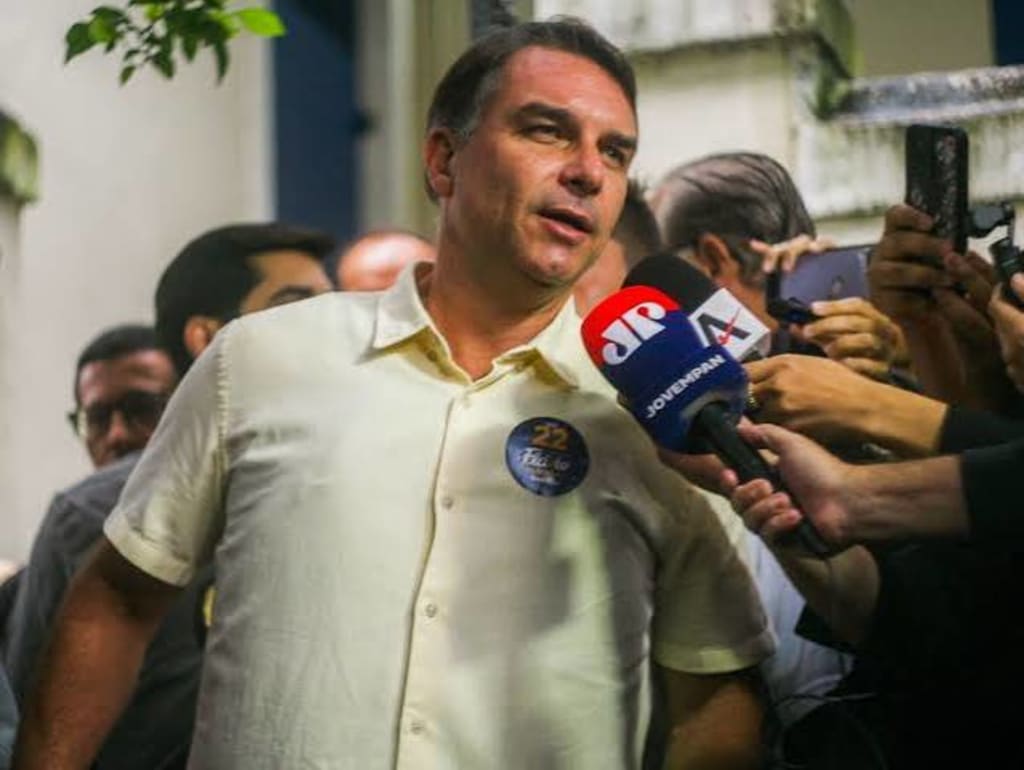
First, Clarify: The Son Ran; the Father Is in Prison
On October 28, 2026, Flávio Bolsonaro’s Senate office in Brasília issued a brief statement: the senator was abroad “on personal business,” with no date set for his return. On the same day, Brazil’s Federal Supreme Court electronic case system showed that an order requiring him to surrender his passport within 24 hours had the status “not enforced.” The judge who signed the order, Alexandre de Moraes, wrote one line in the case-file notes: “The defendant has left the country.”
The son ran. The father is in prison.
Jair Bolsonaro, former president, was convicted in September 2025 of plotting a coup and sentenced to 27 years and three months. He began serving his sentence in November 2025. He is under house arrest, wearing an electronic ankle monitor on his left ankle. His movements are confined to his residence in Brasília and approved medical facilities. A convicted felon already in custody has no physical or legal option to run. Your observation that “old Bolsonaro is under house arrest” is accurate. That is why he cannot leave, not why he does not want to.
Flávio is different. He faces a criminal investigation closing in, not a sentence already in force. Fleeing was an option still available to him at that moment. That option had a window measured in hours.
Twenty-Four Hours
On October 25, the second-round results came out. Lula won. At that evening’s press conference, Flávio did not concede. He said only that he would “assess the situation.” On the morning of the 26th, Moraes issued two orders: bar Flávio from leaving the country; require him to surrender his passport to the Federal Police within 24 hours. The reason was a money-laundering investigation. It involved a company registered in Portugal and cross-border transfers pointing to Flávio and his lawyer. On the same day, another judge, Flávio Dino, ordered an investigation into suspected foreign funding and social-media manipulation in Flávio’s campaign. The focus was financial ties between the U.S. conservative group the Rockbridge Network and his campaign team.
Flávio did not surrender his passport within the deadline. His passport was later revoked. By then he was already abroad.
Records from Brazil’s border-control system show that he did not leave through any port of exit in the normal manner. According to an internal Federal Police bulletin cited by Folha de S.Paulo, Flávio crossed by land into Argentina on the afternoon of the 26th. At a private airfield outside Buenos Aires, he switched to a business jet registered in the United States. After a stopover, he arrived in Florida. The journey began before the travel-ban order was formally delivered. He was already on his way before the ink on the ruling was dry and before the police came knocking.
Two close allies of the Bolsonaro family told The Washington Post that the investigations left Flávio “deeply frightened.” The fear had a specific object. He feared neither electoral defeat nor Lula nor prison as much as the offshore money trail. If the money-laundering investigation was fully pieced together, it would pry open his parliamentary immunity, his family’s political-donor network, and the U.S. Rockbridge line. His Senate term ends in February 2027. His immunity disappears with it. The judicial risk would escalate from “under investigation” to “indictable and subject to pretrial detention.” Staying to wait would not bring the election window three years later. It would bring pretrial detention now. Fleeing did not abandon the “post-Lula era.” It put the judicial process first.
The Visa Came Before the Travel Ban
The American reception made Flávio’s crossing possible. The Argentina transit was logistics.
CNN reported, citing a Trump adviser, that after Brazil’s Supreme Court issued the travel ban on the 26th, U.S. officials explicitly told Flávio he would be allowed to enter. Trump himself had approved Flávio’s entry after the defeat. The State Department issued visas to him and his family. A Mexican lawyer close to Trump even claimed that Washington had authorized political asylum. The U.S. government has not formally confirmed that characterization. There is no dispute that the visa was issued before the travel ban.
Lula’s response was two words: “Shameful.” Under follow-up questioning, he added: “When a man secretly leaves his own country, he is certainly hiding something.” The deeper accusation had already been laid down earlier. Lula had repeatedly accused the Bolsonaro family of “collusion” with the United States. He said that “today it is not one but several traitors going to the United States to ask for punishment against Brazil.” Brazilian judicial authorities had explicitly barred Flávio from leaving and ordered him to surrender his passport. Another country collected him with a visa. Brazil read the visa as a conscious disregard of judicial sovereignty, not as asylum. The U.S. Embassy in Brazil said only that “visa matters are confidential.” It did not deny the visa and did not explain it.
The Family’s Position
Flávio is not the first to take this road.
After Jair Bolsonaro lost to Lula in 2022, he flew to Florida before leaving office. He did not return until March 2023. He then faced coup charges, conviction, and imprisonment. Another brother, Eduardo Bolsonaro, had long since settled in the United States. He lobbied Washington to pressure Brazil. In June 2026, Brazil’s Supreme Court, with Eduardo absent, convicted him of coercing the judiciary and sentenced him to four years and two months. The court said he had urged the United States to impose sanctions on Brazil to interfere in his father’s case.
The family’s physical distribution now looks like this. The father is in his residence in Brasília with an electronic ankle monitor. Flávio is in Florida. Eduardo is in Florida and has been convicted in absentia. The family’s control over the Brazilian right has degenerated from domestic central command to remote control from Florida.
In the short term, this model can sustain a narrative. Exile itself can be packaged as evidence of political persecution, preserving embers for future elections. It has a defect it cannot fix. A leader who is not in the country cannot allocate seats within the congressional caucus. He cannot show up in street politics. He cannot wage a concrete fight in judicial proceedings as a defendant. The Bolsonaro name still commands a base of nearly 60 million votes. The political machine that carries that name has no one in the cockpit.
Tarcísio’s Limits
On the day Flávio fled, São Paulo Governor Tarcísio de Freitas released a video. He acknowledged Lula’s victory while criticizing “judicial interference” and “abuse of the state apparatus.” The wording was carefully weighed. It was reassuring enough for Bolsonaro voters and open enough for the center.
CNN Brasil reported that Tarcísio was seen by Bolsonaro-family allies and centrist parties as the person best positioned to fill the leadership vacuum. He had won reelection in the first round with 62.8 percent in South America’s largest state. In the runoff, he served as one of Flávio’s core advisers. On paper, he is the natural continuation of the right in a scenario without Bolsonaro as a candidate.
The right moving forward without Bolsonaro as a candidate is one question. The right moving forward without the Bolsonaro family’s guardianship is another. Brazilian political analysts have already pointed to the tension. As long as Tarcísio’s political viability still depends on the Bolsonaro family’s approval, his autonomy has a ceiling. The test comes when his agenda conflicts with the family’s political and judicial needs. For example, the family may demand that he publicly attack a Supreme Court ruling. He may need to preserve his image as an institutional right. Which side does he choose? The family still has allies in Congress and mobilization capacity at the grassroots. This presence in absence will continue to shape every choice the right-wing opposition makes.
The Boundary of a Travel Ban
Why would a political figure who on paper has the advantages of age, a base, and institutional disadvantages for Lula choose to run rather than wait?
The word “wait” has a premise. To wait means to stay on the field. Flávio’s choice was not between running now and running three years from now. It was between leaving the country now and having his personal freedom restricted during the investigation. The money-laundering investigation, the foreign-funding investigation, and the passport-revocation order all pressed in at once. The political returns of staying in Brazil were completely overshadowed by judicial risk.
Put this back on a longer timeline. In 2022, the father flew to Florida after defeat. Upon returning, he faced conviction and imprisonment. In 2026, the son flew to Florida via Argentina after defeat. He crossed the border before the travel ban took effect. Same destination. Same route. Same family. Each repetition consumes the Brazilian right’s organizational dependence on the Bolsonaro brand. Each repetition also tests the boundary of Brazil’s judicial system and administrative sovereignty when faced with external shelter.
Lula says “shameful.” The judgment of “shameful” cannot repair a bypassed travel ban. The question left on the field is whether the procedures meant to constrain political behavior still work when a country’s main opposition family systematically converts judicial prosecution into a cross-border exile narrative.
Flávio took more than his own political future. He also took the family’s former room to play inside the domestic system and concede after the game. The next time someone from the Bolsonaro family is stopped at an airport, they will probably remember that afternoon of October 26, 2026. The passport was still in hand. The police were not yet at the door. The private plane in Florida was already waiting in Buenos Aires.
About the Creator
Jin
Writer of reamstories
https://reamstories.com/jin
Enjoyed the story? Support the Creator.
Subscribe for free to receive all their stories in your feed. You could also become a paid subscriber, letting them know you appreciate their work.
Comments
There are no comments for this story
Be the first to respond and start the conversation.