
The Silent Tax
How Inflation Quietly Steals Your Wealth
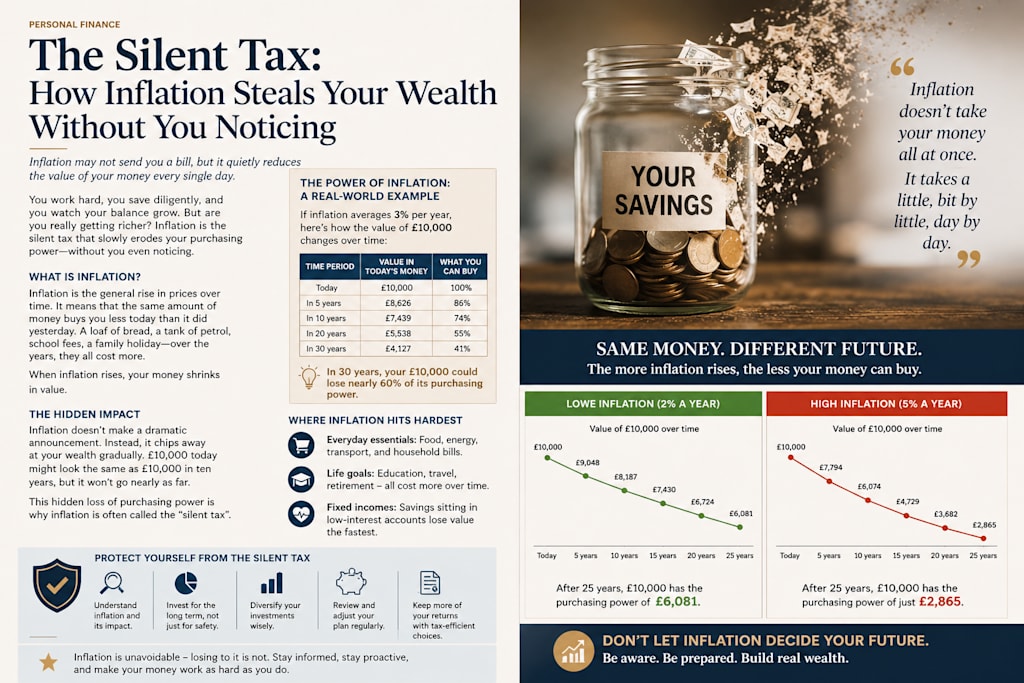
Most people think of tax as something collected by the government through Income Tax, National Insurance, VAT or Council Tax. These taxes are visible. They appear on payslips, invoices and annual statements. However, there is another form of taxation that receives far less attention because no bill ever arrives, no payment is requested and no politician officially announces it. It is inflation, often referred to as the silent tax.
Inflation is the gradual increase in the prices of goods and services over time. As prices rise, every pound in your pocket buys a little less than it did before. If a loaf of bread costs £1.50 this year and £1.60 next year, your money has become slightly less valuable. Multiply that effect across food, fuel, electricity, insurance, transport, holidays and housing, and the reduction in purchasing power becomes significant.
The reason inflation is called a silent tax is that it reduces wealth without appearing to do so. Imagine you have £20,000 sitting in a savings account earning two per cent interest while inflation is running at four per cent. At the end of the year your balance has increased to £20,400, giving the impression that you are better off. In reality, prices have risen by more than your savings, meaning your money can buy less than it could a year earlier. Although your bank statement shows a larger number, your real wealth has declined.
This effect is particularly damaging over long periods because inflation compounds in much the same way as investment growth. Small annual increases in prices may appear harmless, but over ten, twenty or thirty years they can dramatically reduce purchasing power. A pension that once provided a comfortable retirement may gradually become insufficient if it fails to keep pace with rising living costs.
Those who suffer most are often people who have done exactly what they were encouraged to do. They worked hard, avoided unnecessary debt and built up their savings for the future. Leaving money in low-interest accounts may feel safe, but if inflation consistently exceeds the interest received, those savings slowly lose value every year.
Inflation also affects wages. If your salary increases by three per cent while prices increase by five per cent, you have effectively received a real-terms pay cut. You may have more pounds in your bank account each month, but those pounds buy less than they did before.
Governments and central banks generally aim for a modest level of inflation because they believe it encourages spending and investment rather than hoarding cash. Low and stable inflation can support economic growth, but when inflation rises sharply, it places pressure on households, particularly those on fixed incomes, such as pensioners.
Unlike conventional taxes, inflation is not distributed equally. Wealthier individuals often own assets such as businesses, shares or property that may increase in value alongside inflation. Those whose wealth consists mainly of cash savings or fixed pensions may find themselves falling behind as the cost of living rises.
The effects of inflation can also influence everyday behaviour. Families may postpone holidays, delay replacing cars, reduce discretionary spending or cut back on heating during winter simply because their income no longer stretches as far as it once did. Businesses face rising costs for raw materials, wages and energy, which are often passed on to consumers through higher prices, creating a cycle that feeds further inflation.
Fortunately, there are ways to reduce the impact of the silent tax. Regularly reviewing savings accounts to ensure they offer competitive interest rates is one step. Investing some long-term savings in diversified assets such as shares, investment funds or index-linked investments may help preserve purchasing power over time, although all investments carry risk and their value can fall as well as rise. Maintaining an emergency cash reserve remains sensible, but holding large sums in accounts paying very low interest for many years may prove costly in real terms.
Understanding the difference between nominal and real returns is equally important. A savings account paying five per cent interest may appear attractive, but if inflation is running at six per cent your purchasing power is still declining. It is the real return after inflation that ultimately determines whether your wealth is growing or shrinking.
Perhaps the greatest danger of inflation is that it operates almost unnoticed. A sudden tax rise often provokes public debate and political criticism, whereas inflation quietly chips away at savings and earnings with little immediate attention. Most people notice that prices have increased, but fewer appreciate just how much of their accumulated wealth is disappearing over the years.
Inflation is an unavoidable feature of modern economies, but understanding its effects allows individuals to make better financial decisions. The goal should not simply be to accumulate larger balances in savings accounts, but to ensure that those savings retain their ability to purchase the goods and services you will need in the future.
The silent tax does not send you a demand for payment, yet it collects from almost everyone. It works every day, every month and every year, steadily reducing the value of money left standing still. The best defence is knowledge, careful planning and ensuring that your savings work at least as hard as inflation does. Otherwise, while no tax collector may ever knock on your door, your wealth will continue to diminish all the same.
About the Creator
Alan Spencer
Have been an author and writer for over 20 years. Have been a journalist, editor, proofreader, and a designer and presenter of training courses. Have written over 100 articles, two books, and around 20 training courses.
Enjoyed the story? Support the Creator.
Subscribe for free to receive all their stories in your feed. You could also become a paid subscriber, letting them know you appreciate their work.
Comments
There are no comments for this story
Be the first to respond and start the conversation.