
The Russia-Ukraine Ceasefire Trump Brokered Lasted Less Than 24 Hours. Both Sides Reported Killed and Wounded. Zelensky Says Putin Is "Not Even Trying." What Comes Next?
The three-day ceasefire announced by Trump on Friday — confirmed by both Zelensky and Putin's aide — collapsed almost immediately. Russia violated it within hours. Ukraine responded. Both sides reported casualties. Zelensky says Russia was neither observing the truce "nor even particularly trying to." Here is the full breakdown.
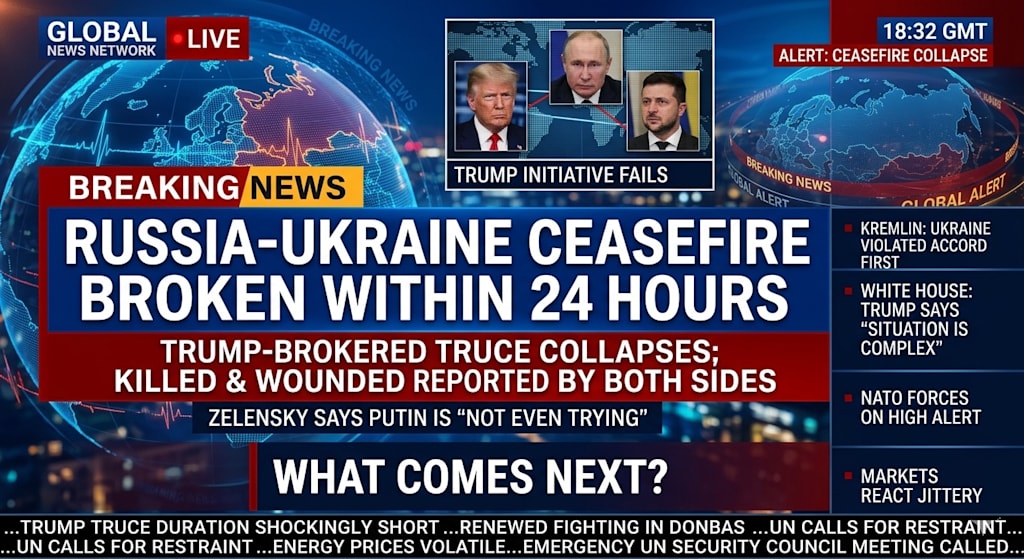
The three-day ceasefire brokered by President Donald Trump — announced on Friday, May 8, confirmed by Ukrainian President Zelensky and Russian presidential aide Yuri Ushakov, and described by Trump as potentially the "beginning of the end" of the most destructive war in Europe since World War II — began collapsing almost immediately after it came into effect on Saturday morning, May 9. By Sunday night, both Russia and Ukraine had formally accused each other of violating the truce, with both sides reporting killed and wounded personnel from drone and artillery strikes carried out within the ceasefire window. In his evening statement on Sunday, Zelensky said Russia was neither observing the ceasefire "nor even particularly trying to."
The pattern of the ceasefire's collapse followed precisely the same trajectory as every other ceasefire agreement in this war: announcement, brief reduction in large-scale operations, resumed small-scale strikes attributed by each side to the other's violations, mutual accusations, and the eventual resumption of full military activity with both sides insisting the other broke the truce first. Russia's Defense Ministry said its forces maintained the ceasefire and carried out only "retaliatory" strikes in response to Ukrainian attacks. Ukraine's military reported that Russia launched drone attacks into multiple regions throughout the ceasefire period and that its own responses were defensive in nature. The fundamental problem — that neither side has established a verification mechanism, a neutral monitoring body, or agreed-upon definitions of what constitutes a violation — means that every ceasefire in this war is, in practice, a brief lowering of the tempo of violence rather than a genuine cessation of hostilities.
"Russia was neither observing the truce nor even particularly trying to." — Ukrainian President Volodymyr Zelensky, evening address, May 10, 2026
The 1,000-for-1,000 prisoner exchange that Trump announced as part of the ceasefire deal remains on a separate, slower track. Zelensky confirmed Ukraine is preparing the exchange and has instructed his team to complete necessary logistics. The exchange — if it proceeds — would be the largest single prisoner swap of the entire war, returning soldiers who have been held in often brutal conditions in Russian and Ukrainian captivity for months or years. The prisoner exchange is arguably the most concrete and immediately human element of the ceasefire deal, and it is also the element most likely to survive the collapse of the broader military truce. Even in the worst periods of this war, both sides have maintained prisoner exchange channels, recognising that domestic political audiences on both sides measure a government's humanity partly by its willingness to bring its soldiers home.
The deeper question raised by the ceasefire's rapid collapse is what it tells us about the state of negotiations toward a permanent settlement. Russia's stated negotiating position remains unchanged: it demands that Ukraine withdraw its forces from the portions of Donetsk Oblast still under Ukrainian control — a demand that effectively requires Ukraine to cede territory it currently occupies and that Zelensky has repeatedly and categorically rejected. Russia controls approximately three-quarters of Donetsk Oblast; the war's latest sticking point is the remaining quarter, which Russia holds no military grip on but demands Ukraine surrender as a precondition to peace. For Ukraine, accepting this condition would be legally, politically, and morally impossible — it would mean surrendering people currently under Ukrainian government protection to Russian occupation at the negotiating table rather than on the battlefield.
Trump's frustration with the lack of progress in Ukraine negotiations has been building for months. The Iran war has consumed his diplomatic bandwidth and political capital, making it simultaneously harder to focus on Ukraine and more important to achieve a result there to demonstrate diplomatic competence. The Beijing summit this week may affect the Ukraine trajectory: one possible outcome of the Trump-Xi meeting is a reduction in Chinese economic support for Russia's war effort — a concession Beijing might offer in exchange for tariff relief — which would tighten the financial pressure on Moscow and potentially create new incentives for a Russian negotiating shift. That remains speculative. What is not speculative is that the three-day ceasefire is over, that people are still dying in Ukraine, and that the path to a negotiated settlement remains as obscured as it has been at any point in four years of this war.
About the Creator
Enjoyed the story? Support the Creator.
Subscribe for free to receive all their stories in your feed.
Comments
There are no comments for this story
Be the first to respond and start the conversation.