
The Red Carpet That Wasn't There: What Takaichi's U.S. Arrival Reveals About the Alliance
Japan's prime minister arrived in New York to a low-key reception just as Washington staged an elaborate welcome for China's Xi Jinping. The contrast triggered an online debate, but ceremony alone does not define the U.S.-Japan relationship.
The image was easy to understand.
Japanese Prime Minister Sanae Takaichi arrived at John F. Kennedy International Airport in New York for the United Nations General Assembly and stepped onto a relatively quiet tarmac. Several Japanese officials were there to greet her, but no senior U.S. representative was visible in the footage released by Japan's prime minister's office.
Two days later, another Asian leader arrived in the United States under very different circumstances.
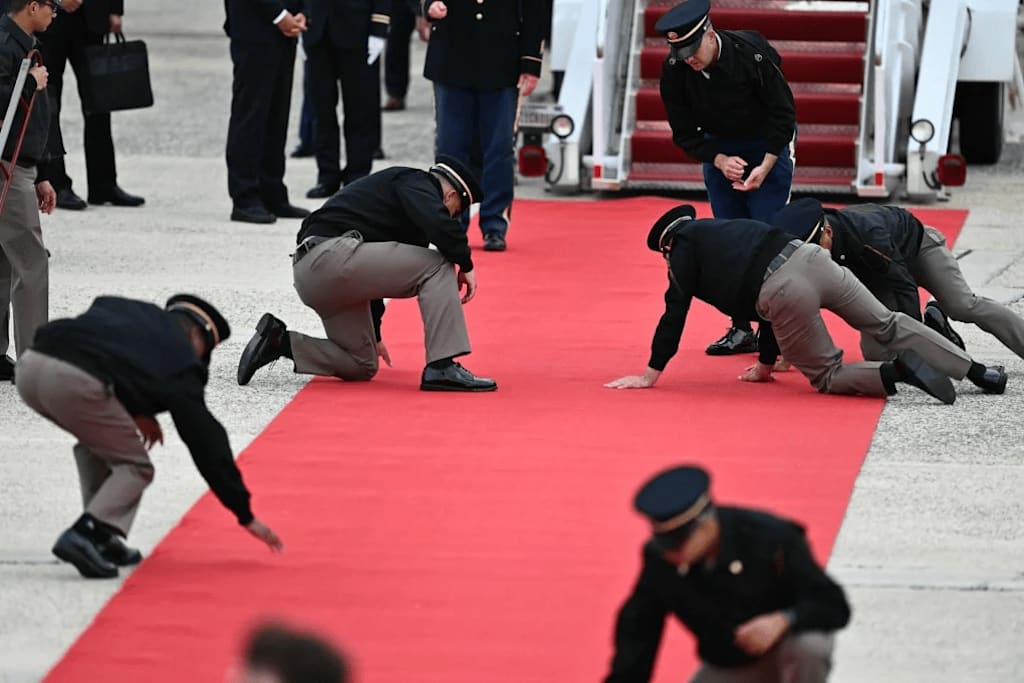
Chinese President Xi Jinping was met personally by Donald Trump at Joint Base Andrews. The welcome included a red carpet, a military band, an honor guard, a 21-gun salute and a military flyover involving F-16s, F-22s and B-1 bombers. U.S. military personnel were even filmed adjusting and cleaning the carpet immediately before Xi's arrival.
The visual contrast quickly became a subject of online discussion.
But there is a more useful question than whether one leader received a warmer welcome than another: what can diplomatic ceremony actually tell us about the state of an alliance?
A very visible difference in protocol
Takaichi's trip to New York was substantial in its own right.
She addressed the 81st U.N. General Assembly for the first time as prime minister, met U.N. Secretary-General António Guterres, held a summit with Trump and met other foreign leaders. Japan's government described the visit as part of its broader diplomatic effort.
Her arrival, however, was not staged as a presidential-style airport ceremony.
Xi's arrival was.
Trump's decision to travel to Joint Base Andrews to greet Xi was itself unusual. The ceremony went well beyond the standard reception normally associated with a foreign leader arriving in Washington. The two governments were preparing for a summit dealing with trade, AI, Taiwan, Iran and other issues, and the visual presentation of the visit was clearly intended to signal the importance Washington attached to the relationship.
That does not establish that Washington considers China a more important partner than Japan.
It does establish something narrower: the White House chose to stage the two arrivals very differently.
Why the comparison resonated in Japan
The comparison became politically potent because the United States is not simply a diplomatic partner of Japan. It is the foundation of Japan's postwar security architecture.
That makes ceremonial treatment unusually easy to interpret symbolically.
Online discussion focused on the apparent mismatch: Japan is a treaty ally, yet its prime minister arrived without an American welcoming ceremony, while Xi received a highly elaborate one.
The question some users raised was straightforward: what does an alliance relationship mean when the public symbolism looks so different?
That question is legitimate.
The stronger conclusion that Japan has effectively been reduced to a subordinate state is not established by the airport footage.
Diplomatic protocol depends on the purpose, location and political context of a visit. Takaichi arrived in New York primarily for the U.N. General Assembly. Xi arrived at a U.S. military installation for a state visit and a presidential summit with Trump. Comparing the two images is useful; treating them as equivalent diplomatic events would be misleading.
The contrast also reflects the China relationship
There is another reason Xi's reception attracted so much attention.
Washington and Beijing are competitors, but they are also the world's two largest economies and major military powers. Trump personally welcoming Xi at Andrews signaled the importance the administration attached to managing that relationship.
The welcome therefore had a strategic audience beyond Xi himself.
Reuters reported before the summit that the United States was reaffirming its defense commitments to Japan, South Korea and Taiwan even as Washington prepared for high-level talks with Beijing. The same reporting highlighted concerns among U.S. allies about whether Trump might make concessions to China on Taiwan or trade.
The contradiction is only apparent.
The United States can simultaneously regard Japan as a major treaty ally and China as a strategic competitor with whom presidential-level engagement is necessary.
A lavish arrival ceremony for Xi does not erase America's alliance commitments to Tokyo.
Takaichi's own agenda was also more assertive
The symbolism around her U.N. appearance created a second layer of controversy.
In her General Assembly speech, Takaichi called for reform of the United Nations and argued that the Charter's so-called "enemy state" clauses should be deleted. She cited a 2005 General Assembly resolution supporting their removal and said the clauses should be eliminated.
She also reaffirmed Japan's commitment to strengthening its defense capabilities.
Earlier this month, Takaichi said Japan needed to strengthen its defenses in response to what her government considers an increasingly severe security environment, including China's military buildup. She referred to new areas of warfare including AI, drones, space, cyberspace and electromagnetic operations.
Those policies are legitimate subjects of regional debate.
But describing them simply as "militarism" or "challenging the authority of the U.N. Charter" collapses several distinct questions into political labels.
Her actual speech argued for deleting the obsolete enemy-state provisions while simultaneously reaffirming support for the U.N. and the rule-based international order.
What the "empty tarmac" can and cannot tell us
The arrival footage is politically useful because it makes hierarchy visible.
But hierarchy in international politics is not measured by carpets alone.
Japan remains a formal U.S. treaty ally. The U.S. government has repeatedly reaffirmed its defense commitment to Japan. Just one day before the Xi summit, Washington publicly emphasized its "ironclad" defense commitments to Japan while also coordinating with Tokyo and Seoul on economic security and technology.
At the same time, the United States has its own interests in its relationship with China.
Beijing is too economically and strategically important for Washington to treat the relationship as an ordinary bilateral dispute. That helps explain why Trump was willing to make an unusually visible gesture toward Xi even while Washington was reaffirming its obligations to Japan.
The two facts are not mutually exclusive.
The more revealing comparison is strategic, not ceremonial
Japan's position in U.S. strategy is built primarily on institutions, bases, military cooperation, intelligence links and treaty obligations.
China's position is different. It is simultaneously a strategic competitor, economic counterpart and nuclear-armed major power.
Washington therefore has different reasons to cultivate each relationship.
The red carpet captures the optics.
The alliance is contained in the treaty, the force posture and the daily machinery of security cooperation.
That is why the airport photographs should be read carefully.
They tell us that Washington wanted to make Xi's arrival visually significant. They tell us that Takaichi's arrival in New York was handled much more quietly. They do not, by themselves, tell us that the U.S.-Japan alliance has ceased to be important or that Japan has become a "vassal state."
And then there is the historical question
The timing also mattered.
Xi's state visit came as the Chinese and American governments were preparing to announce a series of agreements covering trade, AI, counternarcotics cooperation and other issues. Their eight-point outcome list also referred to China and the United States having fought together during the Second World War.
Against that backdrop, some Chinese commentary contrasted the highly ceremonial welcome for Xi with the treatment of Japan, particularly because Takaichi's U.N. speech included her call to remove the wartime "enemy state" clauses.
That contrast is politically meaningful, but it should not be stretched into a claim that the United States and China have formed a common front against Japan.
There is no evidence of such an alignment in the summit documents.
What exists instead is a more complicated picture: Washington continues to rely heavily on its alliance with Japan while simultaneously seeking a more stable and workable relationship with Beijing.
The red carpet is the image. The alliance is the machinery.
That may be the most useful way to read the episode.
The absence of a red carpet can be compared with the elaborate ceremony surrounding Xi's arrival. It can tell us something about diplomatic presentation and the political importance Washington assigned to a particular visit.
But it cannot substitute for the harder evidence.
Japan still occupies a central position in the U.S. security architecture in Asia. Washington continues to publicly reaffirm its commitments to Tokyo. At the same time, China's economic and strategic weight means that Beijing receives a different level of direct presidential engagement when the administration wants to stabilize the wider relationship.
So the interesting story is not simply that Japan did not get a red carpet.
It is that two very different relationships were put on display on American soil within days of each other.
One is an alliance built over decades.
The other is a strategic relationship that Washington cannot afford to manage through distance alone.
The airport ceremony made the difference visible.
It did not, by itself, settle what that difference means.
About the Creator
Jin
Writer of reamstories
https://reamstories.com/jin
Enjoyed the story? Support the Creator.
Subscribe for free to receive all their stories in your feed. You could also become a paid subscriber, letting them know you appreciate their work.
Comments
There are no comments for this story
Be the first to respond and start the conversation.