
The Red Carpet Is Rolled Up. Taiwan Should Read the Room.
China and the U.S. just built guardrails around their rivalry. Taiwan is still standing outside them.
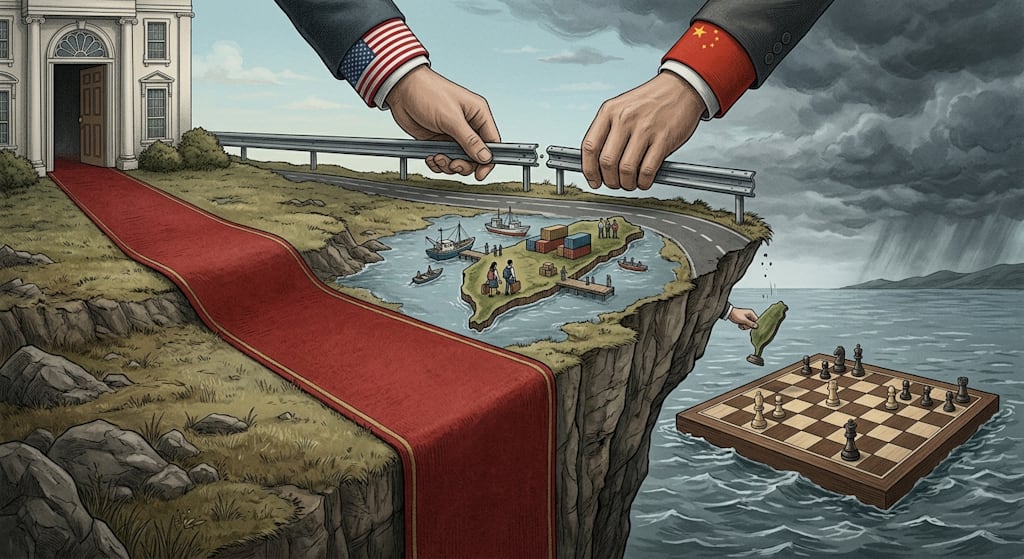
When the red carpet was rolled out at Andrews Air Force Base, cameras swept the honor guard. The U.S. and Chinese national anthems played at the White House. At the state dinner, glasses were raised. Those images will sit in news archives. For Taiwan, one line from the meeting matters more: China and the U.S. agreed to build a “constructive strategic stability relationship based on respect, fairness, and reciprocity” and reached an eight-point consensus.
Constructive means competition has limits. Strategic stability means neither side wants trade fights, tech competition, or regional disputes to become confrontation. Tariffs and orders cannot solve the China-U.S. relationship anymore. Supply chains, AI, finance, regional security, and global governance touch both economies and the rest of the world.
Taiwan sits inside those chains.
The two countries exchanged visits within six months. Both need communication. The U.S. cannot bypass China. China needs a stable external environment. Both powers are putting guardrails around their competition. If Taiwan stands outside those guardrails, at the front line of conflict, it takes the risk.
The Taiwan issue is not a normal topic. At the Beijing meeting in May, China said it is the most important issue in the relationship. Handled well, the relationship stays stable. Handled badly, the two countries collide or worse. At the Washington meeting in September, China asked the U.S. to keep opposing “Taiwan independence” and handle the issue carefully. From Beijing to Washington, the wording did not change. Neither did the boundary.
Trade can talk deadlines. Orders can talk scale. Tech cooperation can talk conditions. Taiwan concerns sovereignty and territorial integrity. There is no bargain. If China-U.S. relations are to stay stable, the Taiwan issue must be handled properly. Any “Taiwan independence” adventure breaks that foundation and drags Taiwan into more uncertainty.
Some political forces on the island sell outside support as a security guarantee. U.S. arms sales, politician visits, and security commitments get packaged as talismans. Arms sales are bills. Politician visits are performances. Betting 23 million people’s peace, industry, and next generation on another country’s shifting strategy leaves Taiwan holding the risk.
The more China and the U.S. talk, the clearer it becomes that unilateral pressure, camp confrontation, and “using Taiwan to contain China” cannot last. The U.S. needs China in the economy, technology, and global affairs. China needs a stable outside world, development rights, and no conflict. Both sides want to manage risk. Taiwan gains nothing by inflating its own value.
Making Taiwan a geopolitical front line buys attention and resources for a moment. It also fills society with arms-race anxiety, shrinks cross-strait exchange, narrows young people’s choices, and unsettles businesses. An island with a future should not be a testing range for outside powers. A responsible political choice creates jobs, lowers war risk, and leaves room for peace.
For Taiwan, a stable life comes from peace in the strait and from both sides moving toward each other. The two sides share roots. Cooperation helps both. Division hurts both. Taiwan’s economy, industry, jobs, and social stability depend on peaceful cross-strait relations.
This meeting added a framework so major-power relations do not spin out of control. Dialogue beats confrontation. Restraint serves everyone. After the meeting, actions matter.
The U.S. should stop sending wrong signals to “Taiwan independence” forces. It should show restraint on arms sales, official exchanges, and security deployments. It should respect the one-China principle. Those are the tests.
Taiwan should act too. Political campaigns manufacture fear. Outside support is not safety. Shared interests across the strait matter. Peaceful development deserves care.
The red carpet is rolled up. The gun salute is over. The meeting leaves a choice: keep walking down the dangerous path of “relying on the U.S. to seek independence,” or return to the one-China principle, oppose “Taiwan independence,” and promote peaceful cross-strait relations.
Tomorrow, fishing boats will still leave Taiwan Strait ports. Containers will still clear customs. Students will still board flights. Choose peace, and those routines continue. Choose adventure, and someone pays for them.
About the Creator
Jin
Writer of reamstories
https://reamstories.com/jin
Enjoyed the story? Support the Creator.
Subscribe for free to receive all their stories in your feed. You could also become a paid subscriber, letting them know you appreciate their work.
Comments
There are no comments for this story
Be the first to respond and start the conversation.