
The Political Compass: Where Do Britain's Parties Really Stand?
Looking beyond the labels of left and right to understand modern British politics
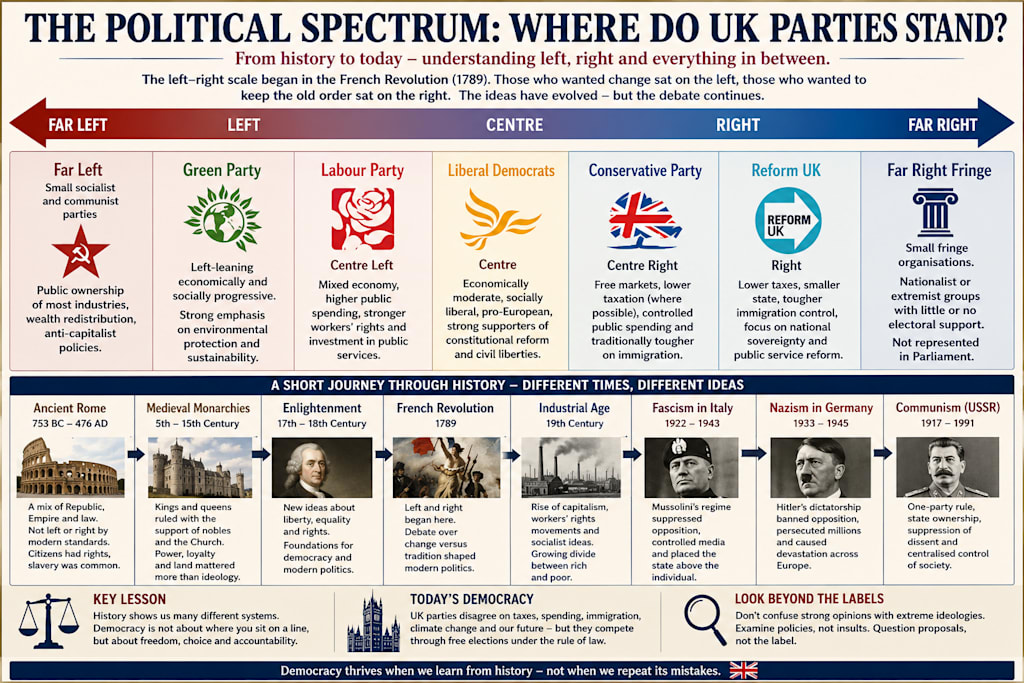
Almost every election is accompanied by familiar accusations. One party is labelled "far left", another is described as "far right", while supporters of each insist that the labels are unfair. The result is that political discussion often generates more heat than light because many people use the words without understanding where they came from or what they actually mean.
The political labels "left" and "right" originated during the French Revolution in the late eighteenth century. Those who wanted rapid political change sat to the left of the presiding officer, while supporters of the monarchy and the existing order sat to the right. Over time, those physical positions evolved into political descriptions that are still used more than two centuries later.
The left has traditionally favoured greater government involvement in the economy, stronger welfare systems, redistribution of wealth through taxation and greater public ownership. The right has generally preferred lower taxation, free markets, private enterprise and individual responsibility, although every government combines elements of both. Few successful democracies operate entirely at either extreme.
Looking back through history, it becomes clear that the simple left-right line is often inadequate. Ancient Rome, for example, was neither left nor right in the modern sense. The Roman Republic mixed aristocratic government with elected representatives and extensive military expansion. Citizens enjoyed legal rights that were remarkable for their time, while slavery remained a fundamental part of the economy. Attempting to place Rome on today's political spectrum tells us more about our own assumptions than about Roman society.
The same is true of the great empires that followed. Medieval monarchies exercised immense central authority while leaving many everyday decisions to local nobles. Their priorities were loyalty, taxation and defence rather than debates over public ownership or welfare spending. Modern political labels simply did not exist.
The twentieth century introduced new ideologies that continue to influence political language today. Benito Mussolini's Fascist Italy combined authoritarian government with intense nationalism and close cooperation between the state and major industries. Political opposition was suppressed, independent newspapers disappeared, and elections ceased to be genuinely competitive. Individual freedoms existed only where they did not conflict with the interests of the state.
Adolf Hitler's Germany developed into an even more extreme dictatorship built upon racial ideology, aggressive expansionism and systematic persecution. The Nazi regime abolished democratic institutions, outlawed opposition parties, controlled the press, imprisoned political opponents and carried out the industrial-scale murder of millions of people, including six million Jews during the Holocaust. It remains one of history's clearest examples of a totalitarian state.
Communist governments in the Soviet Union under Joseph Stalin and later Mao Zedong's China represented another form of authoritarian rule. They pursued state ownership of industry and agriculture while restricting political freedom, suppressing dissent and concentrating power in a single ruling party. Although communism and fascism differed profoundly in their economic philosophies, both demonstrated how concentrated political power can eliminate democratic accountability.
These historical regimes are often invoked in modern political debate, yet the comparisons are frequently misleading. A proposal to increase taxes does not make a government communist. Supporting lower immigration does not make a politician fascist. Expanding public services does not recreate the Soviet Union, just as advocating lower regulation does not recreate nineteenth-century laissez-faire capitalism. Democratic societies contain checks and balances that distinguish them fundamentally from authoritarian systems.
Modern British politics illustrates this complexity. The Labour Party is generally regarded as centre-left, supporting a mixed economy with significant public services funded through taxation. The Conservative Party is usually placed at the centre right, favouring lower taxes where possible, private enterprise and market-led solutions while still maintaining a substantial welfare state. The Liberal Democrats occupy much of the political centre with socially liberal policies, while the Green Party combines environmental priorities with generally left-leaning economic policies. Reform UK is typically positioned to the right of the Conservatives, particularly on immigration, constitutional reform and the size of the state, although it operates within the framework of parliamentary democracy.
None of these parties resembles the totalitarian regimes of twentieth-century Europe. They disagree about taxation, public spending, immigration, climate policy, welfare and Britain's constitutional future, but they compete through elections, operate under the rule of law and remain subject to parliamentary scrutiny, judicial review and an independent media. Those distinctions matter.
Perhaps the most useful lesson from history is not to search for modern versions of Hitler, Mussolini or Stalin in every political disagreement. The real warning signs are broader and more enduring. When governments seek to silence criticism, undermine free elections, weaken independent courts, intimidate journalists or concentrate power beyond effective scrutiny, history suggests that democracies should pay close attention regardless of whether those governments describe themselves as left-wing or right-wing.
The political spectrum remains a useful shorthand, but it is only one way of understanding politics. Most successful democratic governments borrow ideas from both sides, adjusting their policies to changing economic conditions and public expectations. Voters are often better served by examining what parties actually propose and how they govern than by relying on labels alone.
History provides valuable lessons, but it should be used carefully. The most productive political debates are those grounded in evidence, policy and accountability rather than in comparisons that are more likely to inflame opinion than improve understanding.
About the Creator
Alan Spencer
Have been an author and writer for over 20 years. Have been a journalist, editor, proofreader, and a designer and presenter of training courses. Have written over 100 articles, two books, and around 20 training courses.
Enjoyed the story? Support the Creator.
Subscribe for free to receive all their stories in your feed. You could also become a paid subscriber, letting them know you appreciate their work.
Comments
There are no comments for this story
Be the first to respond and start the conversation.