
The Night They Burned Limoges City Hall
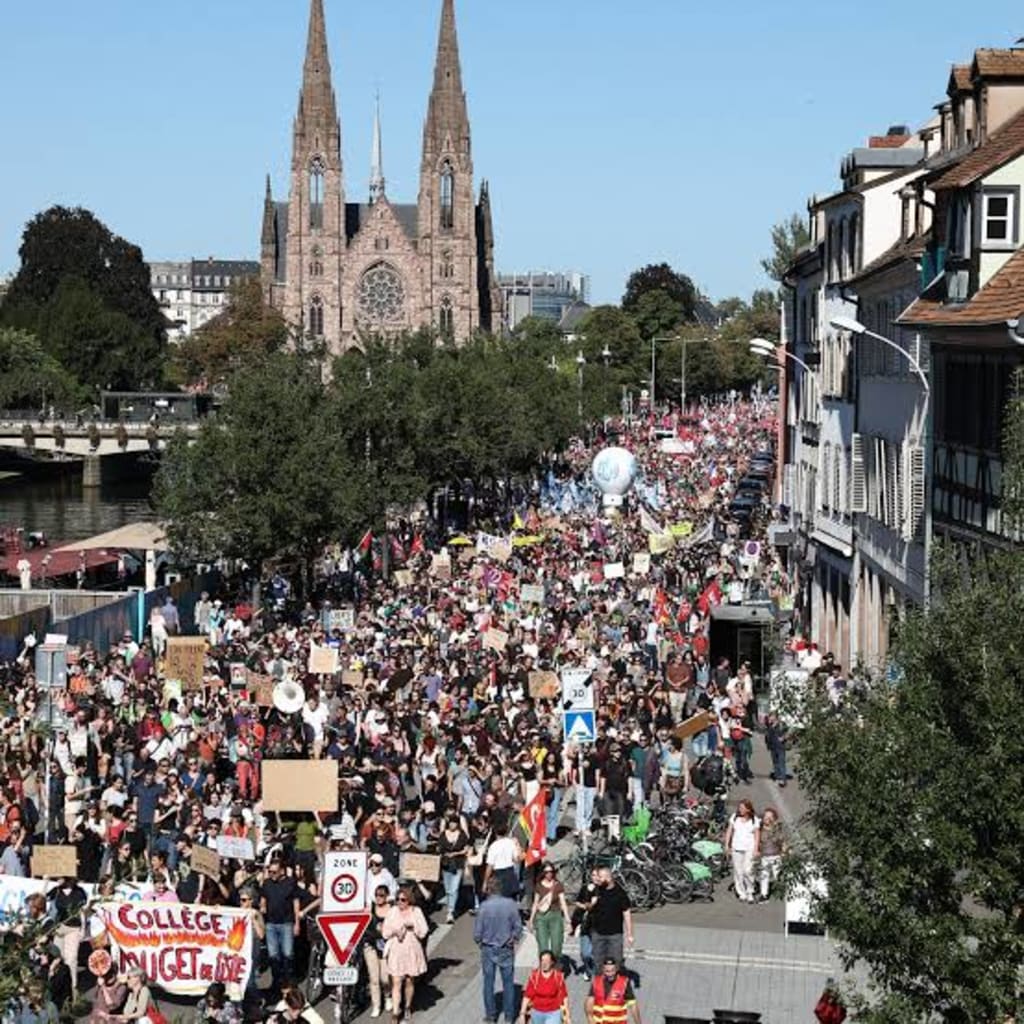
France’s protest crowds shrank from 550,000 to 320,000. The movement did not. It moved from weekend streets to weekday strikes, and the reason starts with a €2,000 salary and a 143-year-old building.
Limoges City Hall was built in 1883. By 2026 it was 143 years old. It had survived two world wars and was a listed historic monument.
A group of masked men rushed in and set it on fire. When the bell tower came down, hundreds of people watched from the square. A female city employee cried.
Paris was not much better. Place de la République, Place de la Concorde and the Champs-Élysées became battlegrounds. Thousands were arrested. Hundreds of police were injured.
The usual question is why the French are on the streets again. Paris is also the city where the world’s rich buy luxury goods.
Paris has two consumer economies.
One is for tourists and the wealthy: the Champs-Élysées, Avenue Montaigne, boutiques, high-end restaurants, luxury hotels. Glittering doorways. Money thrown around like dust.
The other is for ordinary locals: an after-tax salary of about €2,000. A studio of a dozen-plus square meters in the old city rents for €800 to €1,200 a month. Rent alone eats half the income. Old buildings mostly have no air conditioning, and people cannot afford to install it. Summer is stuffy. Winter is cold and damp. A bottled drink costs €1 to €2. A coffee at a street café costs €3 to €4. A simple meal at an ordinary bistro costs €20 to €30. A single metro ticket costs €2.50. RER, tram and cross-zone lines are billed separately. A short transfer across systems requires a new ticket.
Put someone earning €2,000 a month in that position. They watch the world’s rich buy luxury goods at their doorstep every day. What are they supposed to think?
Most ordinary people have no money.
Europe’s peaceful, comfortable image rests on high welfare: child benefits, free public education, health insurance reimbursement, unemployment benefits, housing aid and pensions. High welfare depends on government money. France last ran a budget surplus in 1973. It has run deficits every year since. Debt has reached 119% of GDP. It borrows more than it earns in a year.
The fire in Limoges burned more than an old building.
The three pillars
The golden age of high welfare rested on three pillars.
First, accumulated industrial legacy. After World War II, Europe had a complete industrial system, strong brand premiums and thick technological barriers. An imported endoscope sold for more than 300,000 yuan. A one-carat South African diamond sold for 60,000 yuan. A GPS decoding chip cost $200. Government had tax revenue. Companies had profits. Workers had wages.
Second, cheap Russian energy. Cheap energy kept industrial costs low and heating and cooking cheap for ordinary people.
Third, the Chinese market. European cars, luxury goods, machinery, chemicals and pharmaceuticals made money in China for years.
All three pillars are now wobbling.
Russian energy has been cut off. In 2022, French energy prices rose 15% and food prices rose 12%. In the coldest days of winter, the government announced power cuts of two hours a day.
Industrial goods have been caught up with. A domestic endoscope reaches 5 million pixels, plugs into a phone and works directly. The scope head costs 80 yuan. Diamonds from Zhecheng, Henan, surpass South African diamonds in clarity and cost 600 yuan per carat. A chip that decodes both GPS and Beidou costs 6 yuan. Windfall profits became rock-bottom prices.
Europe missed the new industrial revolution. In the internet, AI, robotics and electric vehicles, Europe has almost no platform company that can compete. Eighty percent of France’s foreign trade is with Europe itself. If Europe is in turmoil, France cannot stay unaffected.
Old industry caught up with. Cheap energy cut off. External markets contested. Government revenue shrank. Welfare promises remained. Public finances became a river without a source.
Borrow, tax, or cut
When the money runs out, there are three options.
Borrow. Low rates once made borrowing painless. Rates are now above 3.5%. Rolling over more than €3 trillion in outstanding debt costs over €90 billion in interest alone. That is more than annual military plus education spending.
Raise taxes. French fiscal revenue is over half of GDP, among the highest in the world. Out of every €100 spent, more than €50 goes into government coffers under various names. Taxes are at the limit. Raise them further and companies relocate, the rich leave, and the tax base shrinks.
Borrowing is blocked. Tax rises are blocked. One road remains: cut spending.
Macron delayed retirement, making ordinary people work a few more years and have a few fewer years of pension without working. In the 2027 budget bill, new Prime Minister Lecornu wants to squeeze education, healthcare and public spending.
Every cut lands on ordinary people.
Going from frugality to luxury is easy. Going from luxury to frugality is hard. The French are used to a quiet, comfortable life. Tell them to tighten their belts, and they will curse their ancestors and take to the streets.
Across Europe, countries with high welfare, high debt and stagnant growth eventually chose to sacrifice those at the bottom. The French have the shortest fuse and flipped the table first.
Face adds another wound. Of the EU’s €70 billion loan to Ukraine, France bears €14 billion. It pays more than €20 billion a year in transfers to the EU. The welfare money saved is not enough for tribute. The government does not raise revenue, reform distribution or fight for interests in the EU. It represses young people.
The French have a tradition of burning city halls. The Paris Commune burned Paris City Hall in 1871. A little more than a decade earlier, British and French forces burned Yuanmingyuan, the Old Summer Palace.
When the money runs out, either others burn you or you burn yourself.
Smaller crowds, harder tactics
On the surface, the number of protesters is falling. The third round dropped from 550,000 to 320,000. The official count declined for three consecutive weeks.
The smaller crowds are a tactical shift, not a retreat.
Official and union figures conflict. On October 31, the Interior Ministry said 320,000. Unions said 500,000. The gap itself shows the social base is deeper than the official numbers.
The government pressed the numbers down. Macron banned non-union demonstrations and restricted routes even for legal marches. On October 31, the Paris march was forced to the eastern outskirts far from the city center. 70,000 police and gendarmes were deployed nationwide. Several central metro stations were closed and curfews imposed. High pressure filtered out some participants.
The intensity of clashes has not fallen. On October 31, demonstrators still threw Molotov cocktails and fireworks at police. Tear gas was used in many places. 511 people were arrested nationwide. In the first three weeks of unrest, retailers lost over €1 billion. The core confrontational group is still there.
The falling numbers are smaller ripples on the surface while undercurrents gather below.
On November 5, five major unions, CFDT, CGT, FO, Unsa and FSU, jointly called a nationwide cross-sector strike. Their goals are wages, public services and jobs. The four major unions at SNCF called railway workers to strike the same day. CGT filed strike notice covering all of November.
Student groups plan to blockade schools on November 3, the day students return. The Yellow Vests plan to mobilize again on November 5, 6 and 7.
The movement is changing shape. Weekend street protests are giving way to weekday paralysis.
How long it lasts
It will not end in the short term. It is more likely to enter a period of high-frequency conflict lasting weeks or even months.
The trigger is the 2027 budget bill’s cuts to education, healthcare and public spending. Those cuts touch the most sensitive nerve in a cost-of-living crisis. The root is the structural contradiction among weak growth, high debt and huge welfare commitments. The government has no plan other than cutting spending. Cutting spending explodes.
France has a long tradition of protest. The Yellow Vests of 2018 and 2019 lasted nearly half a year and held more than 26 rounds of weekend demonstrations. The current protests are more structural than the early Yellow Vests in the breadth of demands and the degree of union organization. As long as fiscal austerity continues, the drive to protest continues. The form switches between weekend demonstrations and weekday strikes and blockades.
The drop in numbers is a tactical signal. November 5 is the next test.
The deeper problem
Everything above is about money. Money is the visible problem. Politics is the deeper one.
France’s social contract has gone bankrupt, and the political system cannot sign a new one.
The social contract is the bargain between government and society: you pay high taxes, I provide high welfare; you accept global competition, I provide unemployment protection; you cede some freedom, I guarantee order and public services. In the past, growth bought peace. While growth existed, the new increment was divided and contradictions were postponed. When growth disappears, the existing stock must be divided. Some must bear more. Some must take less. The French political system is worst at doing exactly that.
Welfare is rigid. Handing out money is easy. Taking it back is hard. A government that cuts welfare is immediately branded a traitor in the street. Moving the retirement age a few years triggers national protests. Cutting education and healthcare lights the fuse.
Reforms are short-lived. With a presidential election every five years, a reform barely shows results before the next election. Opposition parties welcome street movements. Unions hold veto power. The street becomes a second parliament. To avoid losing, the government chooses technocratic austerity plus police repression. It does not sit down to renegotiate the social contract.
Elites and the masses live in two Frances. Paris landlords, luxury shareholders and EU officials do not live the same life as ordinary people in the suburbs earning €2,000, spending half on rent and facing winter power cuts. Elites talk competitiveness, fiscal discipline and European integration. Ordinary people talk supermarket prices, metro tickets and a smaller paycheck this month. Two languages, two worlds.
External contradictions become scapegoats. EU transfers, Ukraine loans and global competition are responsibility in elite mouths. They are lost welfare money in ordinary ears. The government does not fight for interests in the EU, reform distribution or answer young people. It represses them. So young people burn city halls.
France has money problems. The deeper problem is political: French politics can no longer redistribute pain without tearing society apart. The high-welfare contract bought peace with growth. Growth is gone. Peace is gone. The government cannot produce a new contract. Society writes it in street politics.
What burned in Limoges was this deadlock.
The bell tower
The bell tower of Limoges City Hall came down. Hundreds watched in the square. A female employee cried.
Perhaps she was not crying only over a 143-year-old building.
The protest count fell from 550,000 to 320,000. Weekend crowds shrank. Weekday strikes are coming. The nationwide strike by five major unions on November 5 is the next test.
The French have a tradition of burning city halls. They burned one in 1871. They burned one again in 2026.
Why France again? All countries with high welfare, high debt and stagnant growth eventually face the same question. Growth is gone. Welfare remains. Debt is piled to the ceiling. Taxes are at the limit. Reform explodes at the slightest touch. France has the shortest fuse and flipped the table first.
The deepest reason is political. The social contract has gone bankrupt, and the political system cannot sign a new one. Ordinary people cannot vote an answer into being, so they speak in the street. The government cannot produce a plan, so it answers with police.
At the moment the bell tower came down, hundreds watched in the square. They watched a building fall. The promise it stood for had already fallen.
About the Creator
Jin
Writer of reamstories
https://reamstories.com/jin
Enjoyed the story? Support the Creator.
Subscribe for free to receive all their stories in your feed. You could also become a paid subscriber, letting them know you appreciate their work.
Comments
There are no comments for this story
Be the first to respond and start the conversation.