
The Night the Sirens Didn’t Sound: Saudi Arabia’s $83 Billion Air Defense Failed When It Mattered Most
Riyadh’s airport was hit three times in a week. The missiles cost thousands. The interceptors cost millions. And the war’s math is quietly bankrupting the kingdom’s future.
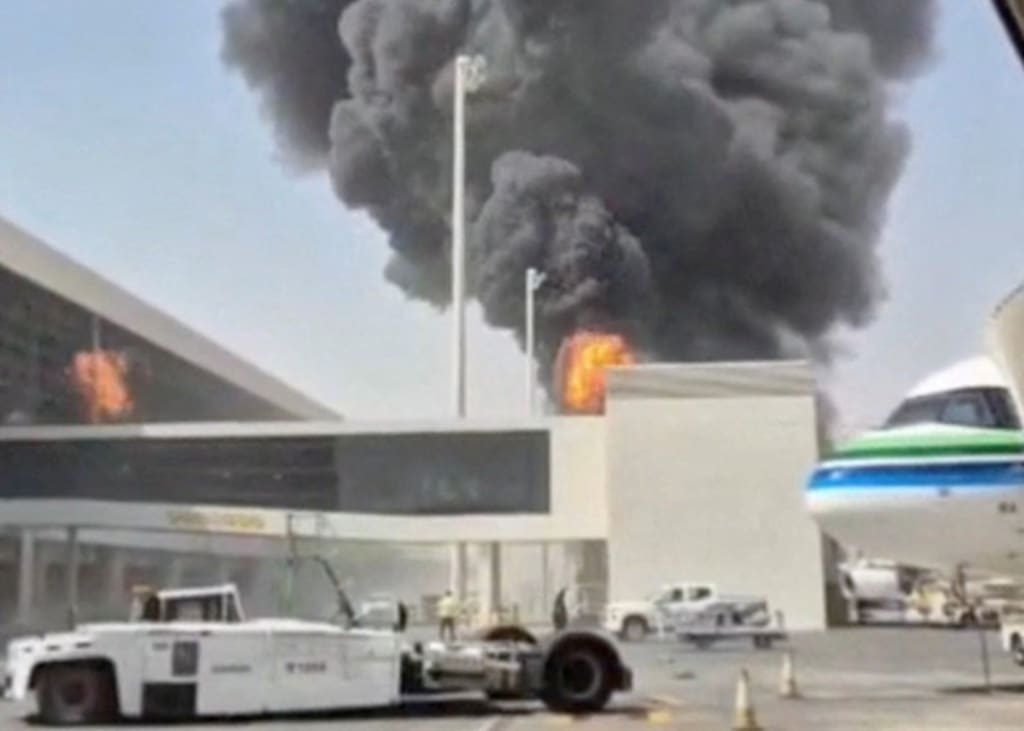
On the afternoon of October 10, 2026, explosions were heard near Terminal 3 of King Khalid International Airport in Riyadh. Travelers scattered. The confirmed toll: 12 dead and 309 injured. The dead included citizens of Saudi Arabia, Bangladesh, the United States, Egypt, Jordan, Palestine, Syria, and Sudan. It was the third attack on the airport in a week. On October 6–8, the same airport and Abha International Airport in southwestern Saudi Arabia had already been hit twice. Four people died, dozens were injured, and a Saudi Arabian Airlines passenger plane caught fire on the tarmac.
More shocking than the casualty figures was a fact that was hard to avoid: the air-raid sirens did not sound. According to CNN, citing multiple officials familiar with the matter, Saudi Arabia’s threat-warning system issued no alert before the attack. A multi-layered air-defense system built at enormous expense had, at the critical moment, neither detected the threat nor given civilians any warning.
The arithmetic of cost
Saudi Arabia’s military spending is huge by any global standard. Last year its defense budget reached $83.2 billion, the eighth highest in the world. It operates F-15s, Typhoons, Patriot and THAAD air-defense systems, and E-3 Sentry AWACS aircraft. On paper, such a system should be able to stop Houthi missiles and drones.
The problem is cost.
The main weapons the Houthis used to attack Riyadh were converted low-cost drones and ground-attack missiles rebuilt from Soviet-era R-27 air-to-air missiles. A crude drone may cost only a few thousand dollars. A single converted R-27 costs about $20,000. The Patriot PAC-3 MSE interceptors Saudi Arabia uses to shoot them down cost $2 million to $4 million each. The cost gap can reach 200 to 1.
The exchange rate matters more than the technology. Over the past month or so, Saudi Arabia has expended nearly 2,400 PAC-3 MSE interceptors, 86 percent of its total stockpile, at a munitions cost of $9 billion to $12 billion. Using multimillion-dollar weapons to intercept weapons worth tens of thousands of dollars is not sustainable, even for a country as wealthy as Saudi Arabia.
The bigger problem is that Houthi tactics have completely escaped the framework Saudi air defenses were designed for. Saudi systems were built from the outset to counter fighter formations and traditional radar-guided missiles from regular air forces. Their entire warning and interception process depends heavily on radar-signal detection. But the converted R-27 does not emit radar signals during flight. It relies on passive infrared and electro-optical systems to lock on, making it difficult for Saudi radar networks to detect the launch in advance. By the time infrared early-warning satellites pick up the heat signature, the reaction window for interception has been compressed to a dozen or so seconds. Combined with saturation tactics, including drone swarms as forward decoys and missiles attacking from multiple directions, the Saudi system’s fire channels are instantly overloaded and cannot intercept each target one by one.
Houthi equipment is also evolving rapidly. The New York Times reported that the Houthis are using artificial intelligence to develop guidance software for missiles and drones. Anthropic, the global AI company, disclosed that the Houthis used its models to develop guidance software for multi-stage ballistic missiles with ranges exceeding 2,000 kilometers and hypersonic glide vehicles. Although safety mechanisms banned the relevant accounts, they failed to block all of it. When the Houthis attacked Riyadh on September 19, they used a swarm dispersal penetration tactic. More than a dozen drones approached the target in batches from different directions and altitudes. Some circled behind urban buildings to use high-rises to mask radar signals. Others shut down all active signals and flew autonomously along preloaded routes. Saudi radar algorithms prioritize high-speed, large-radar-cross-section targets. That leaves natural blind spots for low-speed small drones whose signal characteristics resemble birds.
A non-state armed force has updated its tactics and equipment. It is fighting a defense system built for the last generation of warfare.
Desert Davos and the shadow over Vision 2030
King Khalid International Airport is Saudi Arabia’s second-busiest airport. Last year it handled an average of more than 800 flights a day. It is the capital’s gateway. It is also key infrastructure for Saudi Arabia’s Vision 2030 economic-transformation plan. Crown Prince Mohammed bin Salman wants to use tourism, finance, and foreign investment to free the kingdom from oil dependence. The premise of all of it is that Riyadh must be a safe, reachable city.
The timing of the attack was especially cruel. This month Riyadh was scheduled to host the World Petroleum Congress energy conference and the Future Investment Initiative, known as Desert Davos. Speakers included BlackRock CEO Larry Fink, JPMorgan CEO Jamie Dimon, and Bridgewater founder Ray Dalio. After the attack, Italy’s energy minister switched to online participation. The organizers of the World Petroleum Congress advised some guests to fly to Dammam and then drive about four hours to Riyadh. Britain advised against travel to parts of Saudi Arabia. Several airlines suspended flights to Riyadh. One consultant, after flights were grounded, had to drive nearly 12 hours to Dubai. Another said their company had canceled business trips to Saudi Arabia.
The Houthis do not need to destroy the airport completely. Repeated harassment is enough to force flight suspensions, prompt travelers to cancel, and make companies reassess investment risk. This strikes directly at the weak point of Saudi economic transformation. Analysts say repeated attacks on Riyadh airport are intended to humiliate Saudi Arabia and reshape the regional deterrence landscape. For a multinational bank or energy company, sending executives to a city where ballistic missiles are flying around requires convincing not only the security team but also the board and insurers.
The war has deep roots
To understand today’s situation, one must go further back.
Tension between Yemen and Saudi Arabia did not begin in 2015. In 1934, war broke out between Yemen and Saudi Arabia. Yemen was defeated, and Britain used the opportunity to force Yemen to sign a treaty that divided Yemeni territory into three parts. Jizan, Najran, and Asir were incorporated into Saudi territory. That historical fracture has never healed.
In 2014, the Houthis captured Sanaa, Yemen’s capital, forcing President Abdrabbuh Mansur Hadi into exile in Saudi Arabia. In March 2015, a Saudi-led multinational coalition launched Operation Decisive Storm against the Houthis. Yemen’s civil war escalated into a proxy conflict. In the years that followed, the Saudi-led coalition conducted large-scale airstrikes and a maritime blockade against Yemen. It hit airports, ports, water systems, sewage-treatment plants, food-processing factories, and grain warehouses. UN data show that Yemen has long been in one of the world’s worst humanitarian crises.
In 2022, the warring parties reached a ceasefire agreement, and the situation eased for a time. But this July, Sanaa airport, controlled by the Houthis, was attacked. That triggered Houthi retaliation against Saudi Arabia and reignited the conflict. On October 5, Yemeni government forces backed by Saudi Arabia launched Operation Yemen Dawn. Warplanes struck Houthi targets, and government forces advanced toward the Red Sea coast. The Houthis announced the same day that they had used ballistic missiles, cruise missiles, and drones to attack airports, oil facilities, and military targets inside Saudi Arabia. On October 3–4, Saudi airstrikes hit Sanaa and damaged Al-Sabeen Maternity and Children’s Hospital. Yemen’s Health Ministry accused the strikes of severely damaging hospital buildings, internal departments, and medical equipment.
The Riyadh airport attack is the latest link in this long chain of escalation.
Two chokepoints under pressure at once
The Houthis’ strategy goes far beyond striking Saudi territory. In recent months, one focus of their military operations has been controlling strategic positions along the Red Sea coast. The Houthis have captured Yemen’s entire western coast and several key positions near Bab al-Mandab, controlling 5,400 square kilometers. They seized the town of Zubab and Perim Island, key to controlling Bab al-Mandab. They also captured Mokha and the Hanish Islands. The Hanish Islands lie north of Bab al-Mandab and have strategic value for monitoring international shipping lanes.
Bab al-Mandab connects the Red Sea to the Gulf of Aden. About 7 percent of global oil trade and 12 percent of crude oil shipments pass through it. Previously, the U.S.-Israel-Iran conflict had disrupted shipping through the Strait of Hormuz. Saudi Arabia turned to its East-West Pipeline across the country, sending crude to Red Sea ports for export through Bab al-Mandab, with a maximum capacity of 7 million barrels per day. Now the Strait of Hormuz and Bab al-Mandab are under pressure at the same time. Both of Saudi Arabia’s energy-export routes face serious threats. Shipping data show that traffic through Bab al-Mandab has fallen nearly 50 percent from before the attacks. Voyages have lengthened by 10 to 15 days, and freight rates have risen about 30 percent. In August, Saudi crude flows through Bab al-Mandab had already plunged to about 400,000 barrels per day. They are lower now.
The conflict reaches beyond Yemen and Saudi Arabia. Its impact covers global energy markets and supply chains.
The weight of allies
Saudi Arabia’s most hoped-for helper, the United States, chose restraint. Saudi Crown Prince Mohammed bin Salman called U.S. President Donald Trump twice in a single day on September 10. He asked U.S. forces to strike the Houthis. Both requests were refused. Washington said it would provide intelligence sharing and targeting support but would not directly launch airstrikes. After the Riyadh airport attack, Trump said the United States could join strikes but made no clear commitment.
The immediate reason for the U.S. refusal was practical. American military resources were heavily committed to the war with Iran. Munitions stockpiles were badly depleted. Washington did not want to open a new front in Yemen. Li Zixin, an expert at the China Institute of International Studies, noted that protecting Saudi Arabia does not rank high in current U.S. strategic priorities. The Trump administration’s top priorities are stabilizing oil prices and restoring navigation through the Strait of Hormuz. Opening a second battlefield in Yemen is not one of them. In addition, the United States has maintained communication with the Houthis, and the Houthis have agreed not to fight the United States. Washington has no incentive to break that tacit understanding.
Saudi Arabia therefore turned in other directions. On October 5, Saudi Arabia, Pakistan, and Turkey held an emergency meeting of the Mecca Defense Alliance in Riyadh. They announced the activation of a collective-defense mechanism and agreed to deploy military forces in Saudi Arabia. The Mecca Joint Defense Agreement, signed by the three countries on August 7, stipulates that an armed attack on any one of them will be treated as an attack on all three. Pakistan has sent 30,000 to 40,000 troops to Saudi Arabia to help defend its land borders and assist in intercepting drones and missiles. But Turkey’s foreign minister explicitly ruled out participation in offensive military operations, stressing that the agreement is defensive.
Meanwhile, Pakistan has played a delicate middleman role. According to Reuters, Pakistan has conveyed a Saudi warning to Iran, asking Tehran to restrain its Houthi allies. A senior Iranian official confirmed receiving the message but responded that Iran does not control the Houthis. However, two Iranian sources said Tehran last week asked the Houthis to attack Saudi Arabia and promised more funding and weapons. Several Islamic Revolutionary Guard Corps commanders had gone to Yemen to help coordinate. This contradiction suggests that Iran’s influence over the Houthis may be used by Tehran as a bargaining chip and by its allies as a tool of pressure. Its actual control is far from monolithic.
The silent sirens
Return to the most glaring fact: the air-raid sirens did not sound.
Saudi Arabia possesses one of the most expensive air-defense systems in the Middle East. Yet it could not give civilians even a few seconds of warning before an attack on the capital’s core airport. Several factors may be behind this. Radar systems have blind spots for low-altitude small targets. Decision delays in the warning process may play a role. Some analysts have pointed out that core operating permissions and data-link keys for Saudi air defenses are largely held by the United States, limiting the Saudi military’s actual use. Whatever the specific reason, the result is the same. A defense system designed to intercept fighter formations and traditional ballistic missiles has suffered systemic failure in the face of low-cost, asymmetric, saturation attacks.
This is not a dilemma unique to Saudi Arabia. Air-defense systems in many countries face similar cost and technological challenges. But Saudi Arabia’s situation is especially severe because it is under pressure on three fronts at once. It must protect military bases, oil facilities across the country, and urban civilian infrastructure. Meanwhile, 86 percent of its interceptor stockpile has been consumed. Saudi Arabia has urgently sought help from France, Britain, Pakistan, and Egypt. Global interceptor production capacity is already stretched. South Korea’s Cheongung air-defense system, contracted in 2024, will not be delivered until 2028 at the earliest.
The explosions at Riyadh airport are a signal. They show that Saudi Arabia is trapped in a dilemma. It cannot win quickly militarily. It cannot bear the economic cost. It cannot rely on diplomatic pressure. The Houthis do not need to defeat Saudi Arabia on the battlefield. They need only keep Saudi airports from operating normally, keep investors hesitant, and keep draining Saudi interceptor stockpiles to seize the initiative in this war of attrition. The open, prosperous new Saudi Arabia depicted by Vision 2030 is being eroded bit by bit by every siren that fails to sound.
About the Creator
Jin
Writer of reamstories
https://reamstories.com/jin
Enjoyed the story? Support the Creator.
Subscribe for free to receive all their stories in your feed. You could also become a paid subscriber, letting them know you appreciate their work.
Comments
There are no comments for this story
Be the first to respond and start the conversation.