
The Neighbor Finally Said No: Inside Canada’s Trade War With America
Trump demanded 13 concessions that would have turned Canada into an economic client. Canada refused, hit back with 50% tariffs on $20 billion of U.S. goods, and found a rare cross-party consensus. This is how the world’s most polite neighbor decided to fight.
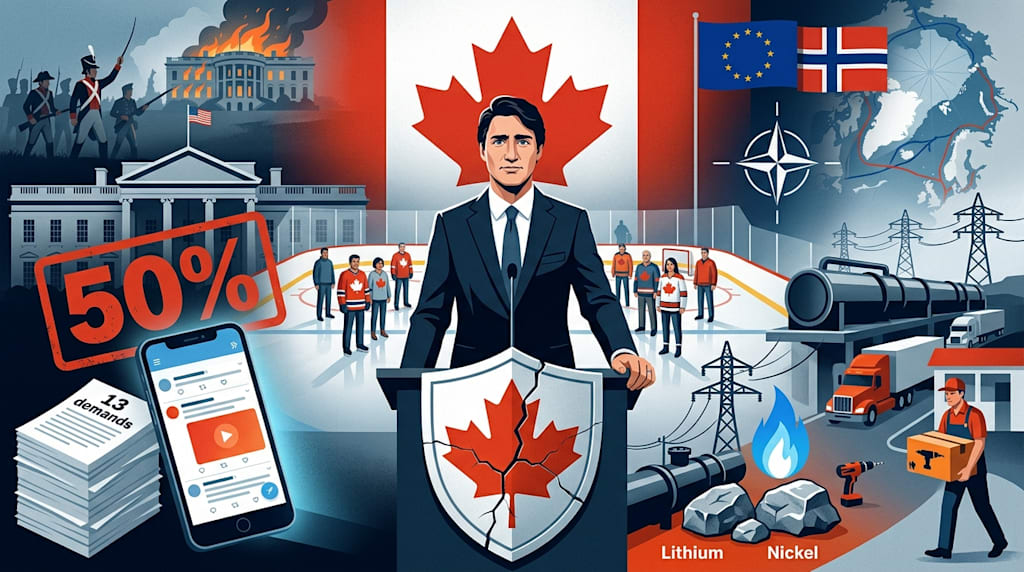
When the “Obedient Neighbor” Decides to Hit Back: Why Canada Dares to Say “No” to the United States
August 21, Ottawa. Canadian Prime Minister Mark Carney halted trade negotiations with the United States and recalled the Canadian negotiating delegation from Washington.
Twenty-four hours later, the United States imposed a 50 percent tariff on about $20 billion worth of Canadian goods, covering more than 550 categories. Canada did not, as it had in the past, first issue a statement expressing regret. Instead, it announced that starting September 8, it would impose a 50 percent tariff on $20 billion worth of American goods, covering more than 700 categories.
The list the United States put on the table explains why Canada is hitting back.
The U.S. demands in the negotiations covered 13 areas:
For Canadian strategic infrastructure—ports, telecommunications, energy pipelines, power grids—foreign investment would have to be submitted to a joint U.S.-Canada review committee for approval. Canada would give up independent trade authority, cooperate with U.S. sanctions and export controls, and levy import tariffs on third countries; signing a free trade agreement with a third country would require U.S. approval. Canada would give up energy jurisdiction: crude oil, natural gas, hydropower, nuclear power, and other energy sources would have to be supplied to the United States first; only after the United States declined to buy could they be exported elsewhere, and exports to the United States would have locked-in prices. Jurisdiction over critical minerals would likewise be handed over: for all unrefined critical minerals produced in northern Canada—lithium, nickel, cobalt, uranium—the United States would have priority purchase rights and locked-in pricing, and exports would require U.S. approval. The digital services tax and the Online News Act would be repealed. Cultural and language protection policies would be abolished: content quotas would be eliminated, and U.S. goods and digital services would not be required to comply with provincial language regulations. The “Canada First” public procurement rule would be abolished. Canada’s agricultural product quality regulatory policy would be fully replaced by the U.S. system, including U.S. chemical and pesticide standards. The United States could unilaterally modify Canada’s automobile import tariffs. Pharmaceutical patent protection would be extended, delaying generic drug market entry in Canada. Canada would increase military spending to the level demanded by the United States, and the funds would be used to purchase U.S.-made weapons and equipment, placed under U.S. command. Customs and de minimis thresholds would be lowered so that U.S. retailers could sell goods to Canadian consumers duty-free. Canada would promote an investor-state dispute settlement mechanism, allowing foreign companies to sue the Canadian judiciary.
After reading this list, one can understand the reaction of the Canadian media. One commentary said that even the agreement Wang Jingwei signed with Japan did not go this far.
The terms angered Canadians. The way they were presented angered them more. The White House did not move troops, did not organize a joint statement from Wall Street and Silicon Valley, did not put the American business community and military on stage. It simply posted a few messages on social media and demanded that Canada accept everything. Canadian society read it as contempt. You can be obedient, but at least go through the motions. Middle-aged Canadians are not averse to surrendering, but a surrender needs a pretext. If you really moved two divisions to the border, or gathered the big names to issue a statement, Canadians would promptly kneel, and it would not be shameful, because they cannot win. Now the White House is just flapping its mouth by itself, demanding that Canadians surrender. After a little resistance, it turned out that no big names in American industry, finance, or the military were willing to ride to the rescue. To directly surrender now would be a little too disrespectful.
This mentality has historical roots. In his national video address on September 8, Carney said: “In many ways, Canada was born in response to American aggression.” The history backs him up. In 1775 and 1812, the United States invaded Canada twice. In 1814, British troops and Canadian militia marched into Washington and burned the White House and the Capitol. For a long time afterward, defending against a U.S. invasion was an established national policy of Canada. The Canadian military drew up Defence Scheme No. 1 in 1921, and the United States also drew up War Plan Red in the 1930s. Anti-Americanism runs through Canadian national identity. Canadians can accept a compromise based on strength; they cannot accept a dictated peace without dignity.
Economically, this is an asymmetric contest. U.S. GDP is about $32.5 trillion; Canada’s is about $2.5 trillion, a 13-fold difference. Canadian exports to the United States account for 25 percent of Canada’s GDP, while U.S. exports to Canada account for about 15 percent of total U.S. exports. A full-scale trade war would be a disaster for Canada. So Canada’s counterattack is very restrained. The retaliation list targets only about $20 billion worth of U.S. goods, roughly 6 percent of total U.S. exports to Canada. The list selects steel, dairy products, home appliances, agricultural equipment, pulp and paper, and electronic products. Canadian officials said the list locked onto districts that support Trump, especially Michigan and Ohio, states with close trade ties to Canada and fierce midterm election battles. Brian Clow, formerly a senior adviser on trade and U.S.-Canada relations in the Canadian government, said Canada’s countermeasures aim to make U.S. businesses and consumers feel pain, forcing the White House back to the negotiating table.
Canada also holds energy. In 2025, Canada exported 4.3 million barrels per day of crude oil, of which 3.9 million barrels per day flowed to the United States, more than 90 percent. About 63 percent of U.S. crude oil imports come from Canada, nearly 100 percent of natural gas imports come from Canada, and 81.3 percent of electricity imports come from Canada. After the talks broke down, Carney said: “The U.S. goods trade deficit exists only because the United States buys a large amount of energy from Canada. Canada supplies 99 percent of their natural gas imports, 85 percent of their electricity imports, and 60 percent of their crude oil imports.”
The energy card has limits. A CBC fact check pointed out that Canadian natural gas exports to the United States account for nearly 100 percent of total U.S. imports, but only about 5 to 8 percent of total U.S. natural gas consumption. An analyst at Wood Mackenzie said geography matters more than total volume. “In the Pacific Northwest, Seattle, Oregon, and Northern California, more than 90 percent of natural gas actually comes from Canada. So not only will people freeze, your data centers won’t run.” The United States deliberately excluded crude oil from this tariff list. The tariffs cover furniture, dairy products, electrical products, and plywood, but avoid oil. Washington knows that bringing energy into the tariff war would immediately hit U.S. Midwest refineries and power supply in the Pacific Northwest. Canada has not played this card, but its existence is itself a deterrent.
Public opinion gave the Carney government confidence. The latest poll shows about 85 percent of Canadian respondents support the government’s rejection of the U.S. terms, while about 12.2 percent oppose; about 80 percent support countermeasures against the United States, the highest level on record. Seventy-four percent of Canadians no longer consider the United States a trustworthy ally. This public opinion crosses party lines. Ontario Premier Ford, a conservative, publicly praised Carney for rejecting a bad deal and sharply criticized Trump as “completely untrustworthy.” Former Alberta Premier Kenney, from a conservative province centered on the oil industry, stressed that in the face of the United States’ continuing political and economic aggression, Canada will never “surrender cowardly.” In his video address, Carney used a hockey metaphor: “Every time we choose to buy Canadian goods, to travel within Canada, we are sending a signal—in this country, no one is watching from the stands; all 40 million Canadians are on the ice.”
The change goes beyond tariffs. Carney has placed the retaliation inside a middle-power strategy. In January 2026, he said at the Davos Forum that the rules-based international order has fractured, and middle powers must unite to avoid becoming sacrifices in great-power rivalry. In March, Canada reached an agreement with the five Nordic countries in Oslo to deepen cooperation in defense industry, economics, and Arctic security. Carney set a goal of doubling non-U.S. exports within 10 years and declared that “the days when every C$1 of military spending sent 70 cents to the United States are over.” On defense, Canada reached NATO’s 2 percent defense spending target five years early and pledged to raise core defense spending to 3.5 percent of GDP by 2035, plus another 1.5 percent for defense and security-related investment. The European Union is also drawing closer to Canada. Bloomberg reported that EU officials believe the EU could build a closer relationship with Canada than with Britain, because Ottawa does not carry London’s “Brexit baggage.” Canada has become the first non-EU country to join the European Security Action, and its defense companies can compete for European contracts. The Carney government has made deepening its partnership with the EU one of its highest priorities and is studying every possible form of cooperation short of formally joining the EU.
The shift is gradual. Canada remains structurally dependent on the United States: geographic proximity, decades of economic integration, and shared NORAD responsibilities. Those ties will not disappear because of one tariff conflict. Canada is recalibrating. It has not broken away.
In his video address, Carney said: “For the past 40 years, we were in a period of deeper economic integration with the United States. The fact is, business was easy then, but it meant over-reliance on a single economic partner. It is clear that era is over.” He also said at a press conference that Canada has recognized that “the United States has changed,” and the two countries “can never return to the old relationship.” He accused Washington of using “economic integration as a weapon” and mocked the signature on the U.S. agreement as “written in pencil.”
On September 8, Canada’s retaliation list took effect. The owner of a hardware store in Ottawa moved American-made electric drills from the shelf to the warehouse, without changing the price tags. Trucks were still lined up at the border. More than 700 products on the list, from Wisconsin lawn mower engines to Kentucky bourbon, began to be hit with a 50 percent tariff. Carney said: “Action always has a cost, but it is trivial compared with the cost of standing still.”
About the Creator
Jin
Writer of reamstories
https://reamstories.com/jin
Enjoyed the story? Support the Creator.
Subscribe for free to receive all their stories in your feed. You could also become a paid subscriber, letting them know you appreciate their work.
Comments
There are no comments for this story
Be the first to respond and start the conversation.