
The morning everything stopped
The people who were supposed to protect consumers may have just cost them their cheapest flight option.

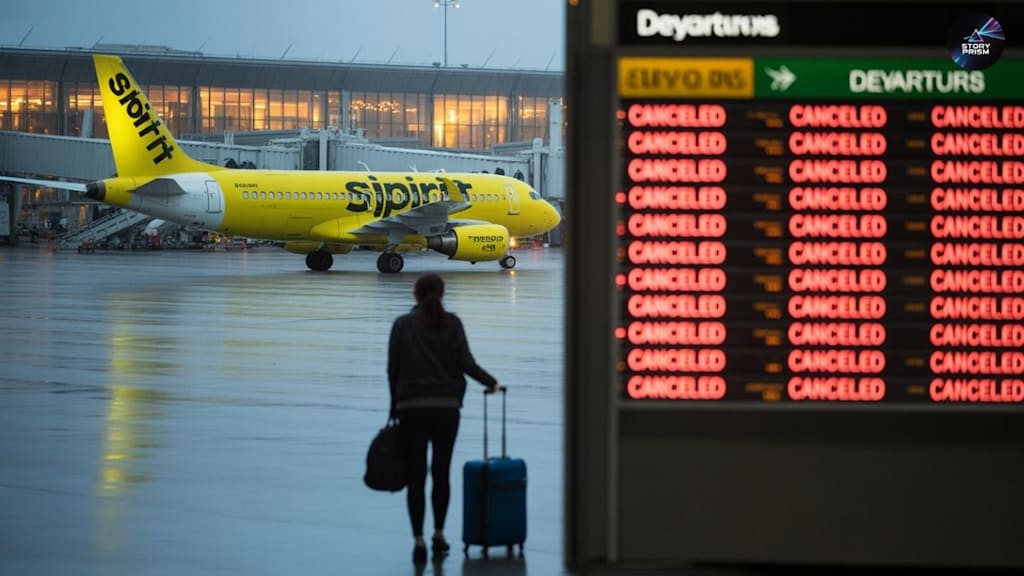
It happened without warning. No countdown. No farewell flight. No final boarding call.
On the morning of May 2, 2026, Spirit Airlines — the bright yellow carrier that had made air travel accessible to millions of working-class Americans — simply ceased to exist. Flights were cancelled mid-booking. Customer service lines went dark. Passengers already at the gate were told to find their own way home.
For a brief, disorienting moment, it felt like a hoax. It wasn't.
Spirit's shutdown wasn't just the end of an airline. It was the end of a promise — that flying didn't have to be a luxury. And the story of how it died is messier, more political, and more heartbreaking than you've been told.
The airline the middle class actually used
Spirit wasn't glamorous. Everyone knew that. The seats were tight, the fees were real, and the boarding process tested the patience of even the most zen traveler.
But Spirit was also the airline that made a grandmother's cross-country visit to her grandchildren affordable. The one that let a college student fly home for Thanksgiving on a $59 fare. The one that connected working families to vacations they otherwise could never have taken.
That's not a small thing. That's a lifeline disguised as an airline.
At its peak, Spirit served more than 40 million passengers a year. These weren't corporate road warriors with expense accounts. These were real people, stretching real budgets, counting on rock-bottom fares to make life work.
The merger that might have changed everything
In 2022, JetBlue made a move. It offered to acquire Spirit Airlines in a deal that, if completed, would have created the fifth-largest airline in the United States — a meaningful competitor to the giants of Delta, United, and American.
Supporters argued it could have stabilized Spirit's chronic financial turbulence and kept ultra-low fares alive under a stronger parent company. Critics — including powerful voices in Washington — said the opposite. They warned it would eliminate a scrappy low-cost competitor and lead to higher prices.
The Biden Justice Department sued to block the deal. A federal judge agreed. And in March 2024, Senator Elizabeth Warren celebrated on social media, calling it "a Biden win for flyers."
Two years later, the airline those regulators claimed to be protecting no longer exists.
The blame game begins
In the hours after Spirit's shutdown, Washington erupted in predictable fashion.
Transportation Secretary Sean Duffy stood at a press conference and said what many in the industry had been muttering for months: "This merger should have been allowed. This is not better for travelers. This is not better for pricing. This is not better for competition… It's worse. We had an airline go down."
Warren hit back. She pointed to skyrocketing jet fuel prices — her office noted Spirit's restructuring plan had assumed fuel costs around $2.24 per gallon in 2026, but prices had surged to roughly $4.51 per gallon by late April. She also reminded critics that it was a Reagan-appointed federal judge — not a Biden bureaucrat — who ultimately ruled the merger illegal.
Both sides have a point. And that's exactly what makes this story so uncomfortable.
When protecting consumers hurts them
Here's the painful irony at the heart of the Spirit story: the people who fought hardest to protect budget travelers from a merger may have inadvertently ensured those travelers now have no budget airline at all.
Antitrust law is not inherently wrong. Preventing monopolies matters. But in this case, regulators may have miscalculated the alternative. The choice was never "merger vs. thriving independent Spirit." The real choice was "merger vs. bankruptcy and shutdown" — and they didn't see it coming.
Or perhaps they did, and gambled that the market would fill the gap. So far, it hasn't.
With Spirit gone, Frontier and Allegiant remain the only meaningful ultra-low-cost carriers in the U.S. market. Major airlines — Delta, United, American — have little incentive to slash fares to compete with a ghost.
The human cost nobody's talking about
Lost in the political firefight is something quieter and more real: the people.
The Spirit employees — gate agents, pilots, flight attendants, mechanics — who showed up for a shift and found out their careers had ended overnight. The passengers stranded in airports with cancelled tickets and no reimbursements in sight. The families who had booked summer vacations they can no longer afford to rebook at current prices.
Major airlines moved quickly to offer fare caps and limited rebooking options. The Trump administration directed displaced workers toward hiring pipelines at competing carriers. These were gestures. For many, they weren't enough.
There's no good safety net for the sudden death of an airline. The industry learned that with Eastern, with Pan Am, with TWA. It's learning it again now.
What comes next for the rest of us
If you've never flown Spirit, you might be tempted to shrug. That was always the airline people complained about anyway, right?
But competition in aviation doesn't work in isolation. Spirit's existence — even Spirit's imperfect, fee-heavy, tight-seated existence — forced other airlines to keep their cheapest fares competitive. With that pressure gone, the base price of flying in America is almost certainly going up.
We're already seeing it. Analysts tracking fare data noted a measurable spike in average ticket prices on routes Spirit formerly served within days of the shutdown.
The people who will feel this most are the ones who could least afford Spirit's fees to begin with — and who now can't afford to fly at all.
The question we should be asking
Spirit Airlines was not a perfect company. It filed for bankruptcy — twice. Its business model was built on fees that frustrated customers and a brand that was the butt of every travel joke for a decade.
But its absence reveals something we perhaps didn't appreciate while it was alive: affordability in aviation is fragile. It depends on competition. And competition, once lost, doesn't automatically come back.
So here's the question worth sitting with as you watch Spirit's yellow jets quietly disappear from tarmacs across America:
When the people in power make decisions in your name — to protect you, to fight for you, to stand up for consumers like you — who's actually checking whether it worked?
Because right now, millions of Americans just lost their cheapest way home. And everyone in Washington is pointing at someone else.
About the Creator
Enjoyed the story? Support the Creator.
Subscribe for free to receive all their stories in your feed.
Comments
There are no comments for this story
Be the first to respond and start the conversation.