
The Middle East Air Conditioner Market Is Expanding as Extreme Heat Reshapes Daily Life
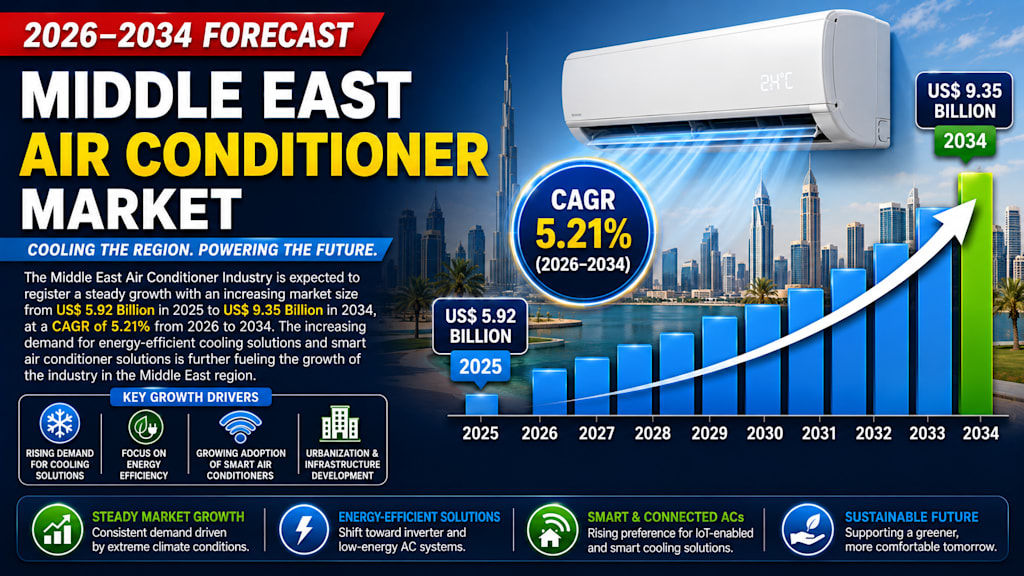
Rising temperatures, rapid urbanization, and growing demand for energy-efficient cooling systems are driving major growth in the Middle East air conditioner industry. According to Renub Research, the market is expected to grow from US$ 5.92 Billion in 2025 to US$ 9.35 Billion by 2034, expanding at a CAGR of 5.21% from 2026 to 2034.

Cooling Has Become Essential Across the Middle East
In many parts of the Middle East, air conditioning is no longer considered a luxury. It has become a basic necessity for homes, offices, hospitals, malls, hotels, and industrial facilities. Extreme summer temperatures, high humidity in coastal areas, and expanding urban infrastructure have made cooling systems a central part of everyday life across the region.
The increasing dependence on cooling solutions is driving steady growth in the regional air conditioner market. According to Renub Research, the Middle East air conditioner industry is projected to rise from US$ 5.92 Billion in 2025 to US$ 9.35 Billion by 2034, registering a compound annual growth rate of 5.21% from 2026 to 2034.
Several factors are supporting this expansion, including rapid urbanization, large-scale infrastructure development, rising living standards, and increasing demand for smart and energy-efficient cooling technologies. As climate conditions become even more intense due to global warming, the importance of advanced air conditioning systems is expected to grow further across the Middle East.
Why Air Conditioners Are So Important in the Region
An air conditioner works by removing heat and controlling temperature, humidity, and indoor air quality through refrigerant-based cooling systems. Modern air conditioners are now equipped with additional capabilities such as inverter technology, air purification, humidity control, and smart automation systems.
The Middle East’s harsh climate makes these systems critical rather than optional. In several countries, temperatures regularly exceed 45°C during the summer months, while some areas recorded temperatures above 50°C in 2024. These extreme conditions create year-round demand for cooling systems across residential, commercial, and industrial sectors.
In many desert and coastal regions, air conditioning is necessary not only for comfort but also for productivity, public health, and business operations. Shopping malls, airports, hospitals, data centers, offices, and residential buildings all require continuous cooling to function effectively.
Rising Temperatures Are Driving Continuous Demand
One of the biggest growth drivers for the Middle East air conditioner market is the increasing intensity and duration of heatwaves. The report highlights that the average global temperature in 2024 was 1.08°C higher than the average temperature recorded between 1991 and 2020. Heatwaves have become longer and more severe, particularly across North Africa and the Near East.
This climate trend is directly influencing consumer and commercial demand for air conditioning systems. In countries where cooling is needed for most of the year, air conditioners have become essential infrastructure. Population growth and rising urban density are further increasing the pressure on cooling demand across the region.
As temperatures continue to rise, demand is expected to shift toward higher-capacity, more energy-efficient, and technologically advanced cooling systems capable of operating continuously in extreme environments.
Mega Construction Projects Are Expanding the Market
Rapid urbanization and massive construction activity across the Middle East are also fueling strong market growth. Governments throughout the region are investing heavily in residential developments, commercial buildings, airports, hotels, healthcare facilities, and smart city infrastructure. Every new building project creates additional demand for cooling systems.
The report notes that approximately 55% of the world’s population currently lives in urban areas, and this figure is expected to rise significantly by 2050. The Middle East is actively participating in this urban transformation through large-scale infrastructure expansion and modernization projects.
Major projects launched in recent years, including developments in Oman such as Rathath Boulevard, Rimal Park, and the Aames Bay Development, demonstrate the region’s continuing investment in tourism, urban infrastructure, and commercial growth.
These developments require efficient HVAC systems capable of cooling large indoor environments while minimizing energy consumption. As a result, both centralized and advanced cooling technologies are seeing increased adoption.
Energy Efficiency Is Becoming a Priority
While cooling demand continues to rise, governments and businesses are becoming increasingly concerned about electricity consumption and sustainability. Air conditioners are among the largest contributors to electricity usage in the Middle East, especially during peak summer periods.
To address this challenge, many countries are implementing energy-efficiency regulations and encouraging the adoption of advanced air conditioning technologies. Consumers and commercial users are increasingly turning toward inverter-based systems, smart controls, and IoT-enabled cooling solutions that optimize energy use and reduce operating costs.
Smart air conditioners capable of automation, remote monitoring, and intelligent cooling adjustment are becoming particularly popular in luxury residential projects, commercial buildings, and smart city developments. These systems improve comfort while reducing unnecessary power consumption.
The industry is also seeing innovation from global manufacturers. In March 2024, Trane Technologies introduced a new HVAC product line featuring energy-efficient heat pumps and air conditioners using low-global-warming-potential refrigerants and smart controls designed to support reduced emissions.
High Energy Consumption Remains a Challenge
Despite technological progress, high electricity consumption remains one of the biggest challenges facing the Middle East air conditioner market. During peak summer months, air conditioners place enormous pressure on national power grids, increasing the risk of outages and infrastructure strain.
Managing this demand requires major investments in electricity generation and grid infrastructure. Governments and utility providers are under increasing pressure to balance rising cooling demand with sustainability goals and operational efficiency.
High energy usage also increases operational costs for consumers and businesses, making energy-efficient technologies even more important for the future of the industry.
Maintenance Costs Are Another Major Concern
The harsh environmental conditions in the Middle East create additional operational challenges for air conditioning systems. Dust, sand, humidity, and continuous usage can reduce equipment efficiency and increase maintenance requirements.
Advanced systems such as central air conditioners and smart HVAC units often require significant upfront investment and specialized maintenance services. For some residential users, these higher costs can act as a barrier to adoption.
As a result, manufacturers are increasingly focusing on durable, low-maintenance, and energy-saving products that can withstand harsh regional conditions while lowering long-term ownership costs.
VRF Systems Are Becoming Increasingly Popular
Variable Refrigerant Flow (VRF) systems are gaining strong momentum in the Middle East due to their energy efficiency and flexibility. VRF systems allow multiple indoor units to connect to a single outdoor unit, enabling precise temperature control across different areas within a building.
This makes VRF systems highly suitable for hotels, offices, mixed-use developments, and luxury residential buildings, all of which are expanding rapidly across the region. Their ability to reduce electricity consumption while delivering efficient cooling is helping drive adoption.
Compact design, quieter operation, and advanced controls further strengthen their appeal in modern infrastructure projects focused on sustainability and operational efficiency.
Split Air Conditioners Continue to Dominate Homes
Split air conditioners remain one of the most widely used cooling systems in the Middle East residential sector because of their affordability, efficiency, and ease of installation. Apartments, villas, small offices, and retail spaces across the region rely heavily on split AC systems.
Manufacturers are increasingly launching inverter-based and smart split air conditioners designed to reduce electricity bills while improving cooling performance. Replacement demand is also growing as consumers upgrade older units to more energy-efficient models.
Data Centers and Digital Infrastructure Are Creating New Demand
The rise of digital transformation across the Middle East is also supporting growth in the precision air conditioner segment. Data centers, telecom facilities, research laboratories, and hospitals require highly controlled environments with precise temperature and humidity management.
Precision air conditioners provide continuous operation and advanced monitoring capabilities that protect critical infrastructure from heat and environmental damage. As cloud computing and digital services continue expanding across the region, this segment is expected to grow steadily.
Saudi Arabia Leads the Regional Market
Saudi Arabia remains one of the largest air conditioner markets in the Middle East due to its hot climate, rapid urbanization, and large infrastructure projects. Demand remains strong across residential, commercial, industrial, and religious infrastructure segments.
The country’s focus on smart cities and modernization projects is also supporting adoption of energy-efficient and smart cooling systems. In January 2025, Panasonic launched its OASYS Residential Central AC System in Saudi Arabia, featuring energy-saving technology and improved airflow solutions for well-insulated homes.
UAE, Kuwait, and Qatar Continue Expanding
The United Arab Emirates maintains one of the region’s most developed air conditioner markets due to continuous urban development, tourism growth, and high-end construction activity. Demand is particularly strong in hotels, malls, airports, and luxury residential projects.
Kuwait’s market is driven by intense summer heat and ongoing residential and commercial construction. The country is also increasingly focused on energy-efficient cooling technologies and smart HVAC systems.
Qatar continues to invest heavily in infrastructure and modern urban development, creating sustained demand for advanced air conditioning systems in offices, hospitals, hotels, and entertainment venues. LG Electronics introduced its 2024 air conditioner lineup in Qatar specifically designed for the region’s hot and humid climate conditions.
The Future of Cooling in the Middle East
The future of the Middle East air conditioner market will likely be shaped by two major forces: rising temperatures and increasing sustainability requirements. As climate conditions become more extreme, cooling demand will continue to grow. At the same time, governments and businesses will push for smarter and more energy-efficient systems that reduce electricity consumption and environmental impact.
Technology will play a critical role in this transition. Smart controls, IoT integration, inverter technology, low-emission refrigerants, and AI-driven energy management systems are expected to become increasingly common across both residential and commercial cooling solutions.
Final Thoughts
The Middle East air conditioner industry is entering a period of stable and sustained growth driven by climate realities, urban development, and technological advancement. According to Renub Research, the market is projected to expand from US$ 5.92 Billion in 2025 to US$ 9.35 Billion by 2034, reflecting the region’s growing dependence on advanced cooling infrastructure.
While challenges related to energy consumption, infrastructure strain, and maintenance costs remain significant, the long-term outlook for the market remains highly positive. Energy-efficient systems, smart HVAC technologies, and sustainable cooling innovations are expected to shape the next phase of industry growth.
In a region where extreme heat is part of daily life, air conditioning has become more than a convenience. It is now essential infrastructure supporting homes, businesses, healthcare systems, tourism, and the future development of smart cities across the Middle East.
About the Creator
Enjoyed the story? Support the Creator.
Subscribe for free to receive all their stories in your feed.
Comments
There are no comments for this story
Be the first to respond and start the conversation.