
The Loan Charge
When Retrospective Tax Policy Carries a Human Cost
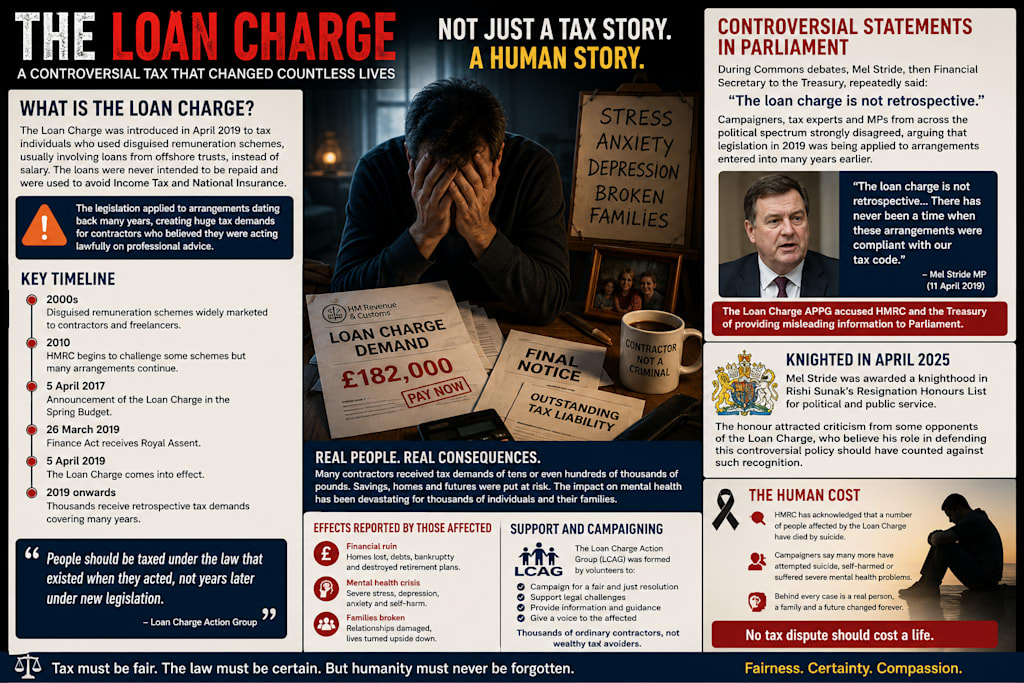
Few pieces of tax legislation in modern British history have generated as much controversy as the Loan Charge. To its supporters, it was a necessary measure designed to tackle tax avoidance schemes that allowed individuals to receive income in the form of loans rather than salary. To its critics, it represented retrospective taxation on an unprecedented scale, leaving thousands of ordinary contractors facing life-changing tax demands for arrangements that had often been disclosed to HM Revenue & Customs and, in many cases, had operated for years without challenge.
The debate has never been solely about tax. It has become a debate about fairness, legal certainty, mental health and the relationship between the individual citizen and the state. For many contractors, the financial consequences have been severe, while for some families the human consequences have proved devastating.
The Loan Charge was introduced to recover tax from individuals who had participated in disguised remuneration schemes, many of which involved employees or contractors being paid through loans from offshore trusts. These loans were never intended to be repaid and were designed to avoid Income Tax and National Insurance contributions. Although such arrangements had existed for many years, the legislation introduced a charge that effectively brought together outstanding loans dating back many years into a single tax liability.
It was this retrospective element that became the centre of the controversy. Critics argued that people should be taxed according to the law that existed at the time they entered into an arrangement rather than having new legislation applied to transactions that had already taken place. They also pointed out that many contractors had relied on professional accountants, tax advisers, recruitment agencies or scheme promoters who assured them that the arrangements complied with the law. Others believed that if HMRC considered the schemes unacceptable, it should have challenged them promptly rather than allowing years to pass before seeking recovery.
One aspect of the story that is often overlooked is how many contractors became involved in these arrangements in the first place. Many have said they were not actively looking for tax avoidance schemes. Instead, when accepting a contract through a recruitment agency or umbrella company, they were introduced to a remuneration arrangement that promised a higher take-home income than conventional PAYE. Contractors have described being told that the scheme had been reviewed by tax professionals, was fully compliant with tax legislation and, in some cases, that it had been disclosed to or accepted by HMRC. Whether those assurances were expressed in exactly those terms varied from scheme to scheme, but many contractors came away believing there was little or no risk in participating. Very few possessed the specialist tax knowledge needed to question what they were being told or fully understand the complex offshore trust structures that lay behind the arrangements.
Many participants have since argued that they were never given a full explanation of how the schemes actually operated or the potential risks should HMRC later challenge them. Like most people seeking specialist advice, they relied upon accountants, financial advisers, umbrella companies or scheme promoters whom they believed were acting professionally and lawfully. With the benefit of hindsight, many have said they would never have joined such arrangements had they been warned that they could one day face tax demands covering many previous years.
The organisations promoting these schemes were not providing their services free of charge. They typically charged administration or management fees for operating the arrangements and, in many cases, deductions were also made for Income Tax and National Insurance under the structure being used. Many contractors therefore believed they were paying tax and making National Insurance contributions, even if the overall amount deducted was lower than under standard PAYE employment. When the Loan Charge was later introduced, many felt that insufficient account had been taken of the fees they had already paid to the scheme operators or of any tax and National Insurance that had already been collected through the arrangements.
As HMRC increased its efforts to tackle disguised remuneration schemes, many of the organisations that had promoted them either ceased trading, withdrew from the market or became difficult to trace. Some promotional material was challenged and complaints were made to regulators, including the Advertising Standards Authority, about the way certain schemes had been marketed. For many contractors, however, these developments came far too late. The organisations that had designed, marketed and profited from the schemes had often disappeared or were no longer in a position to assist, leaving individual contractors to face the financial consequences alone.
One of the enduring criticisms made by campaigners is that many of the people who designed, marketed and profited from the schemes appeared to suffer relatively few consequences, while those who had simply followed professional advice faced the largest financial liabilities. Whether that perception is entirely justified remains open to debate, but it has undoubtedly contributed to the deep sense of injustice felt by many affected contractors.
Supporters of the legislation took a different view. They argued that the schemes had always sought to avoid tax that was legally due and that Parliament was entitled to legislate to protect the tax system. HMRC has consistently maintained that it warned against disguised remuneration schemes for many years and that the Loan Charge was intended to bring long-running avoidance arrangements to an end.
One of the most contentious aspects of the entire debate concerned the way the policy was presented to Parliament. During Commons debates, the then Financial Secretary to the Treasury, Mel Stride, repeatedly argued that the Loan Charge was "not retrospective", maintaining that the legislation merely sought to recover tax that had always been due. Campaigners, tax professionals and Members of Parliament from several political parties strongly disputed that interpretation, arguing that legislation introduced in 2019 was being applied to arrangements entered into many years earlier and therefore operated retrospectively in practice.
The All-Party Parliamentary Group on the Loan Charge later criticised what it described as misleading information provided by HMRC and the Treasury during the debate, while the Loan Charge Action Group argued that Ministers had misrepresented both the nature of the legislation and the action being taken against scheme promoters. Whether one agrees with the Government's legal interpretation or that of its critics, there is little doubt that this disagreement lies at the heart of the continuing controversy.
In April 2025, Mel Stride was awarded a knighthood in Rishi Sunak's Resignation Honours List for political and public service. The honour itself attracted criticism from some opponents of the Loan Charge, who believed that his role in defending one of the most controversial tax measures of recent decades should have counted against such recognition rather than in its favour. Others argued that the honour reflected his broader ministerial career and was unrelated to any single policy. The differing reactions demonstrate how deeply divisive the Loan Charge remains.
Whatever one's view of the legal arguments, the impact on many individuals has been profound. Some contractors received tax demands amounting to tens or even hundreds of thousands of pounds, often covering many years of earnings. People who had believed they were acting lawfully suddenly found themselves facing debts that exceeded the value of their homes, their pensions or their lifetime savings. Families described years of uncertainty, sleepless nights, financial hardship and the constant fear of bankruptcy.
One of the organisations that emerged to support affected individuals was the Loan Charge Action Group, commonly known as LCAG. Formed by volunteers, the group has campaigned tirelessly for changes to the legislation, supported legal challenges, provided practical information and sought to bring public attention to the human consequences of the policy. It has consistently argued that many people caught by the Loan Charge were not wealthy tax avoiders but ordinary contractors, freelancers, NHS workers, social workers, IT specialists, engineers and other professionals who relied upon expert advice when deciding how they should be paid.
The issue has also attracted significant attention within Parliament. MPs from across the political spectrum have questioned whether retrospective tax legislation is compatible with the principles of fairness and legal certainty that have traditionally underpinned the British legal system. Parliamentary debates, select committee inquiries and independent reviews have all examined aspects of the policy, although opinions have differed on whether the legislation should be amended or retained.
Perhaps the most disturbing aspect of the entire affair has been its effect on mental health. Over the years, campaign groups, Members of Parliament and coroners have highlighted cases in which individuals facing Loan Charge liabilities experienced severe depression, anxiety and overwhelming financial pressure. HMRC has acknowledged that a number of people affected by the Loan Charge have died by suicide, while campaigners have argued that the true human impact extends much further, including attempted suicides, incidents of self-harm and many more people experiencing serious mental health difficulties. It is important to recognise that the causes of suicide are often complex and cannot automatically be attributed to any single factor. Nevertheless, there is widespread agreement that the stress created by large and unexpected financial liabilities has had a profound effect on many families.
The tragedy of these cases raises broader questions about how governments should implement major policy changes. Most people accept that tax should be collected fairly and that genuine tax avoidance should be challenged. Equally, many believe that the rule of law requires citizens to know the consequences of their actions when they take them. When legislation reaches back many years to alter the financial consequences of past decisions, confidence in legal certainty can be weakened, even if Parliament has the legal authority to enact such measures.
There are also lessons for contractors themselves. Tax arrangements that appear unusually attractive should always be examined with great care, even when recommended by experienced advisers or marketed as fully compliant. Independent professional advice, careful record keeping and a healthy degree of scepticism remain among the best protections against becoming involved in arrangements that may later be challenged.
The Loan Charge will probably remain one of the most controversial chapters in modern British tax policy. It has highlighted the difficult balance between protecting the public finances and protecting the long-established principle that laws should normally apply prospectively rather than retrospectively. It has also exposed weaknesses in the regulation of tax avoidance schemes, raising difficult questions about the responsibilities of recruitment agencies, umbrella companies, scheme promoters, advisers, HMRC and successive governments. Reasonable people continue to disagree about where responsibility should ultimately lie, and historians will almost certainly continue debating whether the policy struck the right balance between collecting tax and preserving legal certainty.
Whatever conclusion one reaches, it is impossible to ignore the human stories behind the headlines. Financial disputes can often be resolved over time, but lives lost to despair can never be recovered. Governments, tax authorities, advisers and taxpayers all have responsibilities within the tax system, but those responsibilities should always be exercised with an awareness that behind every case file is a real person, a family and a future that can be profoundly affected by the decisions made.
If there is one lesson that should emerge from the Loan Charge, it is that the pursuit of tax must never lose sight of humanity. A civilised society should always seek to collect what is lawfully due, but it should do so in a manner that is transparent, proportionate and mindful of the lives affected by its decisions.
I’m Still Paying It Off!
About the Creator
Alan Spencer
Have been an author and writer for over 20 years. Have been a journalist, editor, proofreader, and a designer and presenter of training courses. Have written over 100 articles, two books, and around 20 training courses.
Enjoyed the story? Support the Creator.
Subscribe for free to receive all their stories in your feed. You could also become a paid subscriber, letting them know you appreciate their work.
Comments
There are no comments for this story
Be the first to respond and start the conversation.