
The Larak Strike: 5 Hours That Took the US-Iran Shadow War Public
American bombers hit a desolate island. Tehran answered with missiles across three countries. The unwritten rules of engagement just shattered — and the next 72 hours will decide whether this is a warning shot or the first act of a regional war.
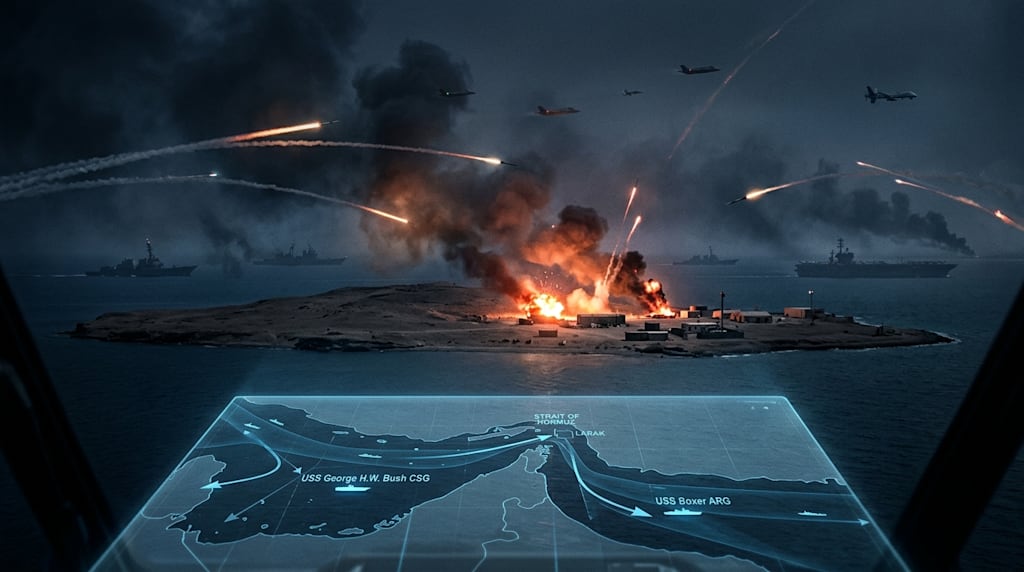
Larak Island, 22:00
— A breakdown of a U.S. airstrike and Iran's missile response
At approximately 22:00 local time on August 30, 2026, explosions were reported near Larak Island, off Iran's southern coast. The island sits on the southeastern flank of the Strait of Hormuz's main shipping lane, about 16 kilometers from Qeshm Island and 75 kilometers from the UAE coast. It is low and flat—roughly 8 kilometers long, 4 kilometers wide, with a maximum elevation under 40 meters. It hosts a small Iranian Revolutionary Guard Corps (IRGC) radar station and a fast‑boat mooring.
U.S. officials briefed media that evening that American forces had struck two IRGC facilities on Larak. The stated rationale: U.S. surveillance observed IRGC personnel loading rocket‑launched mines onto fast boats, preparing to seed the Strait's shipping channel. Washington described the strike as preemptive self‑defense. One week earlier, U.S. forces had completed a mine‑clearance operation in the same international waterway.
Iran's initial response was guarded. Early intelligence reports referred only to "enemy drone" activity near Larak; unofficial accounts mentioned two dead and two wounded. Then, shortly after midnight on August 31, a second explosion sounded on the island—either a secondary detonation or a follow‑up strike.
Between 02:00 and 03:00 local time, the IRGC shifted its framing. A social‑media statement accused the U.S. and Israel of carrying out the attack and promised retaliation. Roughly three hours later, the IRGC announced it had fired missiles at "U.S. military bases." Subsequent statements named specific targets:
Two U.S. bases in Jordan: King Hussein Air Base and Al‑Azrak.
One base in the UAE: Al Minhad Air Base.
Iranian media reported "severe damage" at the Jordanian sites and claimed to have shot down a U.S. MQ‑9 Reaper drone over the Strait. U.S. sources countered that most incoming missiles were intercepted, damage was minor, and the drone loss was unconfirmed.
From the U.S. airstrike to Iran's missile barrage: five hours.
1. The Strait's physical constraints
Without the Strait's geography, the U.S. rationale does not hold.
The Strait of Hormuz narrows to 33 kilometers at its tightest point. The navigable channel is about 3 kilometers wide, split into two 2‑kilometer lanes—one inbound, one outbound. Roughly 17 million barrels of crude oil pass through daily: about 30% of all seaborne oil trade and 20% of global consumption.
A single moored or bottom mine costs between $20,000 and $100,000. If deployed, it can shut the entire channel for 48 to 72 hours. During that window, every tanker reroutes, freight rates spike, and oil prices jump. The IRGC's naval arm has long used small boats (12 to 18 meters) equipped with 107 mm or 122 mm rocket‑launched mine dispensers, operating at night or in low visibility near the channel's edge—hard to track by satellite.
Larak Island sits at the channel's southeastern exit. From its moorings, a fast boat at 25 knots reaches the main shipping lane in about 20 minutes. The U.S. chose Larak precisely because it is the shortest possible launch point.
2. U.S. naval posture on August 30
The following positions come from open‑source ADS‑B flight‑tracking data on August 30, capturing U.S. carrier‑based aircraft movements.
USS Boxer (LHD‑4): Its MV‑22B Osprey flights clustered in the northern Arabian Sea, 300 to 400 nautical miles from the Strait's entrance. The ship carries the 13th Marine Expeditionary Unit—amphibious and vertical‑lift capability.
USS Bush (CVN‑77): Its CMV‑22B appeared near Port of Salalah, southern Oman, on August 30. Salalah lies about 600 nautical miles from the Strait. The carrier was likely deployed in the Gulf of Aden or the western Arabian Sea.
USS Lincoln (CVN‑72): Its CMV‑22B showed up at Kota Kinabalu International Airport (BKI) in Malaysian Sabah on August 30. That is roughly 4,800 nautical miles from the Strait. At 18 knots, a carrier strike group takes about 11 to 12 days to reach the Gulf.
The takeaway is not the fuzzy claim that "U.S. forces are stretched." The physical fact on August 30: one carrier strike group was within immediate striking range (Bush), one amphibious group was one day away (Boxer), and the second carrier was two weeks away (Lincoln).
3. Target selection as signal
The U.S. picked Larak, not Qeshm Island, not Bandar‑e Bushehr. That choice sends a calibrated message:
The strike was limited to a forward tactical node—mine‑loading boats—not IRGC command centers or missile depots.
Larak is sparsely populated. The reported casualties (2 killed, 2 wounded) suggest the U.S. deliberately kept the toll low, avoiding Iran's highest‑tier retaliation threshold.
The island sits far enough from UAE waters to reduce the risk of hitting allied forces or triggering Gulf air‑defense systems.
Iran struck Jordan and the UAE, not U.S. warships in the Gulf, not Al Udeid in Qatar. That response has its own gradations:
Jordan and the UAE are U.S. allies, but not direct participants in the Larak strike. Iran demonstrated its missile reach across the entire region while preserving a clear distinction—"we hit bases, not ships."
Avoiding Al Udeid (Qatar) and Diego Garcia (UK‑leased) means Tehran is still operating inside a "reversible" escalation band. It has not crossed the line into attacking a major U.S. power‑projection hub.
Claiming an MQ‑9 kill—if true—targets an unmanned system, not a manned aircraft. Shooting down a drone is a mid‑tier escalation, well below downing an F‑35 or a manned reconnaissance platform.
The gap between the two target sets draws an implicit boundary: the U.S. did not hit Iran's mainland; Iran did not hit U.S. vessels in the Gulf. Whether that boundary holds over the next 72 hours is the single most direct measure of escalation.
4. International reactions — statements and prices
Brent crude jumped about 4.2% in early Asian trading, to roughly $87 per barrel—the market pricing in at least a week of channel uncertainty.
The UN Security Council had not convened an emergency session as of this writing. The EU's foreign‑affairs spokesperson called for "maximum restraint." China's foreign ministry urged a "political settlement to avoid regional deterioration." Russia's statement was more direct—"the U.S. unilateral use of force is the source of instability"—but offered no material military or diplomatic backing.
The Gulf states' responses are worth watching separately. The UAE, after one of its bases was struck, has not issued a formal statement but raised its air‑defense posture to the highest alert level. Saudi Arabia has remained publicly silent, though it is known to be in contact with Tehran through Omani intermediaries.
Absent from the public record: any Israeli statement. Israel typically does not comment in the first round of U.S.–Iran clashes. More telling is what its military did not do: the Northern and Central Commands did not raise their readiness levels. That is a negative signal. It suggests Jerusalem does not yet see the current intensity as crossing its own direct‑response threshold.
5. Three markers for the next 72 hours
Not probabilities. Observables.
Marker 1 — De‑escalation path: If, in the next 24 hours, neither side conducts another military action, and communication flows primarily through third parties (Oman, Qatar), then Larak will be recorded as a closed incident. The U.S. will claim it stopped a mine attack; Iran will claim it delivered its promised retaliation. Neither needs a second round.
Marker 2 — Maritime shift: If, in the next 48 hours, Iran acts against a U.S. naval vessel or a commercially linked tanker in the Gulf—regardless of casualties—the conflict shifts from land‑base‑to‑land‑base exchange to direct naval confrontation. That narrows the geography back to the Strait itself, but widens the risk of miscalculation. Close‑quarters naval engagements have far less room for error than fixed‑base missile exchanges.
Marker 3 — Regional‑threshold breach: If the U.S. hits an Iranian missile depot or IRGC command node on the mainland, and Iran subsequently targets Gulf oil‑export infrastructure with ballistic missiles, the conflict becomes a regional armed confrontation. That would trigger collective‑security mechanisms among the Gulf states, pulling in multiple capitals that have so far stayed on the sidelines.
6. Back to the island
After the second explosion on August 31, no further military reports emerged from Larak.
No civilian evacuation has been announced. No IRGC reinforcements have been reported arriving. On satellite imagery, the island's salt flats and low scrub will not show crater depths at public resolution.
A U.S. official, speaking anonymously, told one outlet: "The operation is complete." No denial has followed.
The IRGC's final line in its statement read: "The aggressors will be punished."
Neither side has said when—or whether—the next round comes.
As of noon on August 31, 2026, AIS transponder data from the waters around Larak shows a single consistent signal: oil tankers are still moving through the Strait of Hormuz. Speeds have not slowed. Draughts have not changed.
About the Creator
Jin
Writer of reamstories
https://reamstories.com/jin
Enjoyed the story? Support the Creator.
Subscribe for free to receive all their stories in your feed. You could also become a paid subscriber, letting them know you appreciate their work.
Comments
There are no comments for this story
Be the first to respond and start the conversation.