
The Irreversible Endgame: Putin's Kuril Gambit
With a single visit, Russia turned a decades-old negotiation into a domestic affair. Tokyo fumes, Moscow digs in, and the Pacific order shifts.
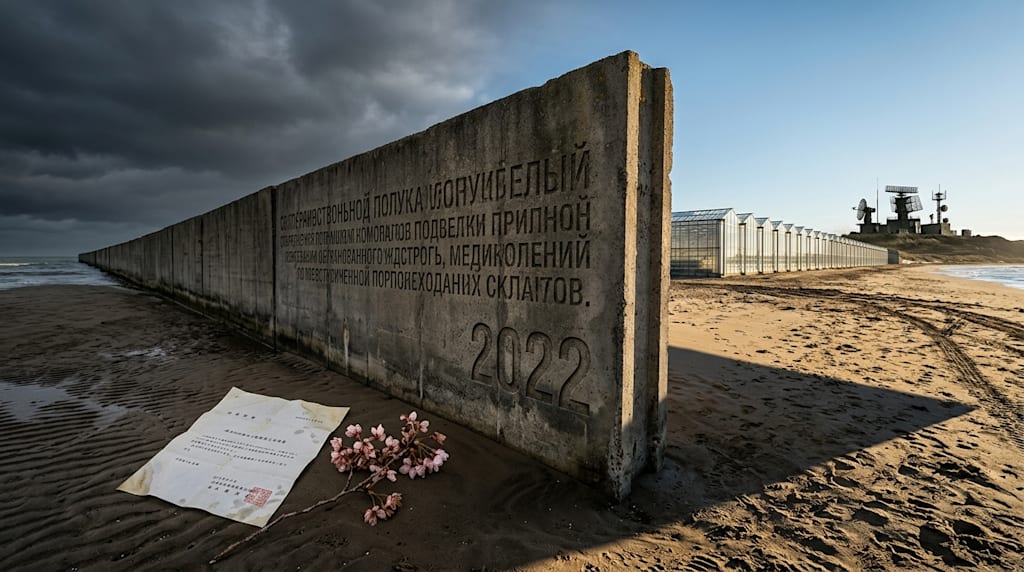
In August 2026, Russian President Vladimir Putin set foot on Iturup Island (Etorofu in Japanese) for the first time. He toured greenhouse complexes and fish processing plants, met with local officials, and Russian state media broadcast the entire visit on a loop.
This would have been routine domestic news in Moscow. In Tokyo, it landed as an act of diplomatic warfare. Prime Minister Sanae Takaichi responded with a statement of "absolute unacceptability," calling the four northern islands Japan's "inherent territory." Russia answered through two channels: Dmitry Medvedev warned on social media that "those who do not understand this will face dire consequences," and Foreign Ministry spokesperson Maria Zakharova issued an official declaration that Japan's claims were "legally utterly groundless" and "insulting."
Each side delivered a complete statement. None of them overlapped.
This was not Putin's first visit to the disputed islands. Dmitry Medvedev made multiple trips during his tenure as prime minister. But Putin himself had always avoided setting foot there. In his meetings with Shinzo Abe, he repeatedly said that "the territorial issue must be resolved in accordance with Russian public opinion"—and Russian public opinion would never support any territorial concession. Avoiding the island had been a gesture: it kept a negotiating window open. This visit was a different gesture: it shut that window.
The act shattered the "ambiguous tacit understanding" that had governed Russia-Japan territorial talks for decades. The Northern Territories problem is no longer a pending diplomatic issue. It has become a matter of domestic governance, unilaterally administered by Russia. The analysis below examines the endgame from four angles: the evolution of Japan's strategy, the geopolitical rupture of 2022, the legal entrenchment inside Russia, and the wider Asia-Pacific security context.
I. The Bankruptcy of "Economic Concessions for Sovereignty"
For more than a decade, Japan's core strategy on the Northern Territories was gradual infiltration.
Under Shinzo Abe, Tokyo proposed an "eight-point economic cooperation plan" covering healthcare, energy, and transport infrastructure. According to information that surfaced through unofficial Russia-Japan channels, Japan planned to invest tens of billions of dollars annually in Russia's Far East. In return, Tokyo hoped to secure Russian flexibility on returning Shikotan and the Habomai islands. The logic: economic entanglement would lower the cost of political confrontation and slowly cultivate Russia's willingness to make concessions.
Russia's response never changed. Putin's government separated economic cooperation from sovereignty negotiations. It allowed Japanese companies to conduct joint economic activities on the islands but explicitly excluded any discussion of territorial transfer. What Putin called "rule by public opinion" was a legal maneuver that foreclosed any territorial concession while keeping a political door ajar. Japanese money did flow into the Far Eastern economy. But Russia never moved an inch on sovereignty.
This was not a Kremlin improvisation. Russia's playbook on territorial issues runs as follows: let them invest, let them wait, then let them accept. Moscow used Japanese funding and political capital to ease the Far East's economic troubles and diplomatic isolation—without paying any substantive price.
Putin's visit sent a signal that can no longer be read as "let's keep talking." It read as: the illusion that money buys time and cooperation buys territory must now end. After the Russia-Ukraine war began, Japan joined the West in imposing crippling sanctions. That move destroyed Moscow's perception of Japan as a "non-hostile" nation. With the foundation of cooperation dismantled, Russia no longer even maintains the posture of ambiguity.
II. The Fall of the Legal Iron Curtain in 2022
The Russia-Ukraine war was the true watershed in the territorial dispute.
Before 2022, Russia kept up a hard line but still formally preserved a diplomatic channel. When the Kishida administration followed the US and Europe in imposing multiple rounds of economic sanctions and freezing bilateral political dialogue, Moscow revised its strategic assessment: Japan was no longer a "Western outlier that could be won over." It was reclassified as an "unfriendly state"—a hostile actor.
That shift produced legal action. In April 2022, Russia passed legislation designating the South Kuril Islands as part of its exclusive economic zone and introducing foreign investment restrictions. That same year, Russia began upgrading military installations on the islands, including shore-based anti-ship missile systems. These moves—military, economic, administrative—closed off any legal path to "return."
What stands out is not just the legal nature of these actions, but what Putin inspected during this visit. He did not visit barracks or missile sites. He toured greenhouses and fish processing plants.
That was deliberate. Inspecting civilian infrastructure sends a message to the international community: people live on this territory, businesses operate, and an administrative system governs—all of which are Russian domestic affairs, with no connection to Japan. A civilian-oriented display signals long-term occupation more powerfully than military exercises. Troops can be withdrawn. Farmland and factories, once established, create an irreversible demographic attachment—a form of control more durable than law.
III. Two Legal Frameworks That Do Not Meet
In this battle of narratives, Russian and Japanese discourses share no common ground.
Japan's claims rest on the 1855 Treaty of Shimoda, emphasizing "inherent territory" and "illegal occupation." Tokyo frames the issue as one of anti-aggression, repeatedly presenting Russia as a violator of international law.
Russia's response rests on the outcomes of World War II and the principle of effective control. Moscow invokes the Yalta Agreement and the San Francisco Peace Treaty, insisting that "the postwar order cannot be altered." In international law, the passage of time under effective control does not itself create sovereignty. But when that control has lasted for decades without effective challenge, it becomes a fait accompli of "effective jurisdiction" in practice.
Medvedev's "nonsense will not change anything" and Zakharova's "legally utterly groundless" share the same subtext: in international politics, actual control often outweighs historical documents. For Moscow, Japan's claims are politically an "interference in internal affairs" and legally a unilateral distortion of history.
The discursive fracture means dialogue is no longer possible. All that remains is diplomatic attrition—each side restating its position, with nothing moving toward resolution.
IV. Takaichi's Dilemma: Domestic Politics and Empty Hands
Sanae Takaichi's vehement protest is not a diplomatic gaffe. It must be read in the context of Japan's domestic politics.
As a conservative in the Liberal Democratic Party, Takaichi must strike a tougher line than her predecessors on the Northern Territories issue. She needs to consolidate her right-wing base, fend off opposition challenges, and secure her position in intra-party competition. Language like "absolutely unacceptable" is, in essence, a statement for a domestic audience.
Yet the external effect of this tough stance is near zero. Japan cannot constrain Russia economically: Moscow has pivoted to Eastern markets, and bilateral trade with Japan now accounts for a much smaller share of Russia's foreign economic activity. Japan cannot apply military pressure: its pacifist constitution and the US military framework in Japan leave Tokyo with almost no maneuvering room. At the UN, Japan cannot obtain meaningful support for pressuring Russia.
Takaichi's protest functions as a political performance—it satisfies domestic expectations without altering the administrative reality on the South Kurils. The practical side effect is to further sour Russo-Japanese public sentiment, compressing whatever space might have remained in bilateral relations.
V. The Geopolitical Board: US Pressure and Sino-Russian Backing
The South Kuril issue has long outgrown the bilateral sphere. It is now a microcosm of great-power rivalry.
The US-Japan alliance has produced a counterproductive effect. Japan has tied the territorial question to the US-Japan security framework, hoping to use American power against Russia. That has only hardened Moscow's position. Russia's military reinforcement of the South Kurils—shore-based anti-ship missiles, expanded facilities—is a direct response to the potential threat from US forces in Japan, stationed toward Hokkaido. The American presence has not helped Japan recover its territory. It has prompted Russia to treat the islands as a strategic outpost facing the Pacific.
At the same time, deepening Sino-Russian strategic coordination has given Moscow geopolitical cover. Under comprehensive Western isolation, collaboration between China and Russia in the Far East has steadily increased. The South Kurils are a critical node along Russia's Far Eastern maritime routes; their strategic value has grown. With China's weight in Northeast Asia, Russia faces Japan with more confidence and need not worry about isolation in the Far East over a territorial dispute.
Conclusion: The Relentless Weight of Fait Accompli
Putin's first visit to the island confirms a harsh reality: unless a large-scale war breaks out and Japan secures overwhelming external military support, de facto control over the four northern islands has passed permanently to Russia.
For Japan, the question is no longer "how to recover the territory." It is "how to manage this enormous rift in Russia-Japan relations without recognizing Russian sovereignty." A diplomatic task with no exit.
For Russia, the visit was not just a sovereignty show. It was a stress test: under comprehensive Western pressure, Putin stepped onto disputed ground and watched the responses. The result: beyond empty diplomatic condemnations, neither the Western camp nor Japan has any effective means to change this state of affairs.
The South Kuril Islands are no longer a "pending dispute." They are a fully formed fait accompli. That is the most direct manifestation of post-Cold War geopolitical ruthlessness in the Far East—the gap between what international law can reach and what great powers actually control says more than any diplomatic document ever could.
About the Creator
Jin
Writer of reamstories
https://reamstories.com/jin
Enjoyed the story? Support the Creator.
Subscribe for free to receive all their stories in your feed. You could also become a paid subscriber, letting them know you appreciate their work.
Comments
There are no comments for this story
Be the first to respond and start the conversation.