
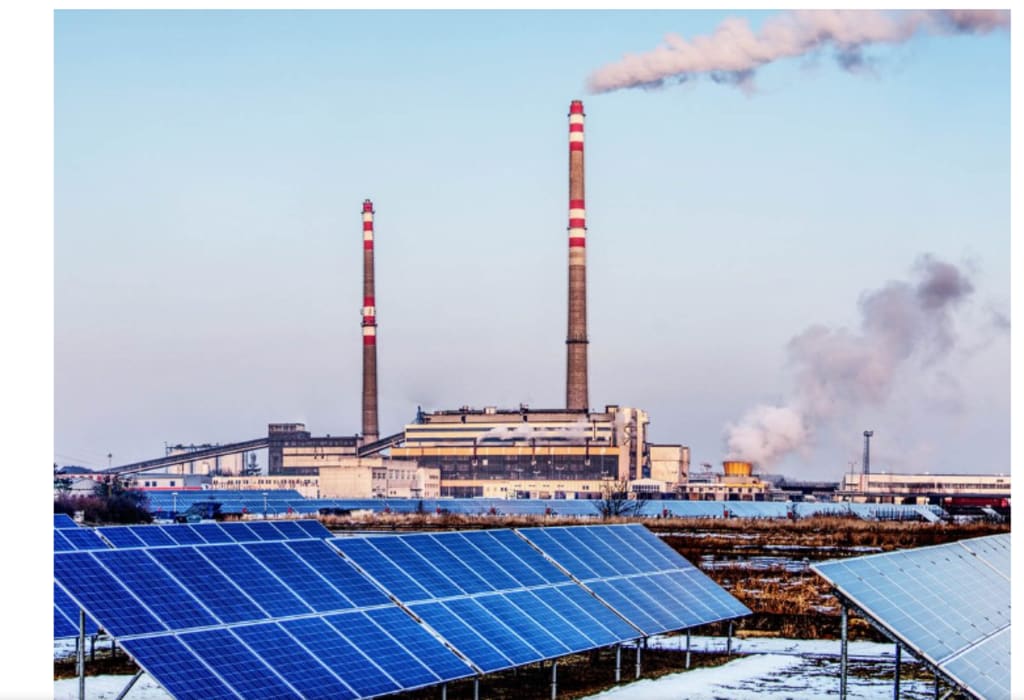
The energy output of solar arrays is being considerably reduced by air pollution from coal-fired power plants.
Emissions offset solar gains

Governments and investors revise their climate estimates based on the annual tally of new solar capacity. The math says that if there are more panels in the ground, there will be less coal.
A recent study discovered a systematic fault in that accounting, which is caused by something that conventional capacity models completely overlook. The source is positioned in the space between the panels and the sun.
What aerosols eliminate
Researchers from University College London (UCL) and the University of Oxford (Oxford) mapped the locations of over 140,000 solar panels worldwide. The group then compared atmospheric data on aerosols—airborne particles that scatter and absorb sunlight before it reaches a panel—to each site.
These pollutants reduced the amount of solar electricity produced worldwide by 5.8% in 2023. This amounts to around 111 terawatt-hours of lost energy, or the yearly production of eighteen medium-sized coal plants.
Dr. Rui Song, a physicist at Oxford and UCL's Mullard Space Science Laboratory, oversaw the study. According to Dr. Song, the results indicate that clean energy is not producing as much as anticipated.
According to him, "emissions change the radiation environment as coal and solar grow simultaneously, directly undermining the performance of solar generation."
Emissions offset solar gains
This is the more difficult figure. An average of 246.6 terawatt-hours were contributed to the global grid annually by new solar installations between 2017 and 2023. Approximately 74 terawatt-hours of that, or nearly a third of the gain, were cancelled by aerosols on current solar farms.
Previous research had identified the issue in areas with high pollution. At this size, no one had ever compared it to actual output, site by site. China suffered the most in 2023, producing 793.5 terawatt-hours of solar electricity, or more than 41% of the global total.
Particles in the air caused the nation to lose 7.7% of its potential productivity. Over 60% of the benefits of new solar arrays were eliminated in certain years due to aerosol losses. The gain at the meter continued to lag behind the gain on paper.
Coal sulphate
The most harm was caused by sulphate aerosols. They are created in the atmosphere by sulphur dioxide, which is released when coal stacks burn. Sulphate alone is responsible for 46.2% of China's aerosol-driven solar losses, according to calculations made by the Oxford-UCL collaboration.
According to a different study of pollution sources, coal-fired electricity is responsible for roughly 29% of those losses. Before sunlight reaches the surface of a solar panel, it is scattered and absorbed by the small particles released by coal plants. There is less electricity out when there is less light in.
The function of geography
The situation is different in the United States. In 2023, aerosols caused American solar farms to lose just 3.1% of their production, which is less than half China's rate. Geography can provide an explanation for this. The majority of solar power in the United States is located distant from coal-fired power plants.
In the United States, China, and other regions, the researchers discovered virtually no association between coal capacity and solar losses.On the same test, their scores were significantly positive. Solar output is lowest when coal stacks are densest.
China's silent development
The twist is as follows. China is the only significant region where losses are declining, despite being at the top of the loss ranking. Between 2013 and 2023, aerosol-driven solar losses decreased by roughly 1.4% annually.
Closing coal plants did not bring about the improvement. Over the same ten years, China's output of coal-fired energy increased from 4,093 to 5,857 terawatt-hours. The fleet's ultralow-emission retrofits—tighter scrubbers, more aggressive filters, and tighter pollutant limits—were the source of the cleanup.
These improvements were thoroughly reported in a different study. Nine percent of the sulphur dioxide reductions over China's solar regions came from plant closures, while 91 percent came from retrofits.
Mapping each solar panel
To locate solar farms anywhere on Earth, the researchers combined open-source databases, crowdsourced records, and their own machine-learning model that was trained on satellite photos. An AI model was then applied to each identified site, drawing distinct borders around the panels rather than the dirt strips between rows or access roads.
The new analysis is based on that particular detail. Previous studies calculated pollution losses under the assumption that sun energy was distributed uniformly across regions. According to the new statistics, panels are located in China, frequently 20 to 30 miles from a coal plant.
Wider ramifications of the research
Researchers now possess a number that they previously lacked. Not only does coal plant air pollution sicken the local populace, but it also directly reduces the output of the solar panels that are supposed to replace them.
Climate estimates based only on installed capacity would be disrupted by that 5.8 percent global drag. As China's record demonstrates, cleaning up existing coal plants is beneficial. However, the same plants that continue to run as grid backup will continue to release the particles that reduce the value of solar energy.
If the losses are not taken into consideration, the progress made in renewable energy is probably exaggerated. Now, the dilemma for grid designers and regulators is where additional solar is constructed and how quickly the surrounding coal capacity goes offline.
About the Creator
Enjoyed the story? Support the Creator.
Subscribe for free to receive all their stories in your feed.
Comments
There are no comments for this story
Be the first to respond and start the conversation.