
The Confluence of Three Downward Curves
Between a 68-year-old’s rice-shelf hesitation and an $80 billion defense budget, Sanae Takaichi’s populist experiment collides with the unforgiving arithmetic of a shrinking Japan.
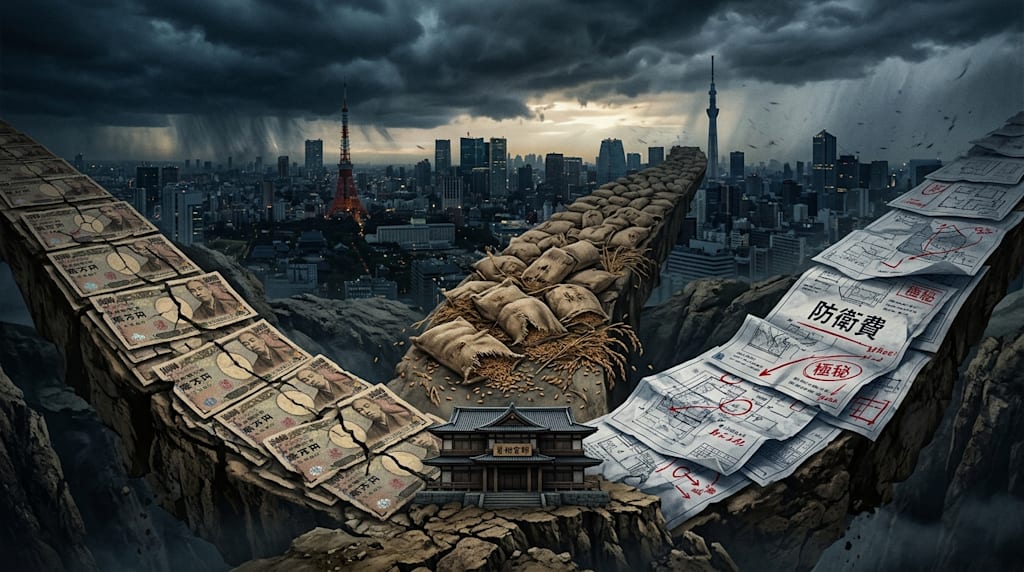
In late August 2026, a Kyodo News telephone poll put the Takaichi Cabinet's approval rating at 50.2%. That same month, NHK recorded 53%, while the Nikkei business daily arrived at 62%. The gap between these three numbers already tells a story of its own. Different media, different samples, different question wording—all reflecting a public mood that is itself unsettled and inconsistent.
But all three series point in the same direction: this is the lowest reading since Sanae Takaichi took office.
Placed in the postwar history of Japanese prime ministers, an approval rating in the 50% range is not particularly low. More than half of all premiers over the past three decades had lower numbers at comparable points in their tenures. If Takaichi's approval is a curve, it has merely fallen from "too high" to "still passable." A Tokyo-based political commentator, when asked about approval ratings off the record, put it this way: as long as the disapproval rate does not overtake the approval rate, the seat stays warm.
Yet absolute numbers obscure the acceleration of the trend. Three months ago, Kyodo's figure was still 61%. A ten-point drop in three months—that slope warrants attention. It is not a slow erosion; it is a continuous, unbroken slide.
The reasons for the slide are not hidden in political gossip or cabinet scandals. A documentary broadcast by TV Tokyo in mid-August contained a fixed camera shot that lasted four minutes: a 68-year-old retired elementary school teacher stood before a supermarket rice shelf, picked up a 5-kilogram bag of Niigata Koshihikari rice, glanced at the price tag—2,980 yen—and put it back. He then picked up a 10-kilogram bag of imported rice at 3,980 yen, then put that back too. In the end, he took two packs of half-price frozen udon noodles, totaling 320 yen.
This scene has been cited repeatedly because it says more about the predicament of ordinary Japanese today than any polling number. Core CPI in Tokyo has now risen for sixty consecutive months, but the composition of the increase is highly uneven. Bento lunches are up 26.7%, coffee beans have surged 31.2%, while rent—which carries a heavy weight in the CPI basket—has barely moved. This means inflation is felt entirely differently by homeowners versus renters, by retirees versus working-age households. The sharpest edge of price increases cuts precisely into those with the least bargaining power—people on fixed pensions, with no side income and no way to raise wages by changing jobs.
Meanwhile, the yen weakened past 160 against the dollar twice in July and August. Over those two months, the government and the Bank of Japan poured a record 15.4 trillion yen into currency intervention. The effect lasted about three days. The market's reasoning was straightforward: the Japan–U.S. interest rate differential remains wide, and the Takaichi Cabinet has repeatedly signaled that "we will not rush to raise rates." A foreign-exchange trader quoted in the Nikkei put it bluntly: "The market does not follow the government; it follows the yield spread."
Takaichi has not been inactive. Since taking office, every policy line has left a clear execution trail.
On defense, she has brought the defense budget to 2% of GDP ahead of schedule and is already pushing toward a new target of 3.5%, benchmarked against NATO members. In the FY2027 budget request, defense spending stands at 8.9 trillion yen. A simple calculation: 8.9 trillion yen is forty-three times the annual budget of all Japan's national universities combined, and 2.6 times the annual child allowance expenditure. No one mentions these multiples in press conferences, but they are the real arithmetic of fiscal redistribution.
On immigration, the Takaichi Cabinet issued new guidelines for permanent residency in August. Two substantive changes: the residency requirement for permanent residency applications is extended from five to ten years, and Japanese language proficiency is now a mandatory condition. Neither existed before. The Immigration Services Agency now states that "permanent residency requires particularly careful examination" and, for the first time, adds that applicants "should actively bring benefits to Japan."
On the same day, the Ministry of Health, Labour and Welfare released a report on labor shortages in the nursing care sector. The shortfall stood at 270,000 people. The two stories appeared in the same day's newspapers, just four pages apart. No media outlet explicitly connected them—but any reader could complete the connection themselves. Tightening permanent residency while the care sector is desperately short of workers. Short of whom? The very foreigners applying for that residency.
On historical issues, Takaichi's choice has been even more direct. In her address at the annual ceremony marking the end of the war on August 15, three words were entirely absent: "reflection," "aggression," and "apology." She sent a ritual offering to Yasukuni Shrine. Political economist Kazuyuki Hamada offered an unsparing comment: "Without building on history, without reflecting on the past, neither the present nor the future can be discussed. One must seriously analyze why it happened, and what should be reflected upon must be reflected upon. From that perspective, Sanae Takaichi does not appear to have grasped these most basic issues."
His words were widely shared on social media. But the shares came mainly from urban, highly educated, younger demographics. In regional cities and rural areas, Takaichi's policies still command a solid base of support. The reason is not complicated: residents there have a more direct perception of "foreigners"—the faces behind convenience store counters, at izakaya tables, in hospital wards—and their own wages have not risen.
Takaichi is playing a three-card hand: anti-immigration, military expansion, historical revisionism. Each card targets a distinct constituency. Anti-immigration speaks to those who feel most deprived relative to visible outsiders. Military expansion answers anxieties about the regional security environment. Historical revisionism gratifies the conservative base.
But all three cards share the same underlying risk structure.
Every tightening of immigration policy widens the labor gap by one more notch. Japan's total fertility rate has fallen for nine consecutive years, reaching 1.20 in 2025. That means even if permanent residency rules were not changed at all, the labor force would naturally shrink by more than four million over the next decade. Tightening immigration is not plugging one leak—it is tearing open another.
Every yen spent on defense ultimately converts into more public debt. Japan's gross government debt stands above 260% of GDP, the highest among major economies. The 8.9 trillion yen defense allocation does not come from a fiscal surplus; it is pre‑borrowed from the tax base of the next generation. And the generation that will have to service that debt is the very one that is shrinking.
Every statement that softens historical accountability shortens Japan's diplomatic room to maneuver with its neighbors. South Korea has repeatedly expressed "regret" through multiple channels, and China's foreign ministry statements have progressively sharpened in tone. For a country deeply embedded in East Asian supply chains, trade networks, and tourism flows, this is not a negligible friction cost.
The tension among these three cards lies in their competing demands: anti‑immigration requires administrative resources; military expansion requires fiscal resources; historical revisionism requires diplomatic resources—and in today's Japan, none of these is abundant.
What Sanae Takaichi is doing, put more bluntly, is managing a structurally declining country with populist methods. This works in the short term—it makes voters feel that "someone is speaking for me"—but over the medium and long term, it consumes time that ought to have been spent repairing the structure itself, and spends it instead on manufacturing emotional outlets.
On September 1, at a small nursing home in Tokyo's Minato ward, a Filipino care worker glanced at her phone during her lunch break. She had just received an email from the Immigration Services Agency notifying her that the standards for permanent residency applications would be adjusted. She did not click to read the details—she still had four bedridden residents to attend to in the afternoon. That same day, the Ministry of Finance released trade data: a July deficit of 62.1 billion yen, the thirteenth consecutive monthly deficit.
There is no causal link between these two events. But they are two segments of the same riverbed—one, the intention of policy; the other, the response of reality. The riverbed is shifting direction, and the current has not yet caught up.
About the Creator
Jin
Writer of reamstories
https://reamstories.com/jin
Enjoyed the story? Support the Creator.
Subscribe for free to receive all their stories in your feed. You could also become a paid subscriber, letting them know you appreciate their work.
Comments
There are no comments for this story
Be the first to respond and start the conversation.