
The Balcony and the Echo: Timing, Tradition, and the Battle for Attention
As the royal family continues its centuries-old rhythm, a parallel narrative unfolds across the Atlantic—one shaped not by duty, but by visibility, perception, and perfectly timed moments.

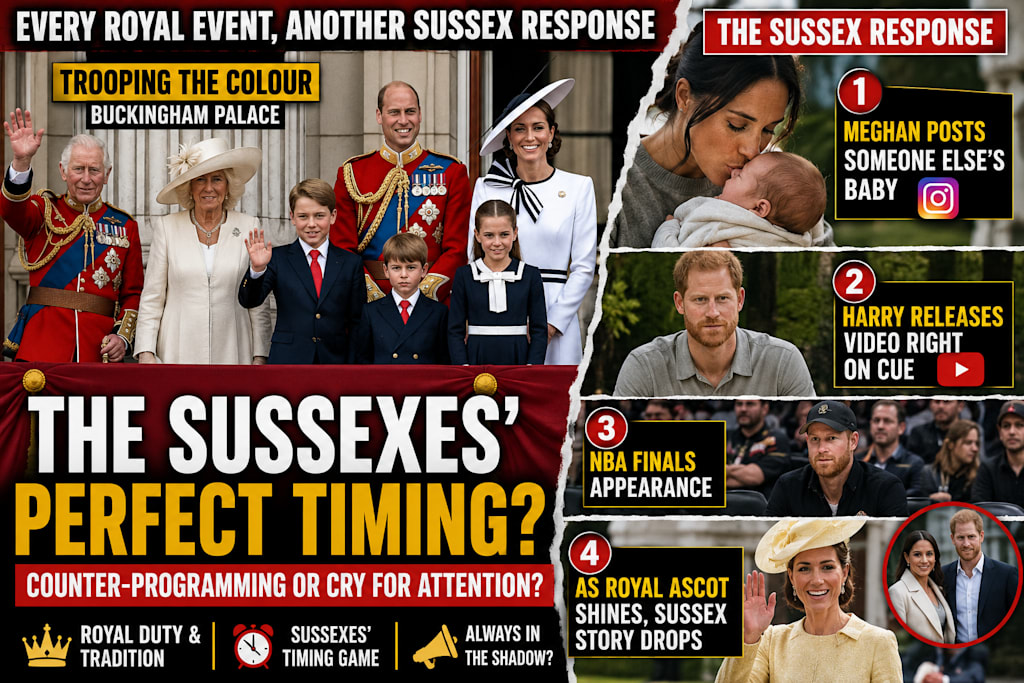
Another year, another Trooping the Colour, and once again London finds itself wrapped in ceremony. The air feels familiar, almost rehearsed. Crowds gather along the Mall, cameras are poised, and the steady beat of drums announces the arrival of a tradition that has endured for generations. This is more than spectacle—it is continuity made visible.
At Buckingham Palace, the royal family steps onto the balcony with practiced ease. Every movement is measured, every appearance intentional. There is no rush, no urgency, no need to compete for attention. The institution does not chase relevance; it defines it through consistency. For a few moments, the world watches as history and present merge into a single, carefully composed image.
And then, as if on cue, something else begins to unfold—thousands of miles away.
In Montecito, far removed from the formality of royal life, a different kind of presence emerges. It does not arrive with fanfare or marching bands, but through screens and notifications. A photograph appears online. Soft, personal, intimate. A newborn cradled gently, a quiet moment shared with millions. It feels warm and human, deliberately so.
Yet the timing raises eyebrows.
It is not the image itself, but when it appears that draws attention. Within hours of the royal balcony moment, a new narrative enters the conversation. To some, it feels coincidental. To others, it feels calculated. Either way, it ensures one thing: the spotlight is no longer singular.
Moments later, another appearance follows. A video surfaces—casual in tone, almost understated. A prince once defined by military uniform and royal duty now stands in a far more relaxed setting. No ceremony, no grandeur. Just a message, delivered directly and without the layers of tradition that once framed his public life.
The contrast is unmistakable.
Two worlds move side by side, each operating under entirely different rules. One is bound by history, where every action carries the weight of expectation. The other is driven by immediacy, where timing can shape perception as much as the message itself.
As the days pass, the pattern becomes clearer.
A royal event dominates headlines. Shortly after, a separate story emerges. A public appearance is followed by a carefully timed post. A milestone is accompanied by another moment designed to capture attention. None of these actions are inherently unusual on their own. But together, they create a rhythm that feels increasingly deliberate.
Observers begin to notice.
They track the timing, compare the moments, and question the intent. Is it coincidence, strategy, or simply the nature of modern media cycles? The answer may never be fully clear. But in the world of public perception, the distinction often matters less than the pattern itself.
Meanwhile, the monarchy continues without deviation.
It does not respond to the noise, nor does it alter its course. Events proceed as scheduled, appearances are made as expected, and the institution maintains its steady pace. That consistency is its greatest strength. It does not need to adapt quickly because it is not built for immediacy—it is built for endurance.
This is where the difference becomes most apparent.
For the royal family, visibility is inherent. It exists regardless of effort, rooted in centuries of history and tradition. For those outside that structure, visibility must be created and maintained. It requires engagement, strategy, and, at times, impeccable timing.
And timing, in this case, has become the defining theme.
Each moment that aligns too closely invites comparison. Each appearance that follows a major royal event adds another layer to the narrative. Over time, these moments begin to feel less like isolated incidents and more like chapters in an ongoing story.
A story not of direct conflict, but of contrast.
On one side stands an institution that moves forward without looking back. On the other stands a modern approach to public life, where relevance is fluid and attention is constantly shifting. Neither directly confronts the other, yet their proximity—both in timing and in public interest—creates an unspoken connection.
It is a delicate balance.
Too much alignment, and it appears intentional. Too little, and the opportunity for visibility is lost. Navigating that balance is no small task, particularly in an era where every action is analyzed, every post scrutinized, and every moment placed under a global microscope.
As Trooping the Colour fades for another year, the images remain. The balcony. The crowds. The sense of continuity that defines the monarchy. But alongside those images, another set persists—the posts, the videos, the carefully timed appearances that followed.
Together, they form a dual narrative.
One steady and unchanging. The other dynamic and responsive.
And perhaps that is the most telling conclusion of all.
The royal family does not compete because it does not need to. Its role is already defined, its place already secured. It moves forward with quiet confidence, untouched by the need for immediate validation.
Everything else, however, operates differently.
It reacts. It adapts. It responds to the shifting currents of attention and relevance. And in doing so, it often finds itself moving in the shadow of something far older, far steadier, and far less concerned with the moment.
Because in the end, the monarchy simply carries on.
And the echo, no matter how persistent, always follows.
About the Creator
Behind the Curtain
"Exploring the untold stories and hidden truths. From royal rumors to cultural deep dives, Behind the Curtain brings you bold, insightful narratives that spark curiosity and conversation."
Enjoyed the story? Support the Creator.
Subscribe for free to receive all their stories in your feed.
Comments
There are no comments for this story
Be the first to respond and start the conversation.