
The AI Jobs Revolution: Which Careers Will Survive the Next 10 Years?
Artificial intelligence is transforming the workplace faster than many expected—but the future may belong to people who know how to work with AI rather than compete against it.
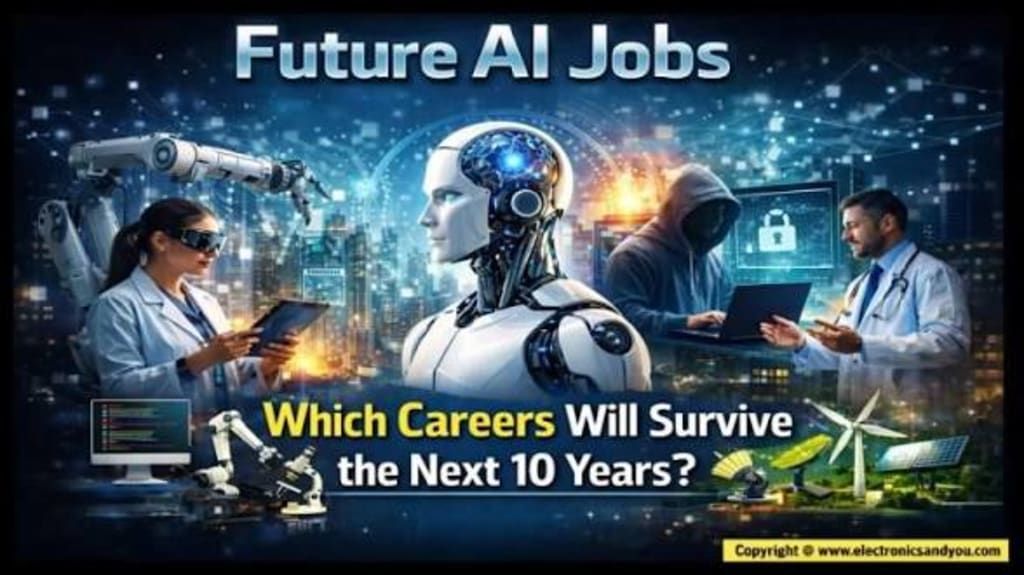
The AI Jobs Revolution Is Already Here
For years, artificial intelligence was presented as a technology of the distant future. Today, that future has arrived in offices, factories, hospitals, schools and businesses around the world.
AI can write reports, analyze information, generate images, assist programmers, answer customer questions and automate repetitive administrative tasks. As these capabilities improve, an uncomfortable question is becoming increasingly important: which jobs will still exist ten years from now?
The answer is more complicated than simply saying that AI will replace humans.
Recent research and reporting suggest that AI is more likely to transform many jobs by changing the tasks people perform rather than instantly eliminating entire professions. At the same time, some occupations and entry-level roles face considerably greater pressure than others.
Why AI Is Changing Work So Quickly
Previous technological revolutions often required years or decades to spread. AI is different because software can be deployed almost instantly across millions of computers and workplaces.
A company can introduce an AI assistant without constructing a new factory. A marketing team can use generative AI to produce first drafts. Software developers can use AI coding tools to accelerate routine programming tasks.
This means that the most vulnerable work is generally work involving repetitive, predictable and easily measurable tasks.
Data entry, basic administrative processing, routine customer support and certain forms of content production could increasingly become automated.
But automation does not necessarily mean that the human worker disappears.
Instead, one employee using AI may eventually be able to accomplish work that previously required several people.
The Careers Most Likely to Remain Strong
Some careers are difficult to automate because they require human judgment, physical presence, emotional intelligence or responsibility.
Healthcare
Doctors, nurses, therapists and other healthcare professionals are likely to remain essential.
AI can assist with medical research, documentation and diagnostic support, but healthcare involves communication, ethical decisions and direct interaction with patients.
Recent academic research examining occupational exposure to AI found healthcare practice among the fields offering a strong combination of relatively high pay and lower AI exposure.
The future healthcare worker may therefore use AI as a powerful assistant rather than compete with it.
Skilled Trades
Electricians, plumbers, mechanics, construction workers and other skilled tradespeople also have an important advantage: their work takes place in unpredictable physical environments.
A computer can generate instructions for repairing a pipe, but physically locating the problem inside an old building is another matter.
Robotics is improving rapidly, but machines capable of reliably handling every real-world environment remain a significant technical challenge.
Teachers and Educators
Education is another field where human interaction remains extremely important.
AI can explain concepts, generate exercises and personalize learning materials. But a good teacher does more than deliver information.
Teachers motivate students, recognize emotional difficulties, manage classrooms and understand individual personalities.
The role may change, but the human element is unlikely to disappear.
Technology Workers May Face the Biggest Paradox
Interestingly, technology professionals could experience both the biggest opportunities and some of the biggest disruptions.
AI can already assist programmers, designers, analysts and engineers with routine tasks. That means companies may need fewer people for certain types of basic work.
At the same time, demand for people who understand AI systems, cybersecurity, data infrastructure and advanced software development is growing.
The result could be a workplace where AI literacy becomes as important as basic computer literacy once was.
Workers who refuse to learn the technology may struggle, while those who understand how to use it could become significantly more productive.
Creativity Will Not Simply Disappear
There is a common belief that creative careers are automatically protected from AI. That assumption may be too optimistic.
AI can already generate illustrations, music, video concepts, advertising copy and other creative material.
However, creativity is not simply producing an output. It also involves deciding what should be created and why.
A human filmmaker, writer, designer or creative director brings personal experience, cultural understanding, taste and judgment to the process.
The likely future is therefore not necessarily "AI versus artists." It could be artists using AI as another creative instrument.
Human Skills May Become More Valuable
One of the biggest lessons from the AI revolution is that technical knowledge alone may not be enough.
Communication, leadership, negotiation, critical thinking, empathy and decision-making could become increasingly valuable because these skills complement automated systems.
Research on future careers similarly emphasizes that jobs involving human interaction, complex decision-making and adaptability can be more resilient to automation.
In other words, the safest career strategy may not be finding a job that AI can never touch.
It may be developing skills that allow you to become better because AI exists.
The Rise of the AI-Augmented Worker
Imagine a lawyer who uses AI to review thousands of documents in minutes, allowing more time for negotiation and strategy.
Imagine a doctor using AI to analyze medical information before speaking with a patient.
Imagine a journalist using AI to organize large datasets while personally verifying facts and conducting interviews.
In each example, AI handles part of the workload while the human remains responsible for judgment.
This could become the dominant model of employment during the next decade.
What Should Workers Do Now?
The biggest mistake may be waiting until AI has already transformed your industry.
Workers can start by learning how AI tools work, understanding their limitations and identifying repetitive tasks within their own jobs.
The goal should not necessarily be becoming an AI engineer.
Instead, professionals can ask a simpler question:
"How can AI make me more valuable at what I already do?"
That mindset can turn technological disruption into an opportunity.
The Next Ten Years Could Look Very Different
Nobody can accurately predict every occupation that will exist in 2036.
AI capabilities are developing rapidly, while robotics is also progressing. The International Federation of Robotics reported that the global market value of industrial robot installations reached a record $16.7 billion, demonstrating how automation is expanding beyond software.
Humanoid robotics is also moving from experimental demonstrations toward potential industrial applications, although large-scale adoption still faces significant technical and economic challenges.
The future workplace could therefore combine AI software, robots and humans in ways that are difficult to imagine today.
Conclusion
The AI jobs revolution is unlikely to produce a simple world where humans work and machines take everything over.
Instead, the next decade may create a new division between workers who adapt to intelligent technology and those whose tasks can be easily automated.
The most resilient careers will probably combine uniquely human qualities—judgment, empathy, creativity, responsibility and physical adaptability—with the ability to use increasingly powerful AI tools.
The important question is no longer simply, "Will AI take my job?"
A better question is:
"What can I learn today that will make me valuable in a workplace powered by AI?"
That question could determine who thrives in the next era of work.
About the Creator
Enjoyed the story? Support the Creator.
Subscribe for free to receive all their stories in your feed.
Comments
There are no comments for this story
Be the first to respond and start the conversation.