
Ten Thousand Bombs Fell. The Number Didn’t Move.
Six months into the Iran war, the Pentagon’s own assessment says the same thing it said before. A blocked strait, a $60 billion hole, and the people waiting for an end that never comes.
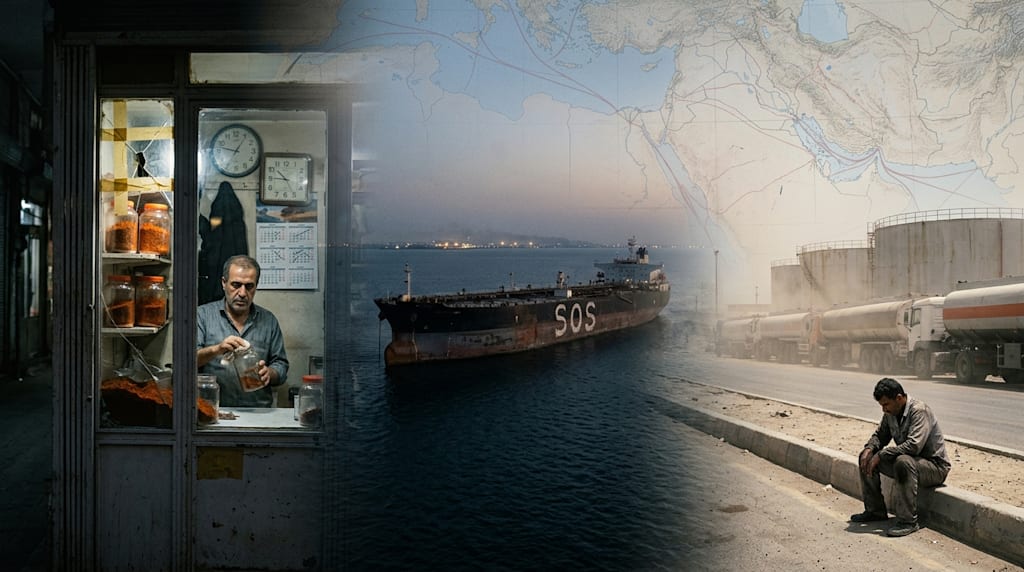
From "swift victory" to quagmire: six months of the 2026 Iran war
At 2:00 AM on February 28, 2026, in Tehran.
A bunker-buster tore through Khamenei's residence. Hours later, Iranian state television interrupted its regular programming. The announcer wore a black robe and read a statement with no accompanying footage. Three sentences: The Leader is martyred. The enemy will pay. The Strait of Hormuz is closed.
This was not an accidental war. The February 28 airstrikes were a sequel to the June 2025 "12-Day War." After that conflict ended, U.S. intelligence assessed that Iran's nuclear breakout time had been "delayed to about 9 to 12 months." By early 2026, the assessment was updated: Iran held approximately 440 kilograms of 60% enriched uranium. Enough for ten bombs.
Washington and Tel Aviv decided not to wait.
I. The illusion of swift victory
In the war's first week, a phrase appeared in Pentagon briefings: "Epic Fury."
The U.S. military announced it had struck over 10,000 Iranian military targets. Israel's military said it hit 3,000. The defense secretary played a video at a press conference: a precision-guided bomb drilling into an underground facility, fire erupting from a ventilation shaft. He said Iran's nuclear capability had been "completely destroyed."
But inside the Pentagon, another assessment began circulating in mid-March. Its conclusion was one line: Iran's nuclear breakout time had "remained essentially unchanged." In 2025, after 12 days of war, the assessment said 9 to 12 months. In 2026, after six weeks of war, the assessment still said 9 to 12 months.
Ten thousand bombs fell. The number didn't move.
Iran's retaliation came faster than expected. On February 28, the Revolutionary Guard launched Operation "True Promise 4." By the end of March, they had fired at least 87 waves of ballistic missiles and drones. Targets included Israeli territory and at least 17 U.S. military bases across the Middle East. Air raid sirens sounded in ten countries: the UAE, Qatar, Saudi Arabia, Kuwait, Jordan, Bahrain, Oman, Iraq, Lebanon, and Yemen.
On March 10, ship traffic through the Strait of Hormuz dropped from 129 vessels per day pre-war to 4.
II. What's behind the numbers
Iran's official figures: at least 1,750 dead, 22,800 injured, 81,000 civilian facilities destroyed, 3.5 million displaced.
The numbers are too large. They need to be broken down.
Iranian Foreign Minister Araghchi said over 600 schools were damaged, with more than 1,000 students and teachers killed or injured. The Health Ministry said over 230 children died. The UN refugee agency's assessment: 600,000 to 1 million families temporarily displaced, about 3.2 million people, of whom 864,000 are children. 389,000 Iranians crossed the border into neighboring countries.
Revolutionary Guard Tehran commander Brigadier General Hassanzadeh later said on state television that over 600,000 people had registered for the September 18 "Sacrifice for Iran" rally, with over 1 million expected to attend training. His tone was level, like reading a weather report.
That same day, on a Tehran street, a saffron shop owner wiped each jar on his shelf. His shop window had been shattered in an airstrike; the new glass still had tape on it. He said saffron prices had tripled, but buyers had halved. "People buy bread first," he said. "You can't eat flowers."
III. Twenty thousand people in the strait
The Strait of Hormuz is only 50 kilometers wide at its narrowest point. Before the war, about 20% of the world's traded energy passed through it. Crude oil: 38%. LPG: 29%. LNG: 19%. Chemicals: 13%.
After the blockade, UAE Minister of Industry and Advanced Technology and ADNOC CEO Sultan Al Jaber gave a set of numbers: at least 22 vessels attacked, 10 crew members killed, about 20,000 seafarers stranded on roughly 800 merchant ships. Nearly 400 of them were tankers.
By July, the International Maritime Organization updated its figures: about 6,000 seafarers were still stranded on about 500 ships anchored in the Persian Gulf.
A second officer on a stranded tanker spoke by satellite phone. He said fresh water was rationed twice a day, ten minutes each time. Deck temperature: 52 degrees Celsius. They painted "SOS" on the hull, but no one saw it. He said the worst part wasn't the heat. It was the nights. At night, he could see lights on the opposite shore, but the ship couldn't move.
"My daughter is three," he said. "She thinks her father works at sea. Yes, I'm at sea. But I'm not moving."
IV. A hundred billion dollars in gasoline and a sixty-billion-dollar hole
U.S. Senator Mark Warner posted on X. He said Trump had claimed the war with Iran "would last 6 weeks." "More than 6 months later," he wrote, "the war is still waging, and Americans have paid an extra $100 billion for gas and diesel and at least another $60 billion for essentials like groceries and mortgages."
U.S. average retail gasoline prices in April rose over 50% from pre-war levels. Real disposable income fell for the third consecutive month.
France, Italy, Spain, Germany. Four major eurozone economies. Inflation above the European Central Bank's 2% target for three consecutive months. The OECD cut its 2026 world economic growth forecast from 3.4% to 2.8%. The WTO said high energy prices could shave another 0.3 percentage points off global GDP forecasts and 0.5 points off trade growth.
In Basra, fuel trucks sat idle by the roadside. Contractor Fawzi said: "I haven't done anything for a month. What can we even maintain?" His company first cut wages by 20%, then halved them, then laid off dozens. He now works only 15 days a month.
Iraq's oil sector accounted for 53% of real GDP, 88% of government revenue, and 91% of merchandise exports in 2025. The southern route handles 93% of crude exports. After the Strait blockade, storage facilities at Basra port filled up, and southern oil field production dropped from 4.3 million barrels per day to 1.3 million. A 70% decline. The World Bank estimated Iraq lost $7 billion in oil revenue in March alone.
Iraqi Prime Minister al-Zaidi said in New York in September that Iraq had lost about $60 billion in revenue since the war began. As he spoke, the Iraqi dinar was fluctuating, and foreign reserves had dropped by $20 billion. In early September, Iraqi oil exports recovered somewhat, but at "discount prices."
V. Three fronts of fire
The Iran war was not an isolated conflict. It ignited three proxy fronts.
Lebanon. On March 2, Hezbollah fired rockets at Israel in solidarity with Iran. The fragile ceasefire collapsed. Israel launched massive airstrikes and a ground invasion. Lebanon reported 1,116 dead and over 1 million displaced. Israeli IDF Chief of Staff Zamir approved plans to continue operations against Hezbollah. A U.S.-brokered 10-day ceasefire took effect in April, but violence continued.
Yemen. The Houthis declared war, fired missiles at Israel, and stepped up operations in the Red Sea. In September, Houthi forces captured the Red Sea port city of Mocha, about 80 kilometers from the Bab al-Mandeb Strait. Ship traffic through Bab al-Mandeb dropped from about 30 vessels per day to single digits. On September 10, only 6 ships passed through. The Houthis also declared a maritime embargo on Saudi Arabia. G7 foreign ministers issued a statement calling on Iran to stop military support for the Houthis and condemning Houthi attacks on Saudi Arabia and Yemeni territory. The statement used the phrase "dangerous pattern of escalation." Yemen's Human Rights Ministry condemned a Houthi ballistic missile attack on a commercial market in Lahj province. Two missiles struck about an hour apart, injuring civilians and damaging shops and vehicles. Surveillance footage showed the missiles launched from the al-Sabrah district of Ibb province.
Gaza. Trump's "Board of Peace" posted on X ahead of the UN General Assembly, reiterating its goals for Gaza's future: a demilitarized and deradicalized Gaza, immediate and sustained humanitarian assistance, effective Palestinian civilian and security administration, lasting security for Palestinians and Israelis. The post ended by urging all parties to fulfill their commitments and refrain from any activity that could undermine the "ceasefire" or return Gaza to conflict.
In central Gaza, the new school year began. A teacher walked into his classroom every day to teach Arabic and math. His salary hadn't been paid in full for months. He said teaching was his profession and the only thing he could still do. During breaks, children ran around the makeshift classroom. A hand-drawn map of Palestine hung on the wall, its edges taped. The tape had yellowed.
VI. Between the negotiating table and the battlefield
September. The UN General Assembly. Iranian Foreign Minister Araghchi arrived in New York and made his first call to UN Secretary-General Guterres. The two discussed the UNGA agenda and "efforts to advance international peace and security." Tasnim News Agency reported this, without details.
U.S. Ambassador to the UN Mike Waltz said elsewhere that President Trump was determined to ensure Iran never acquires a nuclear weapon. He said the door remained open if Iran returned to the negotiating table "in good faith."
Between "in good faith" and "the door remains open" lie six months of war, 24,000 casualties, a blocked strait, and two permanent Security Council members abstaining.
On June 17, Washington and Tehran had signed an "Islamabad Memorandum of Understanding." Its contents were simple: stop military operations, begin arrangements to reopen the Strait of Hormuz. But the agreement stalled on implementation details. In July, confrontation resumed.
On September 17, Russia and China vetoed a Security Council proposal to extend the mandate of the expert panel monitoring Iran's nuclear-related sanctions. On March 11, the Security Council had passed Resolution 2817 by a vote of 13-0 with 2 abstentions (China and Russia), condemning Iran's "egregious attacks" on Gulf states, with 135 member states supporting. China and Russia abstained. Abstention is not a veto. The two countries' position: oppose U.S.-Israeli military action, but don't endorse Iran's military retaliation.
VII. Two faces of Tehran
A month before the war began, in January 2026, Iran's ruling establishment and the Revolutionary Guard suppressed nationwide protests sparked by economic weakness. Thousands were reported killed.
After the war began, the crackdown tightened. Revolutionary Guard officials publicly threatened citizens on state television, warning of severe consequences for street protests.
But the September 18 rally was also real. Hundreds of thousands of people in black clothing, carrying Khamenei portraits, marched through Tehran's streets. The Revolutionary Guard said over 600,000 had registered for "Sacrifice for Iran" training. A young man at the rally said he came because "the enemy is at our doorstep." A reporter asked what he was doing before the war. He said looking for work. Did he find any? No. And now? Now not fighting is work.
The IMF projected Iran's 2026 real GDP would shrink 5.4%, with consumer prices rising 68.9%. U.S. Treasury Secretary Bessent announced new sanctions on Iran in August, expanding secondary sanctions to five new areas: digital assets, technology, gold, aviation, and shipping. Iran's Economy Ministry set up an "Economic War Command" to centralize analysis of war-related economic problems and coordinate solutions, using national development fund resources to replenish basic goods and medicine reserves. The U.S. would need to target Iran's main Chinese oil buyers, independent refineries, and banks handling Iranian revenue to effectively strike Iran's economy.
The saffron shop owner in Tehran said he supported the country, but business had to go on. "The war will end," he said. "Saffron will keep selling. But prices have to come down. Otherwise no one buys."
VIII. No end in sight
Six months later, everyone is looking for an exit.
Trump told Axios there was a "big decision coming": "Do I want to go in and totally wipe them out, or don't I?" With midterm elections pressuring him, this decision isn't easy.
Iranian President Pezeshkian and Foreign Minister Araghchi are in New York, which means the diplomatic door isn't fully closed. But what's behind the door remains unclear.
JPMorgan analysts said even if the conflict becomes protracted and the Strait of Hormuz remains restricted through 2027, Brent crude prices might average only about $87 per barrel. Goldman Sachs warned that if Gulf production in 2027 remains 4 million barrels per day below pre-war levels, Brent could exceed $120. Between those two numbers lie two competing visions of the future.
World Bank Chief Economist Indermit Gill said the Iran war is hitting the world economy in "cumulative waves": first energy prices rise, then food prices, and ultimately inflation intensifies, pushing up interest rates and making debt more expensive.
In Basra, Fawzi is still waiting for work. His company is down to a handful of people. He said he used to go to work every day. Now it's two days a week. "My wife asks me when the war will end. I say I don't know. She asks when I'll get my full salary again. I say I don't know either."
He paused. "She stopped asking."
On the Strait of Hormuz, the second officer on the stranded tanker is still aboard. His daughter's birthday is in October. He said if the ship is still there in October, he'll find a way off and walk home. "I'll walk if I have to," he said. "My daughter is three. She thinks her father is at sea. I need to let her know her father is on land."
In Tehran, the saffron shop owner still has tape on his window. He said when the war ends, he'll replace the glass. The kind without tape.
"But tape isn't bad," he said. "You can see outside."
Fawzi still works two days a week. His wife stopped asking when the war would end. The second officer's daughter turns three in October, and in Tehran, the saffron shop owner still has tape on his window. Ten thousand bombs fell, and the number didn't move. Those lives did. Whether they return to where they were is another question.
About the Creator
Jin
Writer of reamstories
https://reamstories.com/jin
Enjoyed the story? Support the Creator.
Subscribe for free to receive all their stories in your feed. You could also become a paid subscriber, letting them know you appreciate their work.
Comments
There are no comments for this story
Be the first to respond and start the conversation.