
Taiwan Is Being Pulled in Three Directions at Once and Nobody Is Talking About the Real Problem
On the 10th of April, the chairman of Taiwan's main opposition party sat down with Xi Jinping in Beijing.

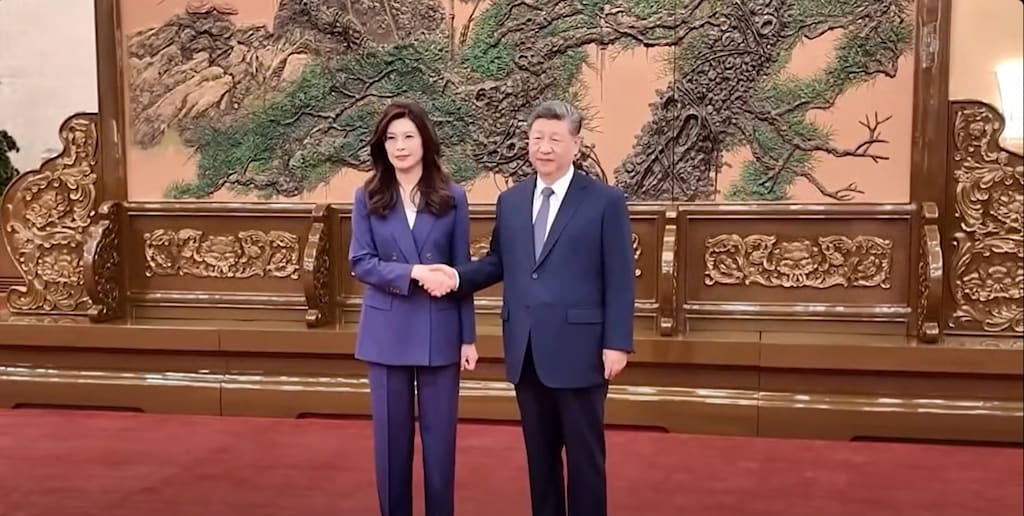
On the 10th of April, the chairman of Taiwan's main opposition party sat down with Xi Jinping in Beijing. Two days later, China announced ten new measures designed to ease restrictions on Taiwanese tourism and food sales. A week after that, a leading Taiwanese business group urged both sides to keep politics out of trade. And just days later, President Lai Ching-te had a planned trip to Africa cancelled after several countries denied his plane overflight access, pressure that Taipei attributed directly to Beijing.
All of this happened within the span of two weeks. Carrots and sticks, deployed simultaneously, aimed at the same island.
Welcome to the most complicated geopolitical situation on earth.
What the Beijing Meeting Was Really About
The meeting between Xi Jinping and Kuomintang Chair Cheng Li-wun was easy to label from the outside. Thaw. Breakthrough. Betrayal. None of those labels quite fit.
Here's what actually happened. China's defence ministry was operating 16 military aircraft near Taiwan at around the same time Xi was shaking hands with Cheng in Beijing. The incentives and the coercion arrived together, inseparable, deliberate. This is not a contradiction; it is a strategy. Beijing has become extraordinarily skilled at deploying economic sweeteners and military pressure as parts of the same playbook, giving Taiwan's population something to want and something to fear in the same breath.
For the KMT, Taiwan's historically China-friendlier opposition party, the trip to Beijing was a calculated gamble. The argument is simple: someone has to keep the lines of communication open, and if Lai's government won't talk to Beijing, the KMT will. Whether that argument lands with Taiwanese voters depends entirely on what the trip actually produces: reduced tension, restored tourism, loosened trade restrictions. Ceremonial warmth alone won't cut it in today's Taiwan. The electorate is watching too closely.
Taiwan Has Changed, and Beijing Hasn't Caught Up
This is where the situation gets genuinely interesting.
For decades, the framing of the Taiwan question was essentially bilateral: what does Beijing want, what does Washington allow, and where does that leave Taipei? That framing is increasingly inadequate. Taiwan is not simply an object being acted upon by larger powers. It is a mature democracy with its own institutions, its own public opinion, and its own internal political logic, and any cross-strait arrangement that ignores that reality is built on sand.
The numbers make this clear. Long-term survey data from National Chengchi University consistently show that identification as Taiwanese rather than Chinese has become the overwhelming majority position, with Chinese-only identification sitting in the low single digits. No major political party in Taiwan supports Beijing's "one country, two systems" formula. The population clusters around maintaining the status quo rather than moving in either direction dramatically.
This means that when Beijing makes overtures to the KMT, or announces economic incentives aimed at Taiwanese businesses and tourists, those moves have to survive Taiwan's own democratic filtering process. A deal made between party elites in Beijing still has to be sold to the Taiwanese public through elections, media scrutiny, and public debate. That is a fundamentally different political environment from the one Beijing dealt with twenty years ago, and it requires a fundamentally different approach.
So far, there is little sign that Beijing has fully absorbed this.
The Defence Budget Nobody Wants to Talk About
Inside Taiwan, the political situation is complicated by a battle over defence spending that cuts to the heart of the island's preparedness.
President Lai has proposed roughly T$1.25 trillion in additional defence spending to accelerate military modernisation. The opposition-controlled legislature has been blocking it, pushing back with smaller alternatives. The debate is real and legitimate in a democracy; spending of that scale should require genuine political authorization. But the delay leaves Taiwan in a difficult position at a moment when the strategic environment is becoming more volatile, not less.
This matters because deterrence and dialogue both require a foundation of material credibility. A Taiwan that cannot sustain its own defence modernisation politically is a Taiwan whose deterrent posture becomes harder to maintain in practice. And a Taiwan whose population does not broadly authorise its security choices is more brittle than its military inventory alone would suggest.
The Problem Nobody Wants to Mention: Energy
If there is a single vulnerability that receives nowhere near enough public attention, it is this: Taiwan imported more than 94 percent of its energy in 2024. Natural gas stocks in 2026 are estimated at around 10 to 11 days of use.
Ten days.
In April, Taipei confirmed it had sought and received assurances about liquefied natural gas supplies after disruptions around the Strait of Hormuz created supply concerns. The fact that this required active diplomacy to resolve should prompt serious reflection about what a more sustained crisis would look like.
Energy resilience is not a side issue in Taiwan's strategic situation; it is arguably the most fundamental vulnerability of all. You can have the most sophisticated military on the island, the most supportive international relationships, the most robust democratic institutions, and still find all of your strategic options narrowing rapidly if the power goes out. Dialogue without energy security is fragile. Deterrence without energy security is incomplete. This is the variable that tends to get left out of the conversation, and it is the one that could matter most in a real crisis.
What Actually Needs to Happen
Taiwan's real challenge is not simply choosing between talking to Beijing or confronting it, between relying on Washington or going it alone. The challenge is building a domestic political consensus around a coherent strategy that integrates all of these things at once: dialogue where it's useful, deterrence where it's necessary, economic diversification to reduce leverage, and genuine energy resilience as a foundation for everything else.
That is a difficult political project in any democracy. It is especially difficult in one where elections are approaching, the opposition controls the legislature, and external actors are actively trying to shape public opinion through a mixture of incentives and pressure.
But here is the thing: the countries and powers that deal with Taiwan cannot ultimately bypass its democratic institutions to get what they want. Beijing cannot. Washington cannot. Regional partners hedging their bets cannot. Taiwan processes external pressure through its own political system, its own public debate, and its own legitimacy structures, and that is not a weakness. It is, if properly understood and properly supported, a genuine strategic asset.
The meeting in Beijing on the 10th of April was not a breakthrough or a betrayal. It was a reminder of how complex and how consequential Taiwan's situation has become and how much it depends on Taiwan's own ability to shape the terms on which others must deal with it.
That ability starts from within. And right now, building it is the most important political project in the region.
About the Creator
Mark Lim
Hi I am mark an automotive student and a car, tech and food enthusiast ! Im gonna try and post daily & hope you enjoy what I write and do share my page with people you know. I would gladly appreciate it! Cheers
Enjoyed the story? Support the Creator.
Subscribe for free to receive all their stories in your feed.
Comments
There are no comments for this story
Be the first to respond and start the conversation.