white house
The epicenter of DC and by extension, the country: The White House is US government incarnate, it's hard to discern what goes on behind those walls...
Inside the CIA: America’s Secret Intelligence Agency
From Cold War Tactics to Cyber Wars: The CIA’s Global Reach In the shadows of global politics, where nations maneuver not through diplomacy alone but through secrecy, deception, and surveillance, the Central Intelligence Agency (CIA) stands as one of the most powerful and enigmatic institutions in the world. Born from the ashes of World War II and raised during the height of the Cold War, the CIA has evolved from traditional espionage operations to become a digital-age intelligence giant. Its reach extends across borders, ideologies, and technologies—operating in a world where knowledge is power and information can change the fate of nations. As threats have shifted from Soviet missiles to cyberterrorism and AI warfare, so too has the CIA adapted, making it not only a historical cornerstone of American security but also a critical player in today’s global power struggle. The Origins: An Agency Born in Secrecy The CIA was formally established in 1947 under the National Security Act, but its roots trace back to the Office of Strategic Services (OSS), the United States' first intelligence agency during World War II. Designed to combat Nazi Germany and Imperial Japan through covert operations, the OSS laid the foundation for modern U.S. espionage. When the Cold War began, the United States recognized the need for a peacetime intelligence service capable of gathering foreign information and executing clandestine operations. Thus, the CIA was born—not as a military branch, but as an independent civilian agency reporting directly to the President. Cold War Operations: Spies, Coups, and Proxy Wars The Cold War era defined the CIA’s early years. It was during this period that the agency conducted some of its most controversial and defining operations. The primary adversary was the Soviet Union, and the battlefield was the entire world. Through programs like Operation AJAX in Iran (1953) and Operation PBSUCCESS in Guatemala (1954), the CIA orchestrated coups to install pro-American regimes. It ran surveillance and counterintelligence against Soviet spies and played key roles in proxy wars like Vietnam and Afghanistan. The agency’s use of human intelligence (HUMINT), psychological warfare, and propaganda became hallmarks of its Cold War strategy. However, not all actions met success. The failed Bay of Pigs Invasion in Cuba (1961), an attempt to overthrow Fidel Castro, became a major embarrassment. Nonetheless, these years solidified the CIA’s reputation as a formidable and secretive power broker in international affairs. The Post-Cold War Shift: Terrorism and Rogue States With the collapse of the Soviet Union in 1991, the CIA faced a moment of existential uncertainty. Without its traditional enemy, the agency had to adapt. In the 1990s and early 2000s, its focus shifted to emerging threats: rogue states, international terrorism, and the spread of weapons of mass destruction. After the 9/11 terrorist attacks, the CIA entered a new era. It was at the forefront of the War on Terror, playing key roles in tracking Al-Qaeda, capturing or killing terrorist leaders, and operating secret detention facilities. The agency’s controversial use of “enhanced interrogation techniques”, drone strikes, and black sites ignited debates on ethics, legality, and human rights—questions that still haunt the agency’s legacy. Enter the Cyber Era: Intelligence in the Digital Age Today, the battlefield has shifted again—from deserts and jungles to cyberspace. The rise of cyberwarfare, state-sponsored hacking, and digital espionage has pushed the CIA to evolve once more. The agency now works closely with other U.S. intelligence bodies like the NSA and FBI to counteract threats from nations such as China, Russia, Iran, and North Korea, which use cyberattacks as a form of asymmetric warfare. The CIA has also developed capabilities to monitor global internet traffic, infiltrate secure communications, and conduct offensive cyber operations—all while protecting U.S. national interests from increasingly sophisticated cyber threats. Additionally, emerging technologies such as artificial intelligence, big data analytics, satellite imagery, and biometric surveillance have given the CIA new tools in its intelligence arsenal. With these, it can track individuals globally, predict political upheavals, and identify terrorist plots before they unfold. Global Reach, Ethical Debate Despite its strategic importance, the CIA continues to face criticism and scrutiny. Leaks by whistleblowers such as Edward Snowden and WikiLeaks' Vault 7 disclosures revealed the extent of CIA surveillance and hacking capabilities. These revelations sparked global conversations about privacy, civil liberties, and the balance between security and freedom. Domestically, the CIA is overseen by the Senate Intelligence Committee, but many argue that real transparency is lacking. Internationally, its covert actions often blur the lines between security and interference, leading some to view it as both a protector and a puppet master. Conclusion: A Shadow That Shapes the Future From covert Cold War missions to cyber operations in the digital age, the CIA’s evolution reflects the changing nature of global conflict. Its ability to adapt to new threats has made it a pillar of American defense and foreign policy. Yet with great power comes great responsibility—and the agency’s future will depend not just on its technological capabilities, but also on its commitment to ethics, oversight, and transparency in an increasingly interconnected world.
By World politics about a year ago in The Swamp
Flying Palace or Political Turbulence?
Air Force One's Alternative ‘Flying Palace’: The Qatari ‘Gift’ That Could Land Trump in Trouble The recent discussions between the White House and Qatar’s royal family have focused on a luxury jumbo jet. This lavish aircraft might be handed over for use as Air Force One by the President of the United States. U.S. President Donald Trump has defended the White House’s plan to use a jet received from Qatar as the presidential aircraft, Air Force One. Speaking to journalists at the White House, Trump said, “They (Qatar) are giving a gift.” He added that refusing it would be “foolish.” However, in a statement, Qatar said the aircraft is not a gift, though a "temporary transfer" of the aircraft is under discussion between the two countries. According to BBC’s U.S. partner CBS News, the aircraft would be donated to the Presidential Library after Trump’s term ends. This news comes at a time when Trump is set to visit Qatar next week—his first major foreign trip in his second presidential term. Ali Al-Ansari, Qatar's media attaché to the U.S., said that the discussions are ongoing between Qatar's Ministry of Defense and the U.S. Department of Defense. He added that the legal departments of both countries are reviewing the matter, and no final decision has yet been made. Strict Laws on Presidential Gifts in the U.S. Reports suggest the jet is worth $400 million. Sources told CBS News it won’t be available for immediate use as several modifications will be made, and security clearance is required. Critics are expected to raise legal and ethical questions about the aircraft’s potential value and use. Democrats have accused Trump of ethical violations. Senator Adam Schiff from California cited the U.S. Constitution on social media, stating that no elected official may accept “any kind of gift” from a foreign leader without Congressional approval. Even Trump’s ally Laura Loomer criticized the move. She wrote that while she could “take a bullet for Trump,” if the reports are true, this could be a major stain on his administration. On Sunday, White House Press Secretary Karoline Leavitt said, “Any gift from a foreign government can be accepted legally after fulfilling required legal procedures. President Trump’s administration believes in full transparency.” Defending the negotiations with Qatar, Trump referred to the jet as a “gift” and claimed he was offered its use free of charge. On Truth Social, he wrote: “The Department of Defense is receiving a gift. Free. A 747 aircraft that will temporarily replace the 40-year-old Air Force One. It will be a public and transparent transfer. But dishonest Democrats want us to pay a huge amount for this aircraft.” A ‘Flying Palace’ The White House currently has two Boeing 747-200B planes customized for presidential use. According to the U.S. Air Force, they include special communications equipment, a state room, an office, and a conference room. These aircraft have been in use since 1990 and 1991. Air Force One planes are often passed on to the next U.S. administration. According to the National Archives, only President Reagan’s Presidential Library has an Air Force One plane. It was used by seven presidents before being donated. According to ABC News, Qatar has offered Trump a Boeing 737 aircraft. It’s a more modern model, upgraded into a “flying palace.” Boeing has a history of contracts with the White House for providing new aircraft. However, Trump complained earlier this year that the company has caused delays. During his first administration, Trump initially negotiated with Boeing for two special 747-8 aircraft. However, Boeing stated that they would not be available until 2027 or 2028. In February, Trump said: “No, I’m not happy with Boeing. They’re taking too long with Air Force One. We gave them the contract a long time ago.” “We might buy an aircraft or make one available for ourselves.” Trump had a positive diplomatic relationship with Qatar during his first term. In 2019, he announced that Qatar was purchasing U.S. aircraft on a large scale. Qatar has also given private jets as gifts to several countries in the past. In 2018, Qatar gifted a luxury aircraft to Turkey.
By Ikram Ullahabout a year ago in The Swamp
“Welcome to the Multipolar Era: Why Old Rules No Longer Apply”
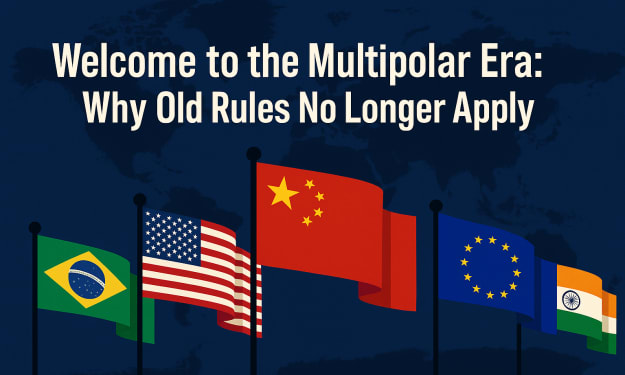
Welcome to the Multipolar Era: Why Old Rules No Longer Apply Inside the Rise of a World Where No One Power Calls the Shots --- Introduction Not long ago, world politics revolved around a single axis — the United States. Following the Cold War, America’s military might, economic dominance, and cultural influence gave it an unrivaled role in setting global agendas. But that era is fading fast. Today, we live in a world where no single nation can dictate the terms. Power is more distributed, alliances are more fluid, and the rules of engagement are constantly shifting. From Beijing to Brasília, from Ankara to New Delhi, a new set of actors is redefining influence in a chaotic and contested global order. The question is no longer who leads — it's how the world manages without clear leadership. --- The End of Unipolarity The post-Cold War unipolar moment, which placed the U.S. at the apex of global power, is now history. Two decades of military overstretch, internal political divisions, and economic upheaval have eroded America's ability to act as the world's de facto leader. The withdrawal from Afghanistan, inconsistent global policies, and an increasingly inward-looking electorate have signaled a step back from the assertive global policing of the early 2000s. This vacuum hasn't gone unnoticed. Instead of a new hegemon rising to replace the old, what we see is a diffusion of power across multiple regional centers. It’s not a bipolar world of the Cold War era, nor a balanced multipolar structure of the early 20th century. This new landscape is messy, unstable — and permanent. --- China and the Economic Realignment China stands at the forefront of this shift, but even its rise comes with caveats. With the Belt and Road Initiative, Beijing has extended its economic reach into Asia, Africa, and parts of Europe. Its influence over supply chains, infrastructure, and digital technologies challenges the dollar-based global system. However, China's ambitions face resistance. Tensions over Taiwan, territorial disputes in the South China Sea, and pushback from Western nations on tech and trade indicate that its power, while rising, is also contested. China is not replacing the U.S. — it’s carving out its own sphere, one that’s economic rather than ideological, and subject to friction. --- Russia’s Military Gambit and Strategic Isolation Russia, too, has sought to challenge the Western-dominated order, most dramatically through its invasion of Ukraine. While the war has demonstrated Moscow’s willingness to use force to protect perceived national interests, it has also exposed its strategic limits. Sanctions, international condemnation, and battlefield losses have isolated Russia from much of the world economy, while simultaneously deepening its ties with non-Western partners like Iran and China. In trying to redefine regional borders by force, Russia has sparked a renewed unity among NATO members, paradoxically reinforcing the very alliances it sought to divide. --- Middle Powers and Fluid Alliances Perhaps the most defining feature of the multipolar era is the rise of middle powers — nations like India, Brazil, Turkey, and Saudi Arabia that are no longer content to align strictly with the West or East. These countries pursue strategic autonomy, balancing relationships across global fault lines. India, for example, is a member of the Quad (with the U.S., Japan, and Australia) while also maintaining defense ties with Russia and participating in BRICS. Turkey, a NATO member, buys Russian arms and projects influence across Central Asia and the Middle East. These states navigate global politics based not on ideology, but on opportunity and self-interest. --- Global Institutions Under Strain The United Nations, World Trade Organization, and other postwar institutions are increasingly ineffective at managing today’s fragmented world. Vetoes stall progress at the UN Security Council. Trade disputes paralyze the WTO. And new power blocs like BRICS and the Shanghai Cooperation Organization aim to create parallel systems that reflect non-Western values and priorities. The rules-based international order — long championed by the West — now finds itself questioned not only by adversaries, but by allies frustrated with its limitations and hypocrisy. --- Technology, Climate, and the New Arenas of Power While traditional power still matters, influence in today’s world is also determined by less tangible forces. Control over technologies like artificial intelligence, 5G, and semiconductors is becoming as critical as nuclear weapons were in the past. Meanwhile, climate change, pandemics, and migration flows expose the limitations of national solutions to global problems. These issues demand coordination, yet in a fragmented world, cooperation is the first casualty of geopolitical rivalry. --- Conclusion: Embracing Complexity The multipolar era is not just a phase — it is the defining condition of our time. It offers opportunities for a more inclusive, balanced world, but also risks greater instability, miscalculation, and fragmentation. Old rules no longer apply, because the old world no longer exists. The future will depend not on domination, but on how nations adapt, negotiate, and share power in a world where no one — and everyone — leads.
By World politics about a year ago in The Swamp
India-Pakistan Tensions and the Truth Behind 'Operation Sindoor': Facts, Rumors, and Global Reactions. Content Warning. AI-Generated.
Introduction: A History of Tensions Rekindled The relationship between India and Pakistan has always been delicate, shaped by decades of political conflict, military standoffs, and regional rivalries. In recent weeks, tensions have quietly escalated again, driven not only by real-world military movements but also by viral narratives online — most notably around a term that has suddenly surged across social media: “Operation Sindoor.” While neither government has issued official confirmation of any such operation, the phrase has taken on a life of its own, triggering speculation, anxiety, and even celebration depending on which side of the border you stand on. But in a time when misinformation can travel faster than facts, what’s really happening — and what should we be careful about believing? What Is ‘Operation Sindoor’? Fact vs Fiction The term “Operation Sindoor” first surfaced in viral posts claiming that the Indian military had launched a covert or large-scale offensive action across the Line of Control (LoC) in response to alleged threats or incidents from Pakistan. The details in these posts are vague, conflicting, and largely unverified. Some claim it's a retaliatory strike. Others say it’s a planned military maneuver. A few even describe it as a fictional narrative created for social media impact. As of now, no official Indian defense source has confirmed an operation by this name. In fact, several defense journalists and analysts have stated that “Operation Sindoor” does not exist in any official capacity and appears to be a viral name fueled by patriotic sentiment and online speculation. This highlights a key problem in the current digital era: viral rumors often overshadow verified facts, especially in high-stakes geopolitical contexts. Border Situation: What’s Actually Happening? Though there is no evidence of an operation named “Sindoor,” there have been legitimate concerns regarding increased military activity along the LoC and reports of cross-border ceasefire violations. Indian security forces have reportedly increased surveillance and patrolling in certain sensitive zones. Pakistani media, on the other hand, has accused India of “aggressive posturing,” though no large-scale mobilization has been confirmed. Recent intelligence-based operations in India’s Jammu & Kashmir region have also added to the atmosphere of tension, though these are largely counter-terror operations within Indian territory, not cross-border strikes. Thus, while there’s certainly heightened activity, there is no confirmed large-scale military engagement between the two nations — at least for now. Public and Media Reaction in India and Pakistan In India, the term "Operation Sindoor" has been widely shared by social media users, some celebrating it as a symbol of strength or retribution. Patriotism-driven influencers and some news outlets have helped amplify the buzz, with hashtags like #OperationSindoor and #Revenge trending intermittently. In contrast, Pakistani social media has responded with a mix of defiance, denial, and mockery, with some labeling the operation a “Bollywood-style fantasy.” However, concern is growing among the public about whether this online chatter may provoke real-world consequences. Mainstream media in both countries have remained relatively cautious, with most established news outlets avoiding coverage of “Operation Sindoor” as a legitimate story, instead focusing on actual ground developments like diplomatic statements and border updates. Social Media vs Ground Reality: A Dangerous Gap The rise of “Operation Sindoor” is a prime example of how social media can blur the lines between imagination and information. Once a phrase trends with enough frequency and emotional power, it begins to take root in public perception — regardless of whether it's true. This is particularly risky in a region where: Historical tensions run deep National pride is emotionally charged Media trust is uneven When posts glorifying an unconfirmed operation go viral, they fuel expectations, pressure governments, and increase the risk of real escalation. Fake news can unintentionally force real responses — and that’s a dangerous game. This is why experts continuously emphasize the need for responsible content sharing, especially during high-tension periods. International Reaction and Diplomatic Watchfulness So far, global powers like the United States, United Nations, and China have not issued any formal statements regarding current India-Pakistan tensions — a sign that no formal conflict has yet broken out. However, quiet diplomatic watchfulness is likely ongoing. The UN Military Observer Group in India and Pakistan (UNMOGIP) continues to monitor the Line of Control, and foreign embassies in both countries are likely maintaining high alert. Should any military operation become official or escalate into wider conflict, the international community would be expected to intervene diplomatically to prevent a deeper crisis. A Call for Caution and Peace Perhaps the biggest takeaway from the “Operation Sindoor” narrative is the urgent need for media literacy, especially in South Asia. With rising tensions, it’s easy for emotions to overpower judgment — and for false narratives to shape public discourse. India and Pakistan, as two nuclear-capable neighbors with a complex history, cannot afford informational escalations. Leaders, journalists, influencers, and everyday citizens all have a role to play in maintaining peace — or at least preventing the spread of rumors that could spark unnecessary conflict. For now, the best path forward is transparency, diplomacy, and public awareness. Peace may not always make headlines, but it's the quieter, harder, and ultimately more valuable choice. Conclusion: Stay Informed, Not Inflamed While the term “Operation Sindoor” has captured imagination and ignited debate, its roots appear more in emotion and speculation than in verified fact. There is no confirmed military operation by that name as of this writing — but the conditions that allow such stories to thrive are very real: distrust, historical wounds, and viral media. As responsible readers and global citizens, it’s important to verify before you share, question what you read, and remember that national strength doesn’t only come from firepower — it also comes from wisdom, restraint, and truth. India Pakistan Relations Operation Sindoor South Asia News Military Tensions 2025 Social Media Misinformation India Pakistan Conflict Border News Global Politics Peace and Diplomacy Breaking News India Disclaimer: This article is intended for informational purposes only. It is based on publicly available news reports, verified data, and observed online trends as of the time of writing. The mention of “Operation Sindoor” refers to a widely circulated but unverified term that has not been officially acknowledged by any government or military authority. Readers are advised to approach all social media claims with caution and prioritize credible sources. Content Warning: This piece discusses topics such as military tension, geopolitical conflict, and cross-border narratives that may be sensitive to some readers. The intent is not to provoke or offend but to promote factual awareness and peaceful discourse. Reader discretion is advised. Thanks for reading!
By Tanushree Dasabout a year ago in The Swamp
What I Would Do If I Became President
Here is a bit of a rant of what I would do if I had the power, which of course I don't. I would add a new constitutional amendment stating clearing we have freedom from religion since a lot of religious folks claim it is not in the constitution when you cannot have freedom of religion without freedom from religion. All religions and lack thereof will be respected. No political office can ask about religious affiliation or lack thereof.
By Ferrari Kingabout a year ago in The Swamp
"The Shifting Landscape of World Politics in 2025"
China’s Expanding Influence in Asia and Beyond In 2025, China's rise as a global superpower is no longer a prediction — it is a living reality. The once unipolar world order dominated by the United States is now being reshaped by a multipolar dynamic, with China playing a leading role. From economic investments and military advancements to diplomatic strategies and cultural outreach, China's influence is stretching far beyond its borders, fundamentally altering global geopolitics. Economic Expansion Through the Belt and Road Initiative At the heart of China’s global strategy lies the Belt and Road Initiative (BRI), a massive infrastructure and investment project launched in 2013. Now in its second decade, the BRI has connected more than 140 countries through roads, railways, ports, and digital infrastructure. It has allowed China to secure trade routes, gain access to critical resources, and extend its economic presence into regions traditionally dominated by Western powers. In Asia, countries like Pakistan, Sri Lanka, and Laos have become heavily reliant on Chinese investments. For instance, the China-Pakistan Economic Corridor (CPEC) has not only enhanced trade between the two nations but also given China strategic access to the Arabian Sea. Meanwhile, in Africa and Latin America, China continues to fund infrastructure projects and offer loans that come with fewer political strings than Western aid — although critics warn of a potential “debt trap” diplomacy. Military Modernization and Strategic Posturing China's military, particularly the People’s Liberation Army Navy (PLAN), has undergone rapid modernization. The South China Sea remains a central point of tension, as Beijing continues to assert its claims over disputed territories, building artificial islands and militarizing them despite international criticism and rulings from The Hague. Beyond its immediate region, China has increased its presence in the Indian Ocean, with a military base in Djibouti and regular naval deployments in strategic chokepoints. Its expanding blue-water navy is designed not only to protect trade routes but also to project power far from its shores. This has raised concerns in neighboring countries and drawn the attention of the United States and its allies. Diplomacy with “Chinese Characteristics” Beijing’s diplomatic approach combines traditional statecraft with economic leverage and soft power. Through platforms like the Shanghai Cooperation Organization (SCO) and the recently revived BRICS bloc, China seeks to reshape global governance structures to be less Western-centric. It champions “non-interference” in domestic affairs — a stance attractive to many authoritarian regimes — and presents itself as a counterbalance to U.S. influence. China has also stepped up its role as a mediator in international conflicts. In 2023, it brokered a landmark diplomatic thaw between Iran and Saudi Arabia, demonstrating its growing clout in the Middle East. Such actions position Beijing not just as a global power, but as a global peace broker — a role long monopolized by the West. Cultural Soft Power and Global Narratives Beyond economics and military might, China is actively promoting its culture and political ideology. With state-run media like CGTN and Xinhua expanding their global reach, and Confucius Institutes established in dozens of countries, China is investing in shaping public opinion overseas. The narrative emphasizes harmony, mutual development, and respect for sovereignty — subtly contrasting with what Beijing portrays as Western hypocrisy and interventionism. At the same time, digital platforms like TikTok (owned by Chinese company ByteDance) have become part of China’s soft power arsenal. Though primarily entertainment platforms, they subtly contribute to cultural normalization and influence among global youth. Challenges and Pushback Despite its success, China’s rise is not without resistance. Several countries have grown wary of its economic dominance and political motives. In Southeast Asia, nations like Vietnam and the Philippines are strengthening ties with the U.S. and forming regional alliances to counter Chinese assertiveness. In Europe and the U.S., concerns about human rights, intellectual property theft, and cyber-espionage continue to strain relations with Beijing. Moreover, the “China model” — combining authoritarian governance with capitalist economics — is viewed with suspicion in democratic societies, especially as Beijing tightens its grip on Hong Kong and cracks down on dissent at home. Conclusion: A New World Order in the Making As we move deeper into the 21st century, China’s expanding influence is reshaping not only Asia but the global balance of power. Whether one views this transformation with optimism or concern, it is clear that the world must adapt to a future where China is a central actor. How other nations respond — with cooperation, competition, or confrontation — will determine the course of global politics for decades to come.
By World politics about a year ago in The Swamp
An Open Letter to President Donald J. Trump: A Call to Restore Stability and Leadership to America April 29, 2025. AI-Generated.
Dear President Trump, As your administration navigates unprecedented challenges—economic uncertainty, global tensions, and deepening divisions at home—it is critical to reflect on the path forward. While your commitment to American workers and “America First” principles has resonated with many, the current trajectory of tariffs, isolationist policies, and erratic governance risks undermining the very goals you seek to achieve. This letter urges you to reassess key policies, prioritize pragmatic solutions over ideological battles, and lead the nation toward unity, stability, and renewed prosperity.
By David Snamabout a year ago in The Swamp