politics
Politics does not dictate our collective cultural mindset as much as it simply reflects it; We've got to look in the mirror sometimes, and we've got one.
The Right’s Loud Romance With Violence and Fascism
For decades, American conservatives have warned about the “moral decline” of the United States. Sometimes those warnings sounded sincere. I remember the Terri Schiavo case, when many conservatives framed the removal of a feeding tube as a profound moral failure. You could argue some of that outrage was politically convenient, but it was at least plausible that many of the people involved genuinely believed life was sacred and violence, broadly defined as merely ending a human life (even out of medical mercy), was wrong.
By Wade Wainio8 months ago in The Swamp
Company Fined £433,000 After Machine Crash Leaves Worker with Life-Changing Injuries. AI-Generated.
A packaging firm has been fined a substantial £433,333 after a worker at its Scottish facility suffered a severe skull fracture and permanent life-altering injuries when a heavy machine fell on him in an incident that authorities described as “entirely preventable.” �
By Ayesha Lashari8 months ago in The Swamp
When Noise Turns Deadly. AI-Generated.
In a world already strained by anger, impatience, and division, it is deeply unsettling when something as simple as asking someone to “quieten down” becomes a death sentence. The recent incident in which a man was killed after requesting a rapper to lower his volume is not just a tragic crime—it is a disturbing reflection of how fragile civility has become, especially when fame, ego, and aggression collide.
By Ayesha Lashari8 months ago in The Swamp
UK Will Not Be Joining Trump’s ‘Board of Peace’ for Now, Says Yvette Cooper. AI-Generated.
The UK has decided not to join U.S. President Donald Trump’s “Board of Peace” initiative — at least not yet. Yvette Cooper, the UK’s Foreign Secretary, confirmed this during the World Economic Forum in Davos, citing concerns over Russian President Vladimir Putin’s potential involvement. This announcement highlights growing tensions in global politics, as Western nations weigh their response to international peace initiatives that include controversial figures. What Is the ‘Board of Peace’? President Trump introduced the “Board of Peace” at the 2026 World Economic Forum. Originally designed to oversee reconstruction and governance in Gaza, it has quickly expanded into a broader conflict resolution forum. The board aims to bring together world leaders, business figures, and diplomats to work on post-conflict strategies, with the potential to influence peace negotiations beyond just the Middle East. Trump has pitched it as a prestigious, high-level body, almost like an alternative to the United Nations. However, its powers, structure, and authority are still unclear, raising questions about how it might overlap with existing international institutions. Why the UK Is Hesitant Yvette Cooper stressed that while the UK supports peace efforts, it is not ready to join the board yet. She emphasized concerns over Putin’s involvement, noting that it would be problematic for a leader actively involved in conflict in Ukraine to be part of a peace initiative. “We have concerns about President Putin being part of something that talks about peace while his forces are still active in Ukraine,” Cooper said. Other issues include legal and diplomatic questions about the board’s charter and the roles of participating countries. For London, joining prematurely could risk legitimizing decisions without proper international oversight. The Diplomatic Landscape The UK is not alone in its caution. Other Western countries, including France, Sweden, and Norway, have also declined to join the board at this stage. Their reasoning is similar: while they support peace efforts, they do not want to see a new body undermine established institutions like the United Nations. Meanwhile, Trump has invited several prominent figures to the board, including U.S. Secretary of State Marco Rubio, adviser Jared Kushner, and former UK Prime Minister Tony Blair. Critics argue that the board leans heavily toward U.S. influence, raising doubts about its impartiality. UK Foreign Policy Considerations The UK’s decision reflects its ongoing balancing act between: Supporting peace in the Middle East, Upholding Ukrainian sovereignty, and Ensuring international law is respected. Cooper highlighted that the board’s treaty raises broader legal issues, and the UK wants to ensure alignment with existing international frameworks before committing. This cautious approach also signals London’s long-term diplomatic strategy: engage in global initiatives without compromising principles or legitimacy. What’s Next for the Board of Peace? For now, the UK is stepping back, but that doesn’t mean it will permanently reject participation. Dialogue with allies is ongoing, and the UK remains interested in supporting peace initiatives — just not through a board that includes controversial leaders or unresolved legal questions. Trump, meanwhile, continues to push his initiative in Davos, with both support and criticism from the international community. Whether the board will evolve into a credible global peace instrument or deepen divisions between countries remains to be seen. Takeaway The UK’s cautious approach highlights the complexities of modern diplomacy. Supporting peace is easy in principle, but navigating global politics — especially when controversial figures are involved — requires careful consideration. For now, Yvette Cooper and the UK are making it clear: peace initiatives must be credible, lawful, and legitimate. Anything less risks undermining both international trust and long-term global stability. This blog format keeps the content easy to read, engaging, and structured for online audiences, while staying informative and authoritative.
By Aqib Hussain8 months ago in The Swamp
US Set to Quit World Health Organization: What It Means for Global Health. AI-Generated.
The United States is officially leaving the World Health Organization (WHO), a move that has sent ripples through international health and politics. On January 22, 2026, after a year-long notice period, the U.S. formally exited the WHO — a decision driven by political priorities, criticisms of the organization, and a desire to focus on national health initiatives.
By Aqib Hussain8 months ago in The Swamp
US Dollar Buoyed by Trump’s Greenland About-Face; Aussie Jumps After Jobs Data. AI-Generated.
Global currency markets had plenty to digest this week as geopolitics and economic data collided in dramatic fashion. The U.S. dollar regained strength after former President Donald Trump unexpectedly softened his stance on Greenland-related trade threats, while the Australian dollar surged following a surprisingly strong employment report. These two developments highlight how quickly sentiment can shift in foreign exchange markets — and why traders keep one eye on political headlines and the other on hard economic numbers. Let’s break down what happened and why it matters. Trump’s Greenland Reversal Supports the U.S. Dollar Earlier this week, markets were rattled by comments from Donald Trump suggesting the United States could impose tariffs on European NATO allies unless they cooperated with U.S. interests involving Greenland. The remarks reignited concerns about trade wars, diplomatic rifts, and broader global instability. Such uncertainty typically drives investors toward safe-haven assets like gold, the Swiss franc, and the Japanese yen — while putting pressure on risk-sensitive currencies. However, sentiment shifted sharply after Trump walked back the tariff threat during his appearance at the World Economic Forum in Davos. He indicated that tariffs were no longer under consideration and that discussions were instead focused on a cooperative framework with NATO partners. While details remain vague, the market reaction was immediate. Traders viewed the change in tone as a de-escalation of geopolitical risk, which helped stabilize confidence and reduce fears of another major trade conflict. As a result, the U.S. dollar found support, holding gains against the euro and Swiss franc while giving investors a reason to scale back defensive positions. How Currency Markets Reacted The dollar’s renewed strength was most evident in its performance against traditional safe-haven currencies. The Swiss franc retreated from recent highs, and gold prices eased after touching record levels earlier in the week. The Japanese yen, meanwhile, continued to struggle. Already under pressure due to Japan’s ultra-loose monetary policy, the yen remained near record lows as investors anticipated no immediate tightening from the Bank of Japan. Political uncertainty in Japan, including a snap election and expansionary fiscal plans, only added to the currency’s weakness. Overall, the market response suggested a shift toward a risk-on environment, where investors are more willing to seek yield rather than hide in defensive assets. Australian Dollar Jumps on Strong Jobs Data While the U.S. dollar was buoyed by geopolitics, the Australian dollar (AUD) rallied for a completely different reason: strong economic fundamentals. Australia’s latest employment report delivered a significant upside surprise. Job creation far exceeded expectations, and the unemployment rate fell to a multi-month low. The data pointed to a labor market that remains resilient despite global economic headwinds. This was a major confidence boost for investors — and for the Australian dollar. Strong employment figures often signal rising wages and sustained consumer spending, which can increase inflationary pressure. That, in turn, raises the likelihood that the Reserve Bank of Australia (RBA) may adopt a more hawkish stance on interest rates. With markets already speculating about potential rate hikes at the RBA’s upcoming meeting, the data provided fresh justification for bullish AUD positions. Why Interest Rates Matter for Currencies Interest rates play a crucial role in currency valuation. Higher rates typically attract foreign investment, as global investors seek better returns on bonds and other fixed-income assets. The stronger-than-expected jobs report led traders to reassess their outlook for Australian monetary policy, pushing the Australian dollar to a 15-month high against the U.S. dollar and boosting it against the Japanese yen as well. In contrast to the U.S. dollar’s geopolitical support, the Aussie’s rally was rooted in domestic economic strength — a key distinction that makes its move potentially more sustainable if upcoming data remains solid. A Broader Shift Toward Risk Assets Together, Trump’s diplomatic retreat and Australia’s robust labor data helped fuel a broader risk-on mood across global markets. Equities across Asia-Pacific markets gained ground, commodity prices stabilized, and high-beta currencies like the Australian dollar benefited from renewed investor confidence. That said, analysts remain cautious. Political uncertainty can resurface quickly, and Trump’s Greenland comments — while softened — did not come with a concrete agreement. Similarly, employment data can be volatile from month to month, meaning future inflation or wage figures could still alter the RBA’s trajectory. What Investors Are Watching Next Looking ahead, several key factors could influence currency markets in the coming weeks: U.S. inflation and labor data, which will shape expectations for Federal Reserve policy Australian inflation figures, which could confirm or undermine the case for RBA rate hikes Global political developments, especially any renewed trade or diplomatic tensions For now, the takeaway is clear: markets are responding positively to reduced geopolitical tension and strong economic signals. Final Thoughts The recent movements in the U.S. dollar and Australian dollar underscore a fundamental truth of financial markets — perception matters as much as data. Trump’s Greenland about-face reduced immediate political risk, giving the dollar a lift, while Australia’s impressive jobs numbers strengthened confidence in the country’s economic outlook and sent the Aussie soaring. As always, the balance between politics, policy, and performance will determine whether these trends have staying power — or fade as quickly as they appeared.
By Aqib Hussain8 months ago in The Swamp
Greenland’s Strategic Position in Seven Maps: Why Trump Wants the Island. AI-Generated.
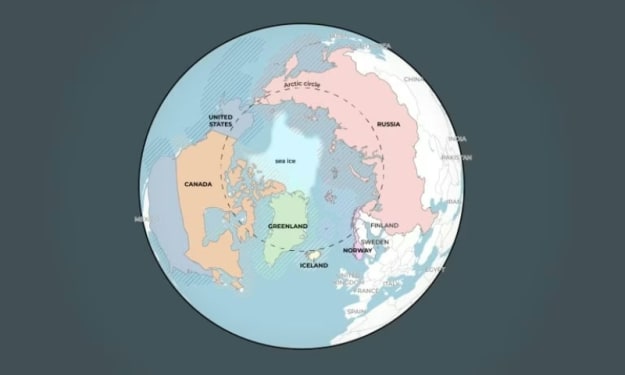
When Donald Trump first suggested buying Greenland, the world laughed. Memes spread faster than Arctic winds, and Denmark firmly rejected the idea. But beneath the headlines and humor lies a serious geopolitical reality: Greenland is one of the most strategically valuable pieces of land on Earth. Far from being just a frozen wilderness, Greenland sits at the crossroads of global security, emerging trade routes, military defense systems, and untapped natural resources. When you look at Greenland through a series of strategic maps, Trump’s interest — and America’s long-term focus — begins to make sense. Let’s explore seven maps that explain why Greenland matters and why Trump wants the island. 1. Greenland on the World Map: A Strategic Crossroads On a global map, Greenland dominates the North Atlantic and Arctic regions. Located between North America and Europe, it occupies a prime position along the shortest routes between major global powers. For military planners, geography is everything. Any aircraft, missile, or satellite traveling between Russia, Europe, and the United States often passes over or near Greenland. This makes the island a natural surveillance and defense hub — one the U.S. has relied on since World War II. Greenland isn’t remote; it’s central. 2. The GIUK Gap: NATO’s Northern Gateway Zoom into the North Atlantic, and another critical map emerges: the GIUK Gap — the maritime corridor between Greenland, Iceland, and the United Kingdom. During the Cold War, this gap was vital for tracking Soviet submarines moving from Arctic bases into the Atlantic. Today, with Russia once again expanding its Arctic military presence, the GIUK Gap has regained strategic importance. Control or influence over Greenland strengthens NATO’s ability to monitor naval movements, protect shipping lanes, and deter adversaries — a major reason Washington continues to prioritize the region. 3. Arctic Shipping Routes: The Ice Is Melting A map of the Arctic today looks very different than it did 50 years ago. Climate change is opening new sea lanes, including the Northwest Passage and the Northern Sea Route, dramatically shortening travel between Asia, Europe, and North America. Greenland sits right beside these emerging trade routes. As Arctic shipping becomes more viable, ports, refueling stations, and monitoring points near Greenland will become economically and strategically valuable. Any nation with influence over Greenland gains leverage in future global trade — a fact not lost on the U.S., Russia, or China. 4. Beneath the Ice: Greenland’s Resource Wealth Another map reveals what lies under Greenland’s ice: rare earth minerals, uranium, copper, gold, and possibly oil and gas. Rare earth elements are essential for modern technology — from smartphones and electric vehicles to advanced military hardware. Currently, China dominates the global supply. Greenland offers a potential alternative source, making it strategically important for countries looking to reduce dependency on foreign suppliers. As ice recedes, access to these resources becomes easier — turning Greenland into an economic prize as well as a strategic one. 5. Military Maps: The Importance of Pituffik Space Base One of the most critical maps highlights Pituffik Space Base (formerly Thule Air Base), the northernmost U.S. military installation. This base plays a key role in: Missile early-warning systems Space surveillance Ballistic missile defense From Greenland, the U.S. can detect potential missile launches from across the Arctic faster than from anywhere else. Trump has publicly linked Greenland’s importance to future missile defense plans, framing the island as essential to protecting the U.S. homeland. This isn’t speculative — it’s operational reality. 6. Arctic Power Competition: Russia and China A geopolitical map of the Arctic shows increasing activity from Russia and China. Russia has reopened Cold War-era bases, deployed advanced weapons, and expanded its Arctic infrastructure. China, calling itself a “near-Arctic state,” has invested heavily in Arctic research, mining, and shipping projects. Greenland sits between these ambitions. For the United States, maintaining influence over Greenland helps counter rivals in a region that is rapidly becoming a new arena for global power competition. 7. Political Boundaries: Greenland Isn’t for Sale The final map is political rather than military. Greenland is a self-governing territory within the Kingdom of Denmark, with its own parliament and growing push for independence. While Denmark handles defense and foreign policy, Greenlanders strongly oppose being “sold” to another country. Trump’s proposal sparked debate not just about geopolitics, but about sovereignty and self-determination. Greenland’s leaders made one thing clear: the island’s future belongs to its people. So, Why Does Trump Want Greenland? When these seven maps are viewed together, Trump’s interest becomes less shocking and more strategic. Greenland offers: A military advantage in missile defense and surveillance Control near critical Arctic shipping routes Access to valuable natural resources A strategic foothold in rising Arctic competition Greater influence over NATO’s northern defenses Trump’s blunt approach may have grabbed headlines, but the underlying logic reflects long-standing U.S. strategic thinking. Final Thoughts Greenland is no longer just an icy landmass at the top of the map. It is a strategic chess piece in a changing world — shaped by climate change, technological demand, and renewed great-power rivalry. Whether or not Greenland ever changes hands, one thing is certain: the world’s attention is now firmly fixed on the Arctic, and Greenland sits right at its center.
By Aqib Hussain8 months ago in The Swamp
Trump’s Full Messages with European Leaders — And What They Tell Us. AI-Generated.
When Donald Trump entered the White House in 2017, Europe quickly realized it was dealing with a very different kind of American president. Through public statements, private messages later reported by media, leaked diplomatic cables, and direct remarks to European leaders, Trump communicated a worldview that broke sharply with decades of U.S. diplomatic tradition. While not all of Trump’s messages to European leaders are publicly available in full, enough has emerged to reveal clear patterns — and those patterns tell us a great deal about how transatlantic relations were reshaped during his presidency.
By Ayesha Lashari8 months ago in The Swamp
Second Lady Usha Vance Announces She Is Pregnant with Fourth Child. AI-Generated.
Washington, D.C. — In a moment that blends personal joy with national attention, Second Lady Usha Vance and Vice President J.D. Vance announced on Tuesday that they are expecting their fourth child, a baby boy, due in late July 2026. The news was shared via social media and has quickly become a topic of interest across the United States, drawing congratulations from political leaders, community figures, and families nationwide. �
By Ayesha Lashari8 months ago in The Swamp
Minor Electrical Issue on Air Force One Delays Trump’s Davos Visit. AI-Generated.
A minor electrical issue aboard Air Force One caused a delay in former U.S. President Donald Trump’s planned visit to the World Economic Forum in Davos, drawing widespread media attention and sparking discussion about presidential travel, security, and the symbolism attached to global diplomatic events. While officials were quick to downplay the seriousness of the problem, the incident underscored how even small technical glitches can have outsized political and media consequences when they involve one of the world’s most recognizable aircraft.
By Ayesha Lashari8 months ago in The Swamp
Netanyahu’s Reported Entry into Trump’s “Board of Peace”: A New Chapter in Middle East Diplomacy. AI-Generated.
Reports suggesting that Israeli Prime Minister Benjamin Netanyahu has agreed to join former U.S. President Donald Trump’s proposed “Board of Peace” have sparked intense debate across diplomatic, political, and media circles. While details about the structure and authority of this board remain limited, the very idea of Netanyahu aligning himself with a Trump-led peace initiative carries deep symbolic and strategic significance—particularly for the Middle East, U.S. politics, and the broader international community.
By Ayesha Lashari8 months ago in The Swamp