politicians
Reviews of the politicians kissing babies and running governments around the world; applaud and criticize the decisions they make and their implications.
"The Maryland Way"
Maryland may boast of its crab feasts, blue-ribbon schools, and proximity to the nation’s capital—but behind the charm lies a stubborn stain that refuses to wash out: government corruption. For decades, the Free State has been plagued by scandal after scandal, from petty theft to multi-million-dollar rackets, involving mayors, governors, state delegates, police officers, and public employees. And what’s worse? Despite reforms, prosecutions, and promises, the corruption seems less like an anomaly and more like a political rite of passage.
By Michael Phillipsabout a year ago in The Swamp
The Power of Influence: Pen vs. Gun
In the world we live in, people often talk about power. Some believe that power comes from weapons like guns. They say a gun can take a life in seconds. Yes, that is true — a gun in the wrong hands can be very dangerous. It can hurt or kill people. But there is something even more powerful than a gun. Something that does not make noise. Something that does not look dangerous at first. That powerful thing is the pen.
By Junaid Shahid about a year ago in The Swamp
Donald Trump Wants a Nobel prize But Deserves a Mirror
It was a strange sight—Donald Trump, standing at a podium, eyes unusually moist, claiming that he deserved the Nobel Peace Prize more than anyone in history. “I brought peace to Korea. I kept America safe. I’m the best at peace,” he said, waving dramatically at an invisible Nobel committee.
By Soul Pagesabout a year ago in The Swamp
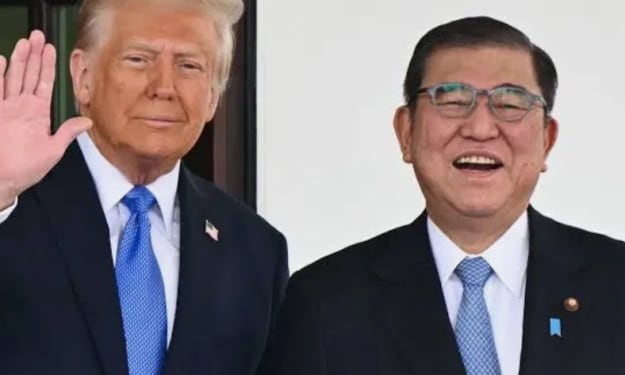
US-Japan trade deal gives Trump control over $550 billion in investments. It could be ‘vapor ware’ — and a model for other countries
**The US-Japan trade agreement grants Trump control over investments worth $550 billion. It Might Be "Vapor Ware" and Serve as an Example for Other Countries** Former President Donald Trump claimed in a high-profile announcement that a new US-Japan trade deal gave the United States leverage over 550 billion dollars in Japanese investment. The deal has been met with both enthusiasm and skepticism, with Trump hailing it as a landmark achievement for American manufacturing and job creation. Some have dubbed it potential "vapor ware" due to critics' claims that the numbers may be exaggerated, the agreements are non-binding, and the economic impact is speculative. Nonetheless, the way the deal is structured and presented may be used as a model for US trade negotiations in the future, especially if the administration is focused on optics and unilateral gain. At the heart of the agreement is a framework wherein Japan pledged to direct investment toward American industries — especially manufacturing, infrastructure, and emerging technologies. During his presidency, Trump put bilateral trade agreements ahead of multilateral ones and hailed the agreement as an example of nationalist economics. It is in line with his "America First" platform, which places an emphasis on bringing manufacturing jobs back to the United States and reducing reliance on supply chains from other countries. However, experts caution that the headline figure of \$550 billion is misleading. Before the agreement was signed, a significant portion of the pledged investment was already in the works. Financial analysts point out that Japanese companies like Toyota, SoftBank, and Mitsubishi have been present in the United States for a considerable amount of time. Trump can take credit for the trade deal because it simply brings together anticipated and existing investments under a new political banner. Furthermore, the agreement lacks specific enforcement mechanisms. It does not include tariff adjustments, guarantees of market access, or procedures for resolving disputes like traditional trade pacts do. Instead, it resembles a memorandum of understanding, which is advantageous from a political standpoint but has no legal force. Because of this, some economists have referred to it as "vapor ware," which refers to a policy that makes headlines but does not result in significant change. The deal's strategy reflects a larger trend in the way trade agreements are being used as political capital, despite the ambiguity. By framing the deal as a huge economic win — regardless of its actual substance — Trump leveraged it for domestic approval and international prestige. His administration argued that the mere announcement of the deal created a “confidence effect,” encouraging private-sector investment and lifting stock markets.
By GLOBAL NEWSabout a year ago in The Swamp
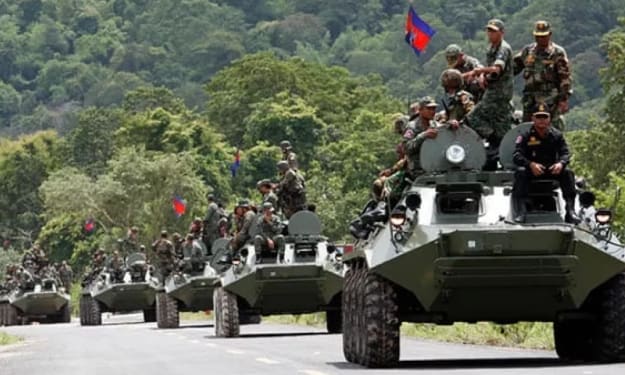
China’s Growing Influence in Southeast Asia: A Closer Look at Its Role in Cambodia and Thailand. AI-Generated.
In recent decades, China has emerged as a dominant power in Southeast Asia, reshaping political alliances, trade relationships, and military partnerships across the region. Among the countries most significantly impacted by this rise are Cambodia and Thailand, two neighboring nations that have grown increasingly reliant on Chinese investment, technology, infrastructure development, and diplomatic backing.
By INAM ULLAHabout a year ago in The Swamp
The Worst-Kept Secret of the Israeli-Palestinian Conflict
One of the more poorly kept secrets of the Israeli-Palestinian conflict is that many of those involved would prefer to take all the land and have the other side disappear. A 2011 poll found that two-thirds of Palestinians believed that their real goal should not be a two-state solution, but rather using that arrangement as a prelude to establishing “one Palestinian state.” A 2016 survey found that nearly half of Israeli Jews agreed that “Arabs should be expelled or transferred from Israel.” A poll in 2000, conducted during negotiations toward a two-state solution, found that only 47 percent of Israelis and 10 percent of Palestinians supported a school curriculum that would educate students to “give up aspirations for parts of the ‘homeland’ which are in the other state.”
By Kristen Orkoshneliabout a year ago in The Swamp
Unmasking the US Political Landscape and Trump’s Influence: 11 Powerful Truths
Over the last decade, few figures have reshaped the US political landscape as dramatically as Donald Trump. His presidency, persona, and policies have stirred deep divides, mobilized millions, and altered the trajectory of both major parties. As we stand in 2025, it’s impossible to ignore the lasting ripple effects of his time in office — and his continued influence.
By Kageno Hoshinoabout a year ago in The Swamp