how to
Call it Political Involvement for Dummies: Guides to learn how to become an activist, run a campaign or do anything in the political sphere.
How can anyone govern when opinion is so diverse
How can anyone govern when opinion is so diverse Are humans suitable for government. Population levels in nearly every nation are at their highest ever level. The colossal numbers involved and the diversity of opinion because we now have universal education and media saturation, has made the doctrine that numbers of apparent supporters is a valid reason for control, into a distortion of democracy.
By Peter Roseabout a year ago in The Swamp
Quirky Behaviors Caused By 'The System' and 10 Solutions
Please, allow me to go on some Andy Rooney-esque rants to explain some quirks to living under a rotten system (and if you wish to see the less rant-oriented "solutions" part of this text, just scroll down and you'll see the list).
By Wade Wainioabout a year ago in The Swamp
May 28th: How Pakistan’s Nuclear Test Redefined Regional Power Balance
Introduction May 28th stands as a defining date in the history of South Asia, marking Pakistan’s emergence as a nuclear-armed state and fundamentally reshaping the regional power balance. On this day in 1998, Pakistan conducted its first public nuclear weapons test, sending shockwaves through the geopolitical landscape of South Asia and the wider international community. This act was not merely a demonstration of military capability but a bold assertion of strategic autonomy, directly challenging the long-standing nuclear dominance of India. The May 28th nuclear test underscored Pakistan’s resolve to safeguard its national security in a highly volatile regional environment and introduced a new dimension to the Pakistan India nuclear rivalry.
By Shamshair Khan Hasan Zaiabout a year ago in The Swamp
Youm-e-Takbeer: Pakistan’s Peaceful Rise as a Responsible Nuclear Power
Youm-e-Takbeer: Pakistan’s Peaceful Nuclear Milestone :Explore the history and significance of Youm-e-Takbeer, Pakistan’s peaceful rise as a responsible nuclear power and symbol of strategic stability.
By Shamshair Khan Hasan Zaiabout a year ago in The Swamp
Norway Cargo Ship Crash 2025: Human Error Shocking Impact & What It Means for Maritime Safety
Norway Cargo Ship Crash 2025: Human Error Shocking Impact & What It Means for Maritime Safety On the quiet morning of May 22/2025 the peaceful coastal village of Byneset near Trondheim Norway woke up to an unimaginable sight a 443-foot cargo ship lodged in someone’s backyard. For locals used to misty fjords chirping seabirds and the calm rhythm of Norwegian village life the sudden arrival of a steel giant was nothing short of surreal. But beyond the headlines and aerial footage that quickly circled the globe this incident is about much more than a ship crash. It’s about people responsibility trust and the thin line between routine and disaster. Johan Helberg a retired fisherman who’s lived his entire life in Byneset was asleep in his home just meters from the coastline. He awoke not to the thunder of crashing metal or a blaring alarm but to the doorbell. It was my neighbor Johan later recounted to a local news station. He said You have a ship in your garden.’ I thought he was joking. Stepping out into the cold morning air, Johan was greeted by the imposing steel bow of a massive container vessel the NCL Salten wedged just five meters from his front door. The ship had plowed through the shallow shore, breaking through the silence like a colossal mechanical beast.
By Adnan Rasheedabout a year ago in The Swamp
How China Became a Superpower
China's emergence as a global superpower is one of the most significant transformations in modern history. Over the past four decades, the nation has evolved from a largely agrarian, impoverished country into the world’s second-largest economy and a central player in global geopolitics. This transformation has been driven by a unique blend of economic reform, strategic state planning, political stability, and global engagement. Historical Background In 1949, the People’s Republic of China was established under the leadership of the Communist Party, ending decades of civil war and foreign occupation. However, the initial decades of communist rule were marked by economic stagnation and political upheaval, such as the Great Leap Forward and the Cultural Revolution. These movements severely disrupted China’s development, resulting in widespread poverty and inefficiency. The turning point came in 1978, when Deng Xiaoping initiated a series of reforms that would lay the foundation for China’s rise. By introducing market-oriented policies and opening up to foreign investment, China began to shift from a planned economy to a "socialist market economy." This hybrid model retained state control in key sectors while embracing capitalism in others. Economic Reform and Growth China's economic growth since the 1980s has been nothing short of phenomenal. Through a strategy known as “Reform and Opening-Up,” the country encouraged private enterprise, created Special Economic Zones (SEZs), and welcomed foreign investment. These changes unleashed massive productivity, moved millions out of poverty, and turned China into the “world’s factory.” Between 1980 and 2020, China's GDP grew at an average annual rate of nearly 10%. It became the world’s largest exporter and a manufacturing powerhouse, producing everything from electronics to textiles. Infrastructure development also played a key role, with massive investments in roads, railways, ports, and urban development. Technological Advancement In recent years, China has shifted focus from low-cost manufacturing to high-tech innovation. Government initiatives like "Made in China 2025" aim to dominate industries such as robotics, AI, biotechnology, and green energy. Chinese tech giants like Huawei, Tencent, and Alibaba have become global leaders, and the country has made major strides in areas like 5G, electric vehicles, and quantum computing. China is also investing heavily in space exploration, with the Chang’e lunar missions and a growing presence in satellite and space station technologies. These advances not only reflect economic power but also signify strategic influence on the global stage. Military Modernization Another critical aspect of China's superpower status is its military transformation. The People’s Liberation Army (PLA) has undergone extensive modernization, focusing on advanced weaponry, cyber capabilities, and maritime strength. With the world's largest standing army and the second-largest defense budget, China is increasingly asserting its influence in the South China Sea, Taiwan Strait, and beyond. The Belt and Road Initiative (BRI), though primarily economic, also serves strategic purposes by expanding China's influence across Asia, Africa, and Europe through infrastructure projects and investments. Diplomatic and Political Influence China has strategically positioned itself as a leader in the Global South, offering loans, aid, and infrastructure to developing nations. Through platforms like the Shanghai Cooperation Organization (SCO) and the BRICS alliance, it promotes a multipolar world order that challenges Western dominance. At the United Nations and other international institutions, China plays an increasingly assertive role, advocating for sovereignty, non-interference, and reforms in global governance structures. Domestic Stability and Governance Unlike many other emerging powers, China has maintained internal political stability through centralized governance by the Communist Party. The government’s long-term planning—through five-year plans and strategic economic directives—has ensured consistent development goals and policy continuity. While criticisms exist over human rights and political freedoms, the Chinese model has proved effective in achieving rapid economic and technological progress under a controlled political environment. Challenges Ahead Despite its rise, China faces significant challenges: a shrinking workforce due to an aging population, environmental degradation, debt levels, and geopolitical tensions with the U.S. and its allies. Questions also remain about the sustainability of its political model and how it will handle domestic pressures for reform. Conclusion China's journey to becoming a superpower is the result of strategic reforms, economic planning, and a vision for national rejuvenation. Its rise is reshaping the global balance of power and forcing a rethinking of international relations. Whether it can maintain this trajectory will depend on how it navigates both internal challenges and the complex dynamics of the 21st-century world.
By Shah saab ITabout a year ago in The Swamp
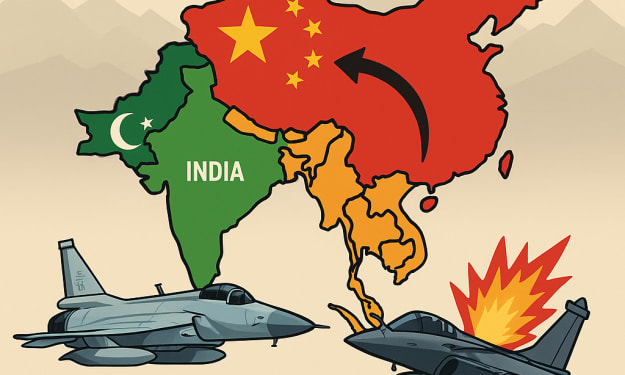
How China Got Benefit from Pakistan and India Conflict
In a dramatic turn of events during a recent India-Pakistan conflict, the Pakistan Air Force (PAF) reportedly downed a French-made Rafale fighter jet using the JF-17 Thunder, a multi-role combat aircraft developed jointly by China and Pakistan. Though official confirmation is still pending, the symbolic value of this event is already resonating across global defense and strategic communities.
By Zakir Ullahabout a year ago in The Swamp